

This article is not for everyone. Do not continue if you have a weak stomach. This is an advanced meditation practice serving specific purposes within Buddhist contemplative training. Death is part of the reality of our lives, and being able to contemplate it and grasp the full scheme of our nature as living beings can serve real purposes in spiritual cultivation. But for people not already established in Buddhism, this practice can be badly jarring and even counterproductive. My advice: unless you are established in Buddhism and in meditation practice, skip this one.
In the previous article in this series we covered the ten kasinas — contemplative devices designed to develop samādhi. This time we take up the ten impurities, the asubha.
These are techniques aimed at monastic practice, and they are the antidote par excellence to the hindrance of attachment to pleasant bodily sensation. They are a deep examination of the perishable nature of the physical body, of its less romantic qualities — a journey into the most hidden corners of our anatomy, and a meeting with reality in its rawest sense.
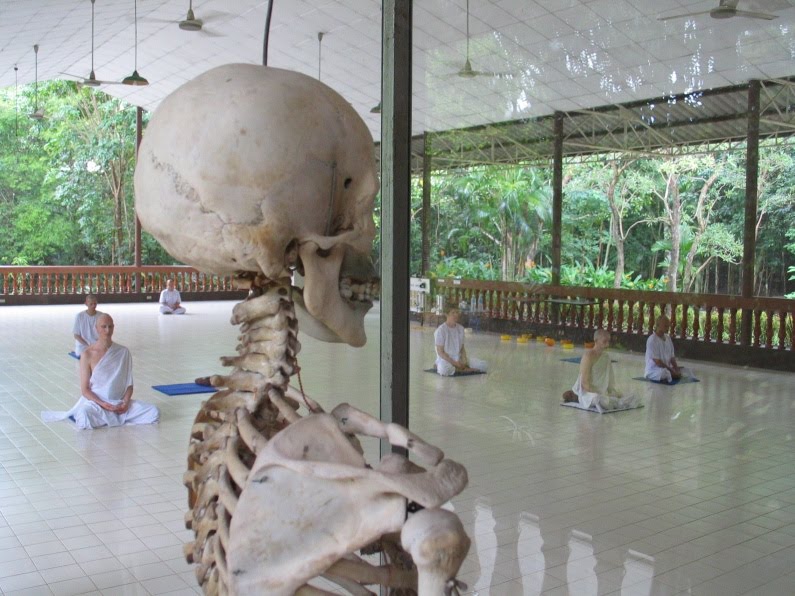
The ten impurities
- A bloated corpse (uddhumātaka)
- A livid corpse, discolored black and blue (vinīlaka)
- A festering corpse (vipubbaka)
- A corpse cut in half (vicchiddaka)
- A corpse half-eaten by wild animals (vikkhāyitaka)
- A scattered corpse (vikkhittaka)
- A corpse hacked apart and scattered (hatavikkhittaka)
- A bleeding corpse (lohitaka)
- A worm-infested corpse (puḷuvaka)
- A skeleton (aṭṭhika)
We are looking at the ten impurities here for entirely didactic purposes. If you are interested in practicing with this object of contemplation, my recommendation is that you find a qualified teacher and do it under their supervision.
How the practice works
If you select one of the ten impurities as your object, you observe a corpse or skeleton in one of the conditions listed above and repeat the corresponding mental note — bloated corpse, bloated corpse, or uddhumātaka, uddhumātaka, according to the case.
After repeating this contemplation for some time, a vivid image of the object appears in the mind, with such clarity that it is as though it had been perceived by the eye. This is the acquired image, the uggaha-nimitta. Once it is fixed and can hold steadily in the mind, you can meditate on it without needing the visual support of the object itself, in any of the meditation postures — sitting, walking, standing or lying down.
Continuing with the acquired image and the corresponding note, the image may take on an extremely bright and crystalline appearance: the counterpart image, the paṭibhāga-nimitta. Here the mind is free of the hindrances and remains on the counterpart image as directed. This state is access concentration, upacāra-samādhi, and through constant fixing it leads to attainment concentration, appanā-samādhi, giving access to the first jhāna.
With the asubhas it is only possible to reach the first jhāna — unlike the kasinas, which give access to all four. Contemplation of the thirty-two parts of the body, kāyagatāsati, reaches the first jhāna in the same way.
The purpose
The essential element of any practice is the purpose behind it. You can know how to drive a car, but without a destination you have no direction to take. So the essential point here is knowing what this is for.
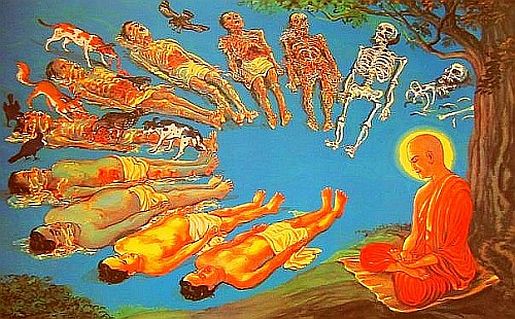
The purpose of these body contemplations is set out clearly in the Satipaṭṭhāna Sutta. It is to understand that the body has nothing to do with the self: it is not me, it is not mine, it is plainly and simply a body. Dismantling that attachment to the self is considered a very high goal.
But the practice also serves as an antidote to one of the strongest hindrances in meditation: kāmacchanda, the hindrance concerning sense objects. Lust, sexual desire, desire for the body, carnal desire — these states paint the body in our minds as attractive, desirable, beautiful. So one of the main aims here is to neutralize the strong desires generated by lust, which interrupt the development of concentration in meditation.
Series: part one covers the ten kasinas.