

A young mother in Sāvatthī, whose only child has died, carries the body on her hip from house to house asking for a medicine that will bring him back, until someone sends her to the Buddha. The Buddha tells her that yes, he knows of such a medicine: a pinch of mustard seed will do, so long as it comes from a house where no one has ever died. It is one of the best-known stories in Buddhism, and it is nearly always told as a lesson in impermanence — everyone dies. That is not a wrong reading. But it skips over the thing that makes the story work, which is that nobody tells her so — not, at least, until she already knows.
Medicine for a dead child
As the commentaries tell it, the story begins earlier. Gotamī was born into a poor family in Sāvatthī and, being thin, was known as Kisā Gotamī — kisā means “lean”, “skinny”. She married into a wealthy household, and her in-laws looked down on her as the daughter of poor people; all of them, one of the texts specifies, except her husband. When she gave birth to a son, they began at last to treat her with respect.
The boy died when he was old enough to run about and play. Kisā Gotamī had never seen death up close, and when they came to take the body away to be burned she would not allow it. She settled him on her hip and went from door to door asking for medicine for her son. People laughed at her — where had anyone ever seen medicine for the dead? — and took her for mad. One of the commentaries adds a detail that is rarely retold and explains a good deal: she was afraid that in this house, where she had been respected only since the child was born, they would now try to get rid of him. Her grief was not only grief. With the son went the only place she had ever had in that family.
A sensible man who saw her thought that sorrow had unsettled her mind, but that there was one person who would know of a medicine, and he told her to go to the Buddha, who was staying at a monastery nearby. She went with the child in her arms, stood at the edge of the crowd that had gathered to hear him, and said: “Blessed One, give me medicine for my son.”
None of this is in the suttas. As with much of the story of Aṅgulimāla, what everyone remembers comes from the commentaries, which took their present form in Sri Lanka many centuries after the Buddha and which tell this story in more than one place: in the commentary on the Dhammapada, where it is attached to verses 114 and 287, and in those on the Aṅguttara Nikāya and on the nuns’ verses. Before the commentaries it appears in the Therī Apadāna, one of the last books to enter the canon, where the nun tells it herself, in the first person. The versions do not agree on everything, and where the difference matters it is noted below. (The sutta and verse quotations here are from Bhikkhu Sujato’s translations on SuttaCentral; the lines from the Apadāna and the commentaries are rendered from the Pali.) The suttas themselves keep Kisā Gotamī, but not the mustard seed, and the last section returns to that.
A house where no one has died
The first thing the Buddha does is say yes. “You did well, Gotamī, to come here for medicine,” he tells her in the Aṅguttara commentary, and then explains what he needs: she is to go into the city and through the whole of it, starting from one end, and bring him white mustard seed from any house in which no one has ever died.
What he asks for is worth a closer look. White mustard, siddhatthaka, is something the story assumes every household will have — at the first door they bring it out without a second thought — and that is the point. A rare medicine would have sent her far away, to a single place, alone with her search. A pinch of mustard anyone could give. So every door opened, and at every door she was offered the seed, and at every door she had to ask the second question.
At the first house they said, “Here, Gotamī,” and brought out the mustard. She did not take it yet. First she asked whether anyone had ever died in that house. “What are you saying, Gotamī? Who could count the dead here?” So she left it there and went on to the next.
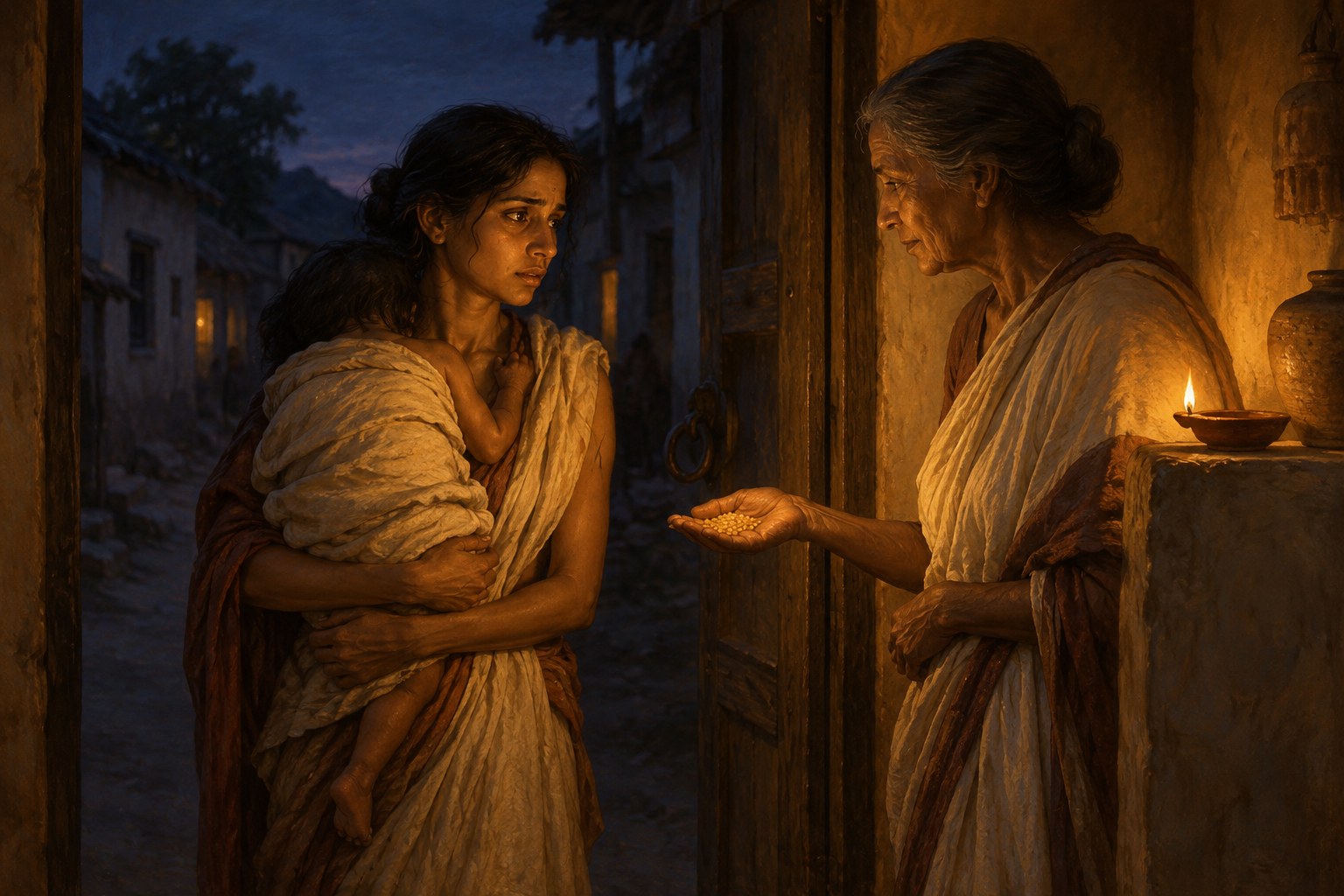
The versions disagree about how long it took her. In the Dhammapada commentary she goes from house to house until evening falls; in the Aṅguttara commentary three houses are enough. It may be the most believable detail in the whole story — that nobody can say how long this takes.
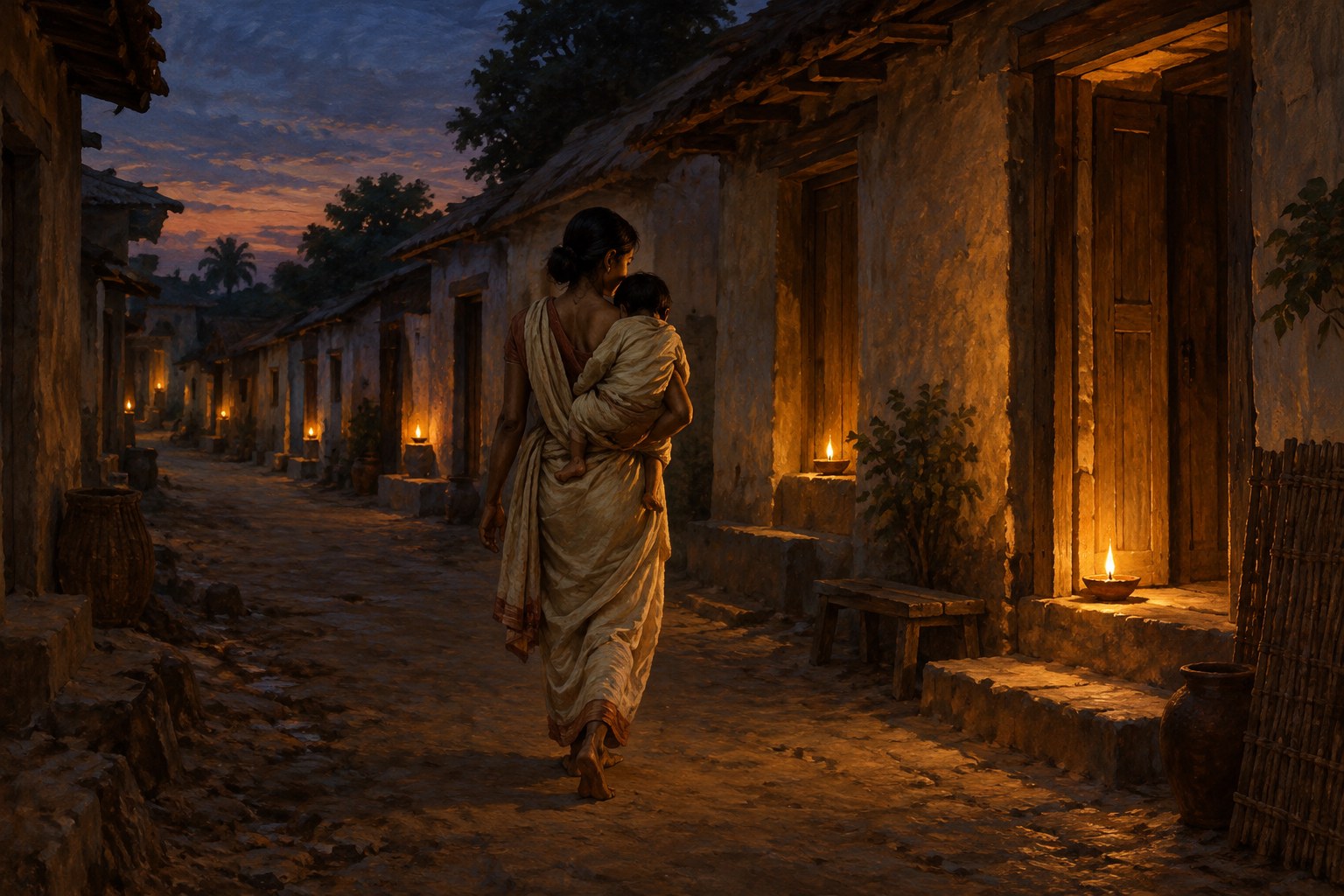
At the third house, or as evening fell, she saw it: the whole city would be like this. And she understood, the text says, that the Buddha had seen it before she did, and had sent her out of compassion. She left the city, carried the child to the charnel ground outside it — the susāna, where bodies were burned or simply left — took him by the hand, and spoke to him:
Little son, I thought this death had come to you alone. But it is not yours alone. It is common to everyone; this is how things are.
She left him there and spoke a verse:
It is not the law of one village, nor the law of one town,
nor is it the law of a single family:
for the whole world with its gods
this is the law — that nothing lasts.
In the Apadāna the same verse is spoken by the Buddha when she comes back to him. In the Aṅguttara commentary she says it herself, beside the child, and this is the version that fits the rest of the story: by then she has found it on her own.
What falls away first is not the pain. It is the belief that this has happened to her alone, and to him alone. “I thought this death had come to you alone.” Anyone who has lost someone knows that kind of solitude — the conviction that this particular grief is shared by no one, and cannot be understood by anyone who has not been through it. The psychologist Kristin Neff, who was the first to define and measure self-compassion for research and who built the idea partly out of Buddhist sources, calls one of its three components “common humanity”, the opposite of isolation: seeing one’s own suffering as part of what happens to people rather than as something that sets one apart from them. The story of Kisā Gotamī does not explain this to her. It has her find it, door by door. Every house that offers her the mustard and tells her it cannot count its dead is one more house that is no longer on the other side.
An errand instead of an argument
The Buddha had an explanation ready, and did not use it. He could have told her at the start what the usual readings say — that whatever is born must die, that attachment is the root of suffering — and all of it would have been true, and she would very likely have heard none of it. Nobody wins an argument with a woman carrying her dead son on her hip and asking for medicine. So instead of an argument he gave her an errand. The Apadāna has a precise word for it: the Buddha was vinayopāyakovida, “skilled in the means of guiding”. Vinaya, which elsewhere names the monastic code, keeps here something of the sense of its root, to lead a person away from something; upāya is the means, the device. What the story admires is not what the Buddha knew, but how he arranged for her to know it.
That should not be overstated. The Buddha does teach her, and what he teaches is not soft. When she comes back empty-handed he asks, “Did you get the mustard seed, Gotamī?” and she answers, “I am done with the mustard seed, venerable sir. Give me, instead, somewhere to stand.” Only then does he speak the verse the Dhammapada keeps as its 287th:
As a mighty flood sweeps away a sleeping village,
death steals away a man
who dotes on children and cattle,
his mind caught up in them.
Out of context it is almost cruel, said to a mother who has just left her son in a charnel ground. But the order is everything. The verse does not come to correct her while she is searching for the medicine; it comes afterward, when the search is over and she is the one asking for something firmer. The word she uses is patiṭṭhā — a support, a footing, ground to put one’s feet on. And the verse tells her nothing she has not already seen at the doors; it only gives it a name. The Apadāna, in its own version, sums up the moment with another exact phrase: tato laddhā satiṃ ahaṃ, “then I regained sati“. The word usually translated as mindfulness means here, quite simply, coming to one’s senses.
This is why the story reads so badly when it is boiled down to “everyone dies, get over it”. Nobody in it tells Kisā Gotamī to stop weeping, or that her son was only an attachment, or how long her grief is allowed to last. The Buddha takes her request seriously — “you did well to come” — sends her to do something with the pain instead of debating it, and lets her go at her own pace. Nobody corrects her grief. What the whole city does, without knowing it, is keep it company, door by door, until it finds its own scale: not that of one house, but that of all of them.
It is tempting to set the story beside the five stages of grief — denial, anger, bargaining, depression, acceptance — and read the search for medicine as the bargaining stage. The comparison does justice to neither. Elisabeth Kübler-Ross described the stages in 1969 from conversations with dying patients, not with the bereaved; they were carried over to grief afterward, and she herself, in a book written with David Kessler in 2005, made clear that they were never meant as a fixed sequence. Research has not found one either: a 2017 review by Margaret Stroebe and colleagues concluded that the stage model has no sound empirical basis, and that expecting the bereaved to pass through it can harm those who do not. What has made the stages so durable is exactly what the story lacks, which is a timetable. The story has one woman, one city and one day — or three houses — and nowhere suggests that anyone else’s grief should take the same shape or the same time.
The lamps in the hall
At that moment, the texts say, Kisā Gotamī became a sotāpanna, a “stream-enterer”, having reached the first of the four stages of awakening, and asked to be admitted to the order. The Buddha sent her to the nuns, and she was ordained.
Some time later, according to the Dhammapada commentary, it was her turn to light the lamps in the hall where the community gathered. She lit them, sat down, and watched the flames: some flared up, others went out. She took it as her object of meditation — so it is with beings, some flaring up and others going out — and the Buddha, the text says, sent an image of himself to appear before her and spoke what is now the Dhammapada‘s 114th verse:
Better to live a single day
seeing the state free of death
than to live a hundred years
blind to the state free of death.
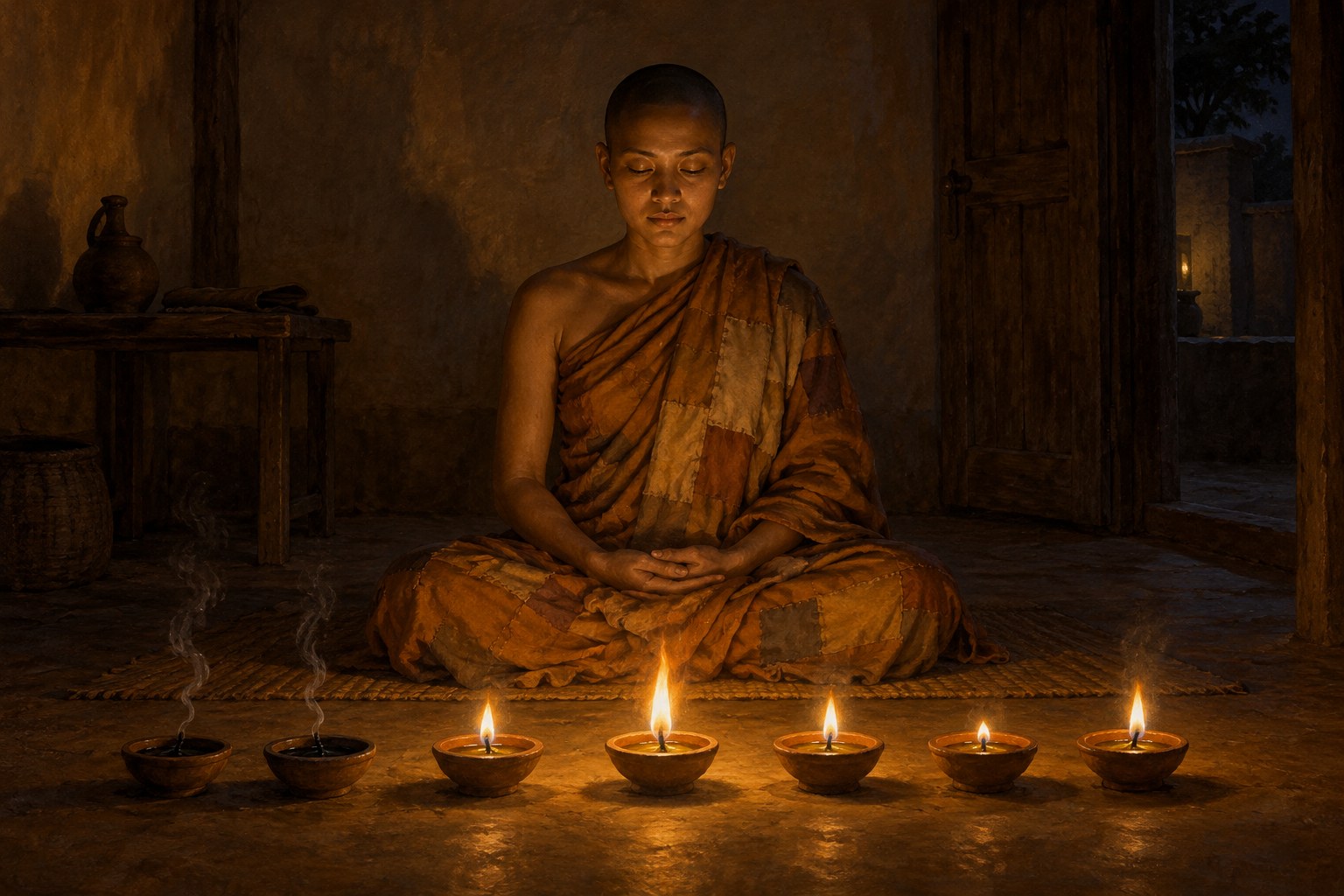
With that verse she reached the end of the path and became an arahant.
Sujato’s “the state free of death” renders amataṃ padaṃ, and amata is literally “not dead” — one of the names of nibbāna, the goal of the path itself. But in ancient India amata, amṛta in Sanskrit, was also the name of the drink of the gods, the nectar that overcomes death. Kisā Gotamī had gone out looking for a medicine against death. The story ends with her seeing what the canon calls by that medicine’s name.
The list in the Aṅguttara Nikāya in which the Buddha names his foremost disciples puts her first among the nuns who wore rough robes, and the Apadāna says what her robes were made of: rags gathered from rubbish heaps, from the streets and from charnel grounds. The woman who had left her son in a charnel ground went on, as a nun, to dress in what was gathered there.
What the oldest texts keep
The oldest texts tell none of this. There is no child in them, no houses, no mustard. What they keep is the nun who came afterward: besides her line in the Aṅguttara‘s list, she appears in two places.
The first is a short sutta in the Saṃyutta Nikāya (SN 5.3). Kisā Gotamī has come back from almsround, gone deep into the Dark Forest outside Sāvatthī, and sat down at the root of a tree to meditate. Māra — the figure who in the canon embodies everything that pulls a person off the path — comes up to her, meaning to frighten her, and addresses her in verse:
Why do you sit alone and cry
as if your children have died?
You’ve come to the woods all alone—
are you looking for a man?
She recognizes him and replies:
I’ve got over the death of children,
and I’m finished with men.
I don’t grieve or lament,
and I’m not afraid of you, sir!Relishing is banished in every respect,
and the mass of darkness is shattered.
I’ve defeated the army of death,
and live without defilements.
The word Māra uses is mataputtā, “a woman whose children have died”, and she hands it back to him exactly as he gave it, with a single word added: accantaṃ, “utterly”, “for good” — Sujato’s “got over”. She does not deny what happened to her; she declares it finished. The taunt may be a stock phrase — it was how one described a weeping woman — but aimed at her it has an edge the text does not need to explain. And the woman who could not accept the death of one child now says she has defeated the army of death.
The second place is her own verses, in the Therīgāthā, the collection of verses of the early nuns (Thig 10.1). They do not mention the mustard seed either. In the middle of them, in fact, is a scene — a woman giving birth by the road beside her dead husband, two children lost, her mother, father and brother burning on a single pyre — that the tradition tells elsewhere as the story of another nun, Paṭācārā, and it is not clear who is speaking it. What is clear is how the verses begin and how they end. They begin not with death but with friendship: good friendship, kalyāṇamittatā, which the Sage praised, and the plain claim that in the company of good friends even a fool becomes wise. And they end:
I’ve plucked out the dart,
laid down the burden, and done what needed to be done.
It is the same friendship as in the story, though the verses do not tell it: a sensible man who saw her in the street and sent her where she could be helped, a teacher who did not argue with her at all but gave her something to do, and a whole city that, without knowing it, kept opening the door. The medicine she asked for did not exist. What she was given was an errand, and someone who knew how to give it.