

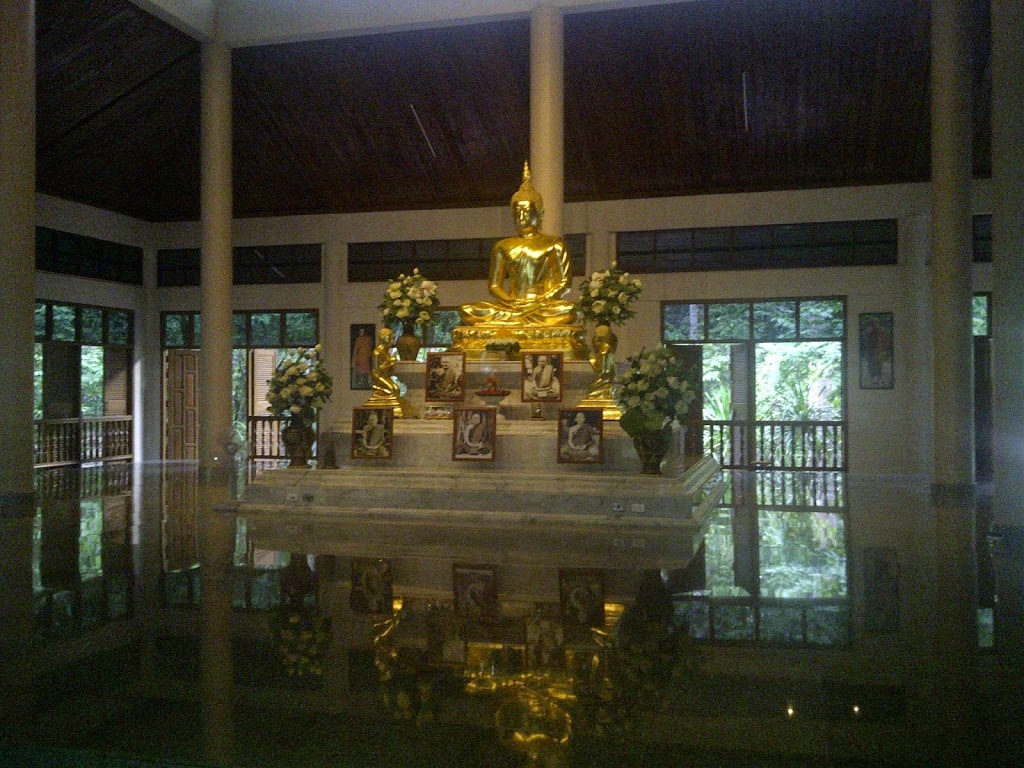
I spent a month living the monastic life in Thailand, as a lay guest at Wat Pah Nanachat — the international forest monastery founded by Ajahn Chah. Afterward I stayed at other monasteries and sat other retreats, but there was one subject I had to face at Wat Pah Nanachat in particular: pain.
Pain in meditation is unavoidable, and it arrives fastest when you have increased the intensity of your practice too quickly — which is exactly what I had done.
First, check the posture
Before treating pain as an object of meditation, rule out the boring explanation: you are sitting badly.
If your back hurts, look at how much effort you are putting into it. A very common mistake is straining to hold the spine perfectly straight in imitation of some photograph, which is exhausting and produces pain quickly. The opposite failure is just as common — letting the back collapse without noticing. Either one will hurt within a short time.
Then look at your knees. Never force the lotus. It will damage them, and the damage can be permanent. If you want the posture, get there through a gradual flexibility program aimed at the joints that actually govern a good seat — the hips, not the knees.
Then ask whether it is dangerous
Once you have reviewed the posture and satisfied yourself that it is sound, and it still hurts, the next question is simple: does this sensation represent an actual threat to your health?
Often it does not. It is entirely normal to feel pain in a long sitting even with good posture, especially one longer than you are used to. Once you have looked at the sensation and concluded that it is not doing you harm, the next step is to look at the nature of the thing itself.
Where pain actually happens
Every experience you have occurs in the mind — it is the operations room, and even the events we file as external actually take place inside us. What you see is not the object; it is the reflection of the object assembled in your consciousness. Light bounces off the thing, passes through the cornea, and is broken down and reinterpreted until it registers as an image, as a concept. What you take for the world outside is happening at your own center. The same is true of every sense: touch, smell, sight, taste, hearing. Buddhism adds a sixth — the mind itself, the sense through which we relate to imagination, ideas and concepts.
Pain is no different. It is one more element arising at that same center. So when it comes, observe it the way you would observe anything else: identify its nature, and identify how you are reacting to it. Watch what it produces in you — aversion, fear, the wish for it to stop. Then return to your original object of meditation.
If the pain is intense, keep observing it until you genuinely cannot bear it any longer. Where that point sits varies enormously between people, and depends on determination, on your pain threshold, on how psychologically affected you are by it, and on your level of concentration and experience.
Watching pain, you will find it sometimes fades and disappears. Sometimes it holds steady. Sometimes it gets worse. There is unmistakably a component of mental predisposition in it — and meditation raises the pain threshold precisely by changing that predisposition, deliberately.
What changed
My sittings at Wat Pah Nanachat were dominated by pain for the first two weeks.
One afternoon we had an extra group sitting on top of the usual schedule. I was completely spent — everything hurt, and I simply did not believe I could carry that much mental and physical exhaustion any further. When the session ended I could not imagine how I would manage the next one, a couple of hours later, the hour we sat together before bed.
Sure enough, when the time came I felt destroyed, so I decided to do walking meditation for a while instead. For some reason I reached a high level of concentration almost immediately, and decided to try sitting again. When I sat down, all the exhaustion and pain of a few minutes earlier — physical and mental — had vanished.
That session was perfect, against every expectation, and it let me see and internalize the mental component of pain: our state of mind and concentration completely alters how we perceive things, to the point of dissolving an exhaustion and a pain we had been certain were real. Curiously, from that point on pain stopped being a subject for me. It did not trouble me. It did not bother me. Which left me with the question: what had changed?
Two arrows
Do not be afraid to face pain in your sittings. Just stay alert to anything with real consequences for your health and correct it as needed — obviously, if you have a knife in your leg you do not sit and observe it, you treat the wound, though there is nothing to stop you observing the experience consciously while you do.
Another point worth having. The Buddha distinguished physical pain from mental pain. If, on feeling the physical sensation, you also feel aversion toward it, then you are suffering twice: the physical sensation, which is unavoidable, and the aversion it generates, which is mental pain. A conscious mind still registers the physical sensation, but does not connect it to any mental counterpart. The load of suffering conditioned onto the pain simply drops away.
Practical measures
A good way to avoid overloading yourself with seated meditation is to alternate it with walking meditation in set periods. Use a timer for each: it lets you be more objective about when a session has finished, and it lets you manage your progress gradually rather than by mood.
And finally — there is no such thing as a bad meditation. Even if the mind spent eighty percent of the session chattering, if you applied right effort in generating attention and concentration, you have moved a little closer to awakening.