

The Buddha was not the only wandering teacher on the Ganges plain. In his time the roads of Magadha and Kosala were full of ascetics who had left home in search of a way out, and several of them had followers, communities and reputations of their own. One of the long discourses of the Pali canon, the Sāmaññaphala Sutta — “the discourse on the fruits of the ascetic life”, the second in the Long collection (DN 2) — tells how a king put the same question to six of the most famous of them, and it keeps what each one said. It is the nearest thing we have to a map of the ideas the Buddha was teaching among, and the best way to see what was new in what he said. One of the six led a tradition that is still alive, Jainism; what it shares with Buddhism, and where the two part, is the subject of a second post.
Ascetics and brahmins
The setting is the Ganges plain in a period that tradition places in the sixth century BCE and most historians now put about a century later. Scholars call it India’s second urbanization — the first was the Indus valley’s, more than a thousand years earlier — and it brought new cities such as Rājagaha, Sāvatthī and Vesālī; coinage and long-distance trade; and two kingdoms, Magadha and Kosala, swallowing the old clan republics that governed themselves by assembly. The Buddha came from one of those republics, the Sakyans. The king in this story, Ajātasattu of Magadha, appears at the start of another discourse (DN 16) set on destroying a second one, the Vajjis: “I shall wipe out these Vajjis, so mighty and powerful! I shall destroy them, and lay ruin and devastation upon them!” (The sutta quotations here are from Bhikkhu Sujato’s translations, on SuttaCentral; the two verses from the Vinaya are rendered from the Pali.)
There were two ways of being religious in that world. One belonged to the brahmins, keepers of the Vedas and the sacrifice, whose place was given to them by birth. The other belonged to those who stepped outside all of that: who left house, family and trade, and moved from place to place living on alms, looking for an answer on their own. They were called samaṇa — śramaṇa in Sanskrit — from a root that means to exert oneself, to toil; a samaṇa is, quite literally, one who strives. The canon names the two together so often, “ascetics and brahmins”, that the phrase hardens into a formula, and both camps are in it. The Buddha was a samaṇa, and before his awakening he had spent six years among the teachers of that world, learning what they taught and leaving it behind.
He was neither the only famous samaṇa nor the senior one. When the king’s ministers in DN 2 suggest whom he might visit, they describe each of the six teachers in exactly the same words: he leads an order and a community, he is well known and famous, many people think him holy, he has been long gone forth, he is advanced in years. And each is called a titthakara, a “ford-maker” — the founder of a crossing, a way over the river. It is the same word the Jains still use, in its Sanskrit form, for Mahāvīra and those before him: tīrthaṅkara. None of the six was a newcomer. The newcomer was the Buddha. In another discourse (SN 3.1), King Pasenadi of Kosala tells him that he had asked these same six whether they claimed to have reached perfect awakening, and none of them did. “So why do you,” the king asks, “given that you’re so young in age and newly gone forth?”
A full-moon night in Rājagaha
The Sāmaññaphala Sutta opens on a king who cannot settle. It is the night of the Komudī full moon, at the end of the rainy season and one of the most celebrated nights of the year, and Ajātasattu is sitting upstairs in his palace in Rājagaha among his ministers. He says aloud: “Oh, sirs, this moonlit night is so very delightful, so beautiful, so glorious, so lovely, so striking. Now, what ascetic or brahmin might I pay homage to today, paying homage to whom my mind might find peace?” Why a king should need someone to bring his mind to peace in the middle of the night is something the sutta does not explain until its last page.
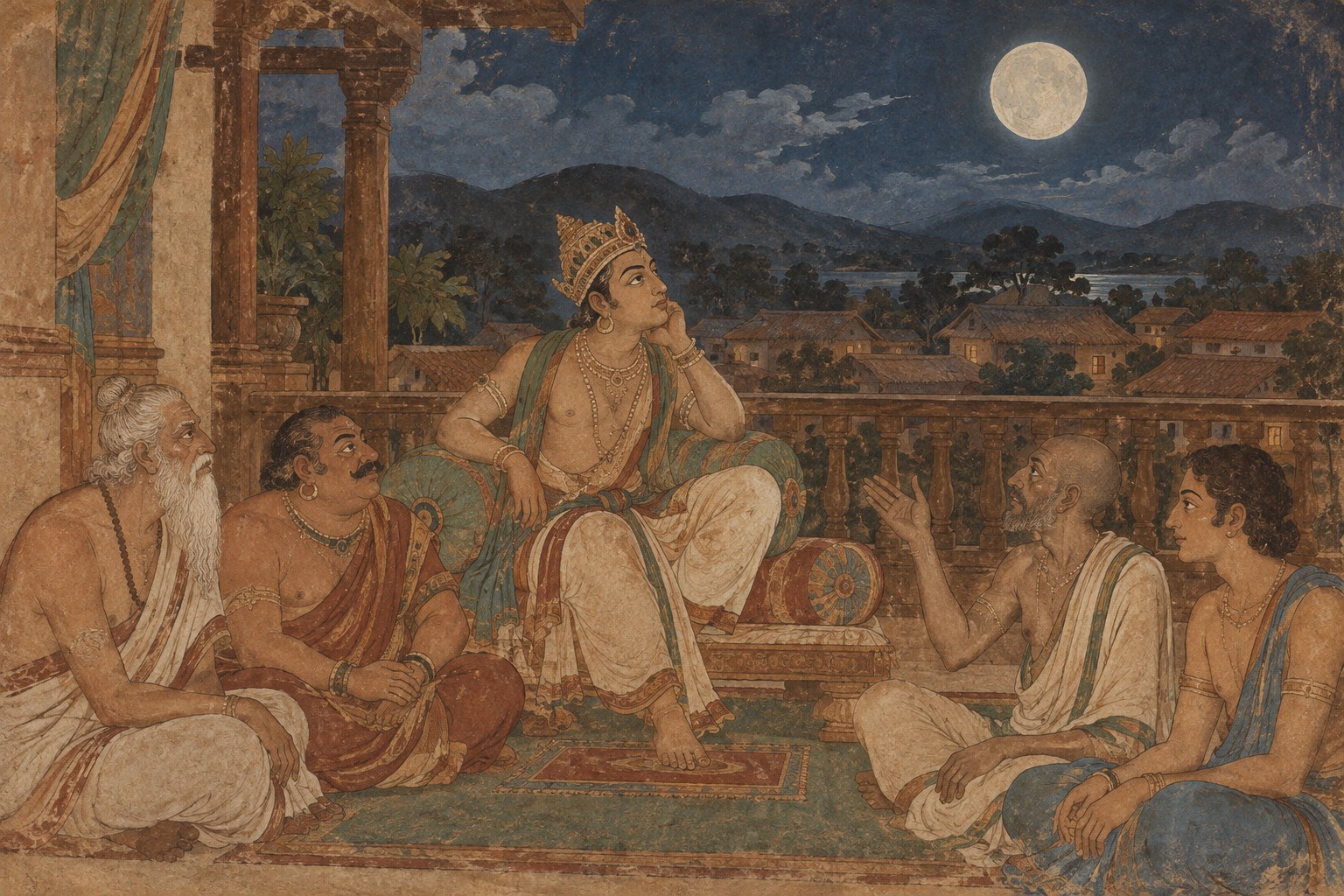
One minister suggests Pūraṇa Kassapa, and the king says nothing. Another suggests Makkhali Gosāla, and the king says nothing. Six names in turn, and six silences. Sitting nearby, silent too, is Jīvaka Komārabhacca, the court physician — the same Jīvaka who, the Vinaya says, was too busy with the king and the monks to treat anyone else — and the king asks him why he has not spoken. Jīvaka tells him that the Buddha is staying in his mango grove with twelve hundred and fifty monks. The king has the elephants made ready: five hundred cow elephants with a woman mounted on each, and his own bull elephant for himself, and he sets out from Rājagaha by torchlight in full royal state.
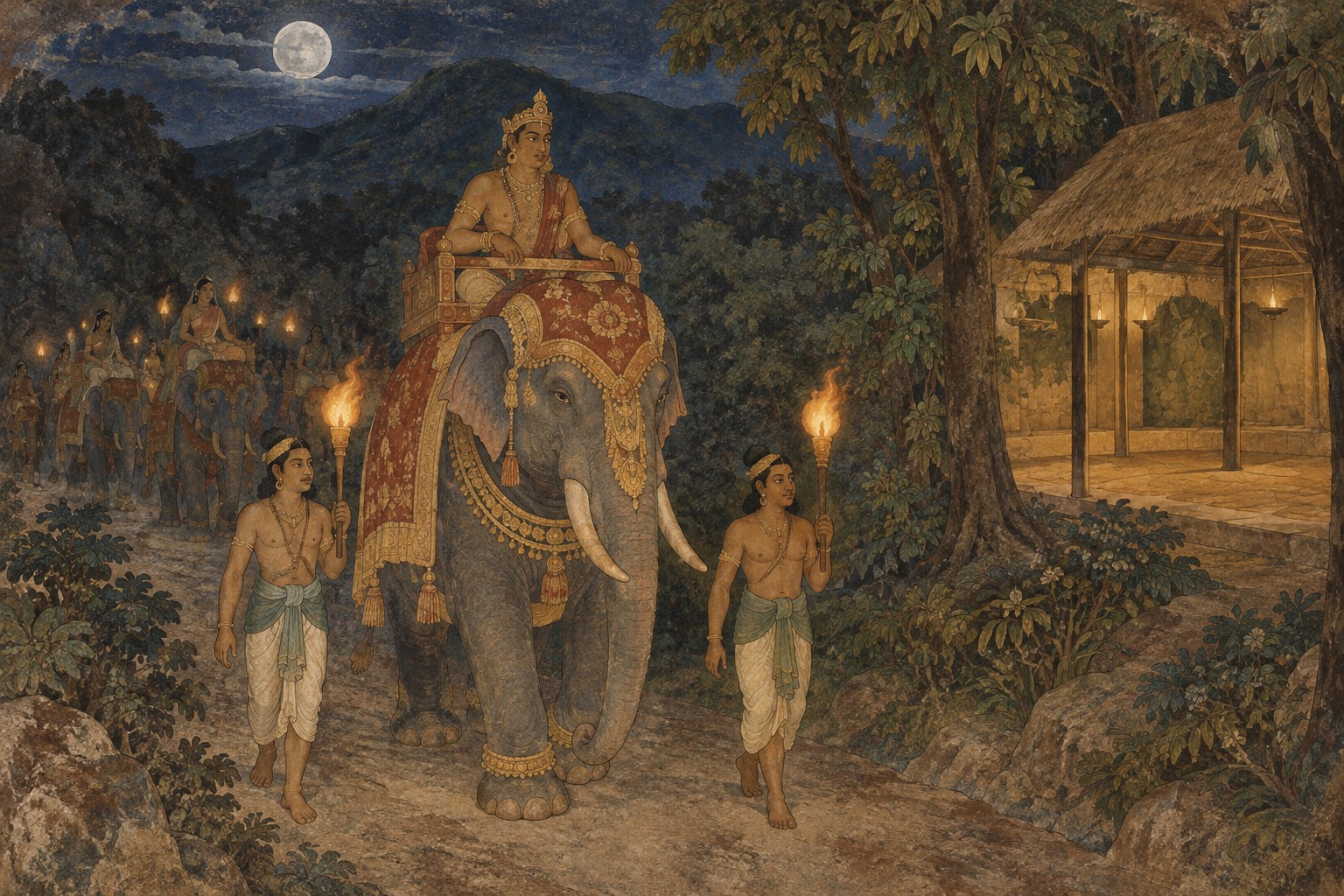
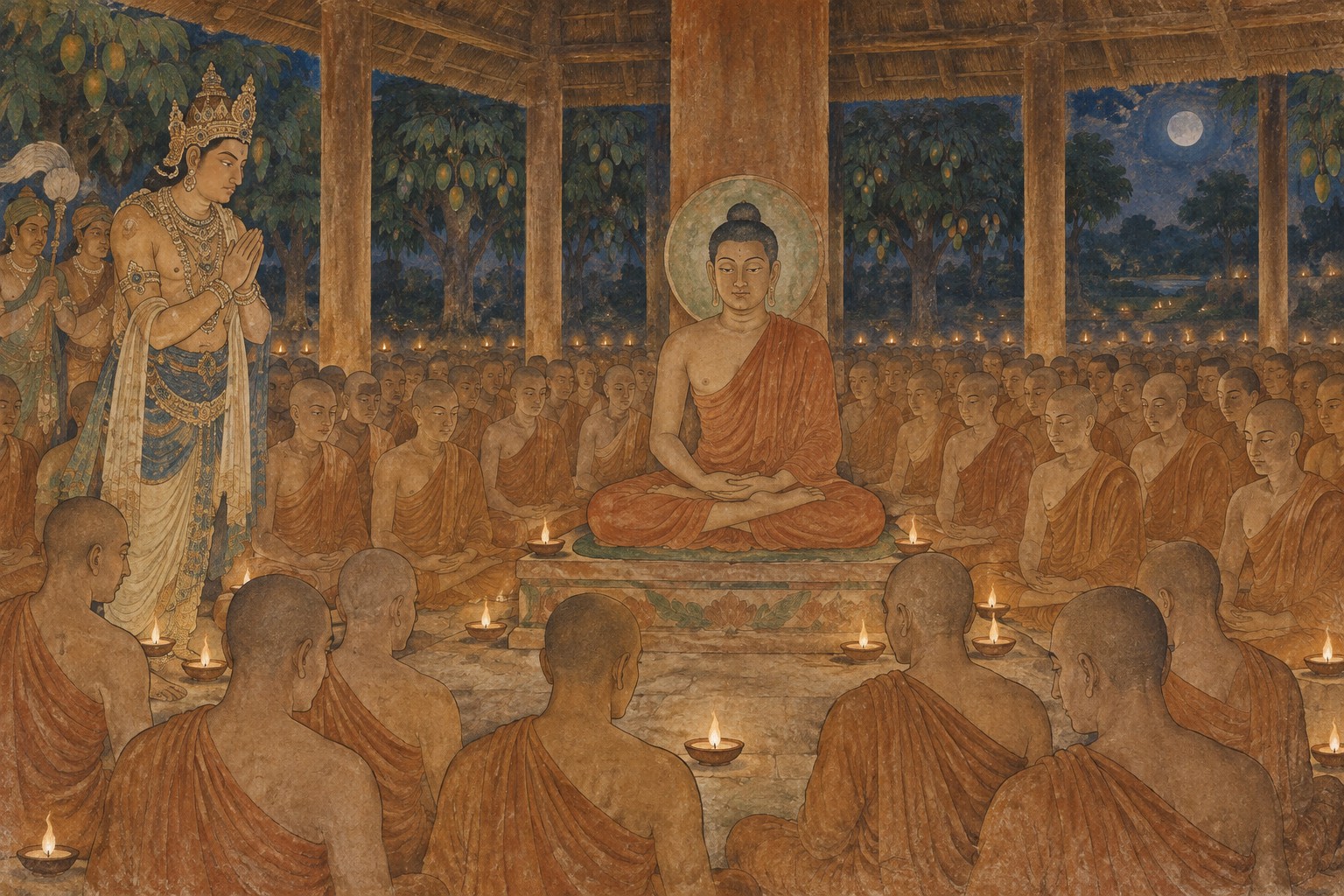
As he nears the grove, he is suddenly afraid; his hair stands on end. How can twelve hundred and fifty monks make no sound at all — no sneeze, no cough, no murmur? Is Jīvaka leading him into a trap, handing him over to his enemies? It is no trap: the lights among the trees are lamps in the pavilion. The king goes on foot, finds the whole community sitting in silence, “so very silent, like a still, clear lake”, and the first thing he says is a wish for his son: “May my son, Prince Udāyibhadda, be blessed with such peace as the Saṅgha of mendicants now enjoys!”
The Jain scriptures know this same king under another name, Kūṇika, and tell of his visit to Mahāvīra much as the Pali canon tells of this one: each tradition remembered the king of Magadha bowing before its own teacher.
Once seated, the king asks his question. He begins with a list of trades — elephant riders, charioteers, archers, bakers, barbers, cooks, potters, accountants — and observes that all of them live off the fruits of their work, and that those fruits can be seen in this life: they keep themselves and their parents, children and friends happy with them. “Sir, can you point out a fruit of the ascetic life that’s likewise apparent in this very life?” The question is sharper than it looks. The king saw ascetics every day living in poverty and mortifying themselves with their eyes on another life, and that is not what he is asking about. He wants to know what is gained here, where it can be seen.
Before answering, the Buddha asks whether he has put the question to anyone else. He has, to six. Then let him say what they told him.
Six answers to a different question
What follows is the part of the sutta historians care about most: the king summarizes, one by one, what six of the most famous teachers of his day said to him. It is worth keeping in mind from the start that these are summaries made by a rival tradition, not the teachers’ own words, and that they should be read accordingly. After each one the king makes the same complaint with the same image: “It was like someone who, when asked about a mango, answered with a breadfruit, or when asked about a breadfruit, answered with a mango.” Breadfruit is the dictionaries’ word for the Pali labuja; the tree is more likely its Indian cousin, the lakoocha, which bears a round yellow fruit. What matters is that it is nothing like a mango.
Pūraṇa Kassapa: nothing is wrong, nothing is good
For Pūraṇa, actions carry no moral weight. One who kills, steals, lies or commits adultery does nothing wrong; one who gives, restrains himself and tells the truth does nothing good. His image is the Ganges: “If you were to go along the south bank of the Ganges killing, mutilating, and torturing, and encouraging others to do the same, no evil comes of that, and no outcome of evil. If you were to go along the north bank of the Ganges giving and sacrificing and encouraging others to do the same, no merit comes of that, and no outcome of merit.” The king sums it up as the doctrine of inaction, akiriya — not that one cannot act, but that acting does not count.
Makkhali Gosāla: it is all decided
Gosāla taught a fate with no gaps in it. There is no cause or condition for beings to become corrupt or to be purified; no one acts of his own will; there is no power, energy or human effort that makes any difference, because all beings are “molded by destiny, circumstance, and nature”. Fool and sage alike must transmigrate for a span fixed in advance — eight million four hundred thousand great eons — and no discipline or austerity will shorten it. At the end, all of them will make an end of suffering: “It’s like how, when you toss a ball of string, it rolls away unraveling.” The king calls this purification through transmigration, saṃsārasuddhi.
Gosāla is the best-known teacher of the Ājīvikas, who for centuries were India’s third great ascetic movement, after the Buddhists and the Jains. The emperor Aśoka had caves cut for them in the granite of the Barabar hills, and inscriptions in the south still mention them in the fourteenth century. According to Jain sources, Gosāla spent six years with Mahāvīra before the two fell out.
Ajita Kesakambalī: nothing survives death
Ajita — “of the hair blanket”, after the blanket woven of hair that he wore as an ascetic practice — denied what everyone else took for granted: there is no point in giving or sacrifice, good and bad deeds bear no fruit, there is no other world, no one is reborn. A person is made of the four elements, and at death earth returns to earth, water to water, fire to fire and air to air, and the faculties pass into space. He puts it with the dryness of a funeral: “Four men with a bier carry away the corpse. Their footprints show the way to the cremation ground. The bones become bleached. Offerings dedicated to the gods end in ashes. Giving is a doctrine of morons.” Fools and sages alike are annihilated when the body breaks up. The king calls this annihilationism, uccheda, and Ajita is one of the earliest known proponents of the materialism India would later call Cārvāka or Lokāyata.
Pakudha Kaccāyana: the sword passes between
Pakudha taught that reality is made of seven bodies or substances — earth, water, fire, air, pleasure, pain, and the soul as the seventh — uncreated, eternal, standing firm like a pillar, neither changing nor affecting one another. From that he drew the most unsettling conclusion of the six: there is no one who kills and no one who has others killed. “If you chop off someone’s head with a sharp sword, you don’t take anyone’s life. The sword simply passes through the gap between the seven substances.” The king does not even give this one a name. He says Pakudha answered one thing with another.
Nigaṇṭha Nātaputta: the fourfold restraint
Fifth in the king’s account is the leader of the nigaṇṭha, the “knotless ones”, of the Ñātika clan — the teacher the Jains revere as Mahāvīra, “the great hero”, the twenty-fourth and last of their tīrthaṅkaras. According to the king, he answered with the fourfold restraint: a Jain ascetic “is restrained in all that is to be restrained, is bridled in all that is to be restrained, has shaken off evil in all that is to be restrained, and is curbed in all that is to be restrained”, and is therefore called “a knotless one who is self-realized, self-controlled, and steadfast.” It is the most obscure of the six answers, and the only one from a teacher whose tradition is still alive. What Jains understand by it, and what Buddhism and Jainism share and dispute, needs a post of its own.
Sañjaya Belaṭṭhiputta: neither yes nor no
The last would commit to nothing. “Suppose you were to ask me whether there is another world. If I believed that to be the case, I would say so. But I don’t say it’s like this. I don’t say it’s like that. I don’t say it’s otherwise. I don’t say it’s not so. And I don’t deny it’s not so.” The same for every question of the day: whether there is no other world, whether there both is and is not, whether there are beings reborn spontaneously, whether good and bad deeds bear fruit, whether a realized one exists after death. The king calls it evasion, vikkhepa, and Sañjaya is the only one of the six he passes judgment on, if only privately: “This is the most foolish and stupid of all these ascetics and brahmins!”
At a glance
| Teacher | What he taught, according to the sutta | What the king calls it |
|---|---|---|
| Pūraṇa Kassapa | Actions bear no fruit: no evil, no merit | Inaction (akiriya) |
| Makkhali Gosāla | Fate decides everything; effort is useless | Purification through transmigration (saṃsārasuddhi) |
| Ajita Kesakambalī | Nothing survives death; there are only elements | Annihilationism (uccheda) |
| Pakudha Kaccāyana | Seven eternal substances; no one kills anyone | One thing for another |
| Nigaṇṭha Nātaputta | The ascetic’s total restraint | The fourfold restraint |
| Sañjaya Belaṭṭhiputta | Affirms nothing, denies nothing | Evasion (vikkhepa) |
The questions underneath
Read together, the six answers show what was actually being argued on those roads. Do actions bear fruit? Pūraṇa said no, and Pakudha that there is no one acting at all. Is everything fixed, or does effort count for something? Gosāla gave it all to fate. Does anything survive death? Ajita said nothing does. Can any of this be known? Sañjaya would neither affirm nor deny. They are, almost one for one, the questions the Buddha’s teaching answers: that action bears fruit — intention, he would specify — that effort counts, that death is not the end, and that the whole round of coming and going can be brought to an end. On that, the Buddha and Mahāvīra stood on the same side, against the other four. Where they parted is another story.
That karma and rebirth were being argued over at all says something about how new those ideas were. The oldest Vedic hymns barely know them; they appear, suddenly and fully formed, in the early Upaniṣads. The Indologist Johannes Bronkhorst has argued that they did not arise among the brahmins at all, but in the culture of this eastern plain, which he calls Greater Magadha, and that the Vedic world took them up afterward (Greater Magadha, 2007). It is a thesis, not a fact, and it is contested: other scholars, among them Richard Gombrich and Alexander Wynne, read the suttas as showing a Buddha in conversation with the Upaniṣads. But the debate is telling in itself. Rebirth, which now looks like the fixed backdrop of every Indian religion, was in the Buddha’s day one of the things people argued about.
A rival’s portrait
All of this has to be read with one caution. Of five of these six teachers, almost everything we know comes from their rivals, Buddhist and Jain. None of the five left a work that has reached us, and of the Ājīvikas, who lasted more than fifteen hundred years, not a single book survives. The Sāmaññaphala Sutta does not quote them; it summarizes their doctrines in the mouth of a king who disagreed with them, in a text preserved by the disciples of another teacher. That is what any tradition does with its competitors, and it is how this should be read — as a map drawn from one bank of the river.
That said, the sutta is not simply inventing. The formula of the fourfold restraint, the most obscure of the six, has a close parallel in an early Jain text, the Isibhāsiyāiṃ, where Vardhamāna — Mahāvīra’s personal name — describes the sage as “restrained in all restraints”, as Bhikkhu Sujato points out in the notes to his translation. Whoever composed the sutta knew their rivals well enough to repeat their vocabulary, if not always to explain it.
And the king himself supplies one more piece of evidence, almost in passing. He argued with none of them. After each answer, he says, he thought: “How on earth could one such as I presume to rebuke an ascetic or brahmin living in my realm?” He neither approved nor rejected what he heard, kept his displeasure to himself, got up and left. A kingdom that kept every kind of ascetic at once, and a king who listened to all of them without committing to any: that was the world in which the Buddha had to make himself heard.
Sañjaya’s students
The teacher who would commit to nothing had, for a while at least, the two most famous disciples in the history of Buddhism. According to the Vinaya, Sāriputta and Moggallāna were living in Rājagaha with the wanderer Sañjaya, among his two hundred and fifty followers, and had agreed that whichever of them found what they were looking for first would tell the other. Sāriputta noticed one of the Buddha’s monks, Assaji, on his almsround through the city, eyes lowered, with a bearing that caught his attention; he followed him until he had finished and asked him who his teacher was and what he taught. Assaji, only recently ordained, said he could give him no more than the gist, and gave it in one verse:
Of things that arise from a cause,
the Tathāgata has told the cause,
and also how they cease:
this is the great ascetic’s teaching.
It was enough for Sāriputta, and when he repeated it to Moggallāna, it was enough for him too.
The two went to take their leave of Sañjaya, who asked them three times not to go, and offered to lead the group together with them. Three times they refused, and they left for the Buddha, and the two hundred and fifty went with them. The people of Rājagaha, the same text says, threw a verse at the monks they met in the street: “The great ascetic has come to Giribbaja of the Magadhans; he has led away all of Sañjaya’s people — whom will he lead away now?” Giribbaja was the old name of Rājagaha. The teacher of the five refusals lost his two best students to one who would give an answer.
A mango for a mango
The Buddha, for his part, answers the question he was asked. He does not begin with nibbāna but with the humblest and most visible fruit he can think of, and he has the king say it himself. Suppose, he says, you had a slave who got up before you and went to bed after you, watching your face to guess what you wanted, and who one day thought that you were a human being too and yet lived like a god, and decided to make merit: shaved off their hair and beard, put on the ocher robe and left home. If your men told you where they were, would you have them brought back to serve you again? No, says the king: “Rather, I would bow to them, rise in their presence, and offer them a seat. I’d invite them to accept robes, almsfood, lodgings, and medicines and supplies for the sick. And I’d organize their lawful guarding and protection.”
That is the first fruit: the slave who becomes an ascetic is saluted by the king. The second is the same, with a farmer in place of the slave. From there the Buddha climbs — conduct, guarding the senses, contentment with little, meditation, knowledge, and finally liberation — and each step is again a fruit that can be seen in this life. The answer takes up most of the sutta and is one of the fullest accounts of the path anywhere in the canon. Asked about mangoes, the Buddha answered with mangoes.
When he has finished, Ajātasattu declares himself a lay follower and then, without anyone asking, confesses: “I made a mistake, sir. It was foolish, stupid, and unskillful of me to take the life of my father, a just and principled king, for the sake of authority.” The Buddha accepts it — “For it is growth in the training of the Noble One to recognize a mistake for what it is, deal with it properly, and commit to restraint in the future” — and once the king has gone he tells the monks: “The king is broken, mendicants, he is ruined. If he had not taken the life of his father, a just and principled king, the stainless, immaculate vision of the Dhamma would have arisen in him in that very seat.” That may also be the reason for a night on which a king needed someone to bring his mind to peace. The fruit was in plain view, and he could not take it.
What is left of the six
That night left in the canon six answers that did not answer what was asked, and one that did. Of five of those teachers, little more than that remains: a few lines in their rivals’ books, a doctrine reduced to a sentence, and a name. Of the sixth, something else remains. His nuns and monks still walk the roads of India on foot, gently clearing the ground of anything living before they sit down, and they would hardly recognize their teacher in the four restraints the king remembered him by.