

The Aṅgulimāla Sutta, the eighty-sixth discourse of the Middle Length collection of the Pali canon, tells of a bandit who murdered travelers and wore their fingers around his neck, and of the afternoon he went after the Buddha with a sword and could not catch him. It is usually told as a story of redemption — even a man like that could change — and it is one. But the sutta does not end where the retellings usually do. It goes on a little further, and that last stretch is what turns a good story into a precise teaching about karma.
The bandit on the road
The sutta introduces him without ceremony. In the realm of King Pasenadi of Kosala there was a bandit, “violent, bloody-handed, a hardened killer, merciless to living beings,” who had laid waste to villages, towns and whole countries, “and he wore their fingers as a necklace.” (The quotations here are from Bhikkhu Sujato’s translation, on SuttaCentral.) Hence the name: aṅguli is “finger” and mālā is “garland”. Aṅgulimāla is less a name than a description that took the place of one, and nobody in the region needed it explained.
One day, after his almsround and his meal, the Buddha set his lodging in order, took his bowl and robe, and set off down the road where the bandit was. The cowherds, farmers and travelers who saw him pass told him to turn back: people used that road only in bands of ten, twenty, thirty, forty or fifty, and still they died at Aṅgulimāla’s hand. They told him three times. Three times he walked on in silence.
A good deal of what is usually told about Aṅgulimāla is not in the sutta. That as a boy he was called Ahiṃsaka, “Harmless”; that he studied at Takkasilā under a famous teacher and that jealous fellow students turned the teacher against him; that the teacher demanded a fee of a thousand human fingers; that he was one short of the count when the next person on the road turned out to be his own mother — all of this comes from the commentaries, written down centuries later. It is part of the tradition and it explains a great deal, but it is worth keeping apart from the text, because the sutta tells the story without any of it and does not miss it.
“I’ve stopped”
Aṅgulimāla saw the ascetic coming in the distance, alone and unaccompanied, “like a conqueror,” and saw no reason not to kill him. He took up his sword and shield, slung on his bow and arrows, and followed. And then the sutta reports, with no embarrassment at all, that running as hard as he could he was unable to catch a man walking at an ordinary pace — he who had run down elephants, horses, chariots and deer.
It is a miracle, and the text plainly credits it to the Buddha’s psychic power. There is no need to explain it away or to apologize for it. It is enough to notice that the line that matters does not depend on it. Aṅgulimāla pulled up and shouted:
“Stop, stop, ascetic!”
“I’ve stopped, Aṅgulimāla — now you stop.”
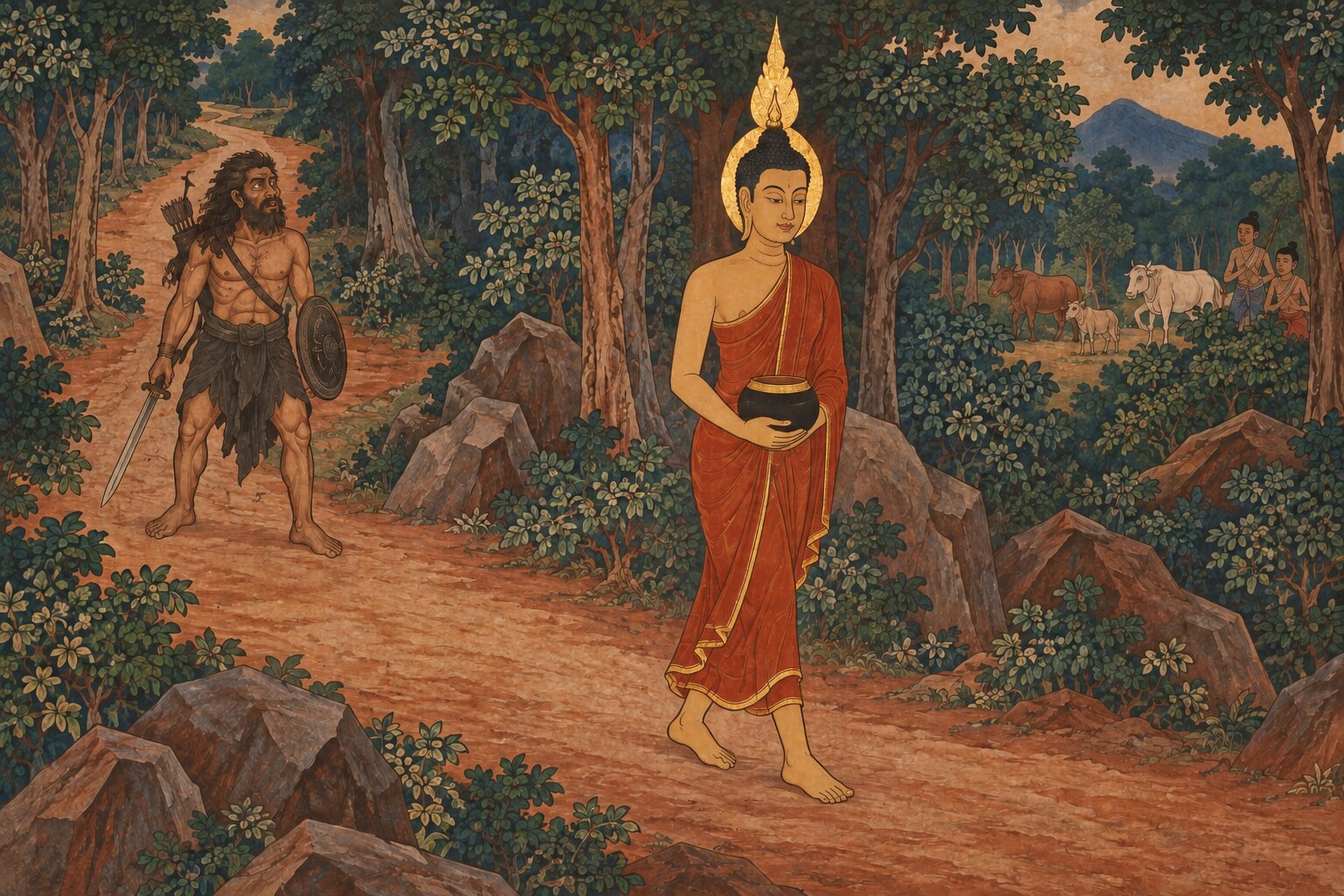
Standing still now, Aṅgulimāla could not make sense of it. The man who was still walking claimed to have stopped, and told the man who had stopped running that he had not. He asked about it in verse, and the Buddha answered in verse:
Aṅgulimāla, I have forever stopped —
I’ve laid aside violence toward all creatures.
But you can’t stop yourself from harming living creatures;
that’s why I’ve stopped, but you have not.
In Pali it is one verb in both mouths — tiṭṭha, “stop”, and ṭhito, “stopped”, “standing”, “still” — and the verse turns its meaning without changing its form. What the Buddha had stopped was not his feet. It was violence — literally, in the Pali, the rod, daṇḍa, set down toward every living thing — and with it the whole movement that drives a hand to pick one up. Aṅgulimāla, planted in the middle of the road, was the only one of the two still going anywhere. It is the idea at the center of Why Buddhism Asks You to Stop — that the point is not to aim the movement at better things but to bring it to rest — said here with an economy no essay can match.
What followed was immediate. Aṅgulimāla threw his sword and weapons down a cliff, bowed at the Buddha’s feet and asked to be admitted to the order. “Come, monk,” the Buddha said, and with that he was one.
Without rod or sword
In Sāvatthī, meanwhile, a crowd had gathered at the palace gates demanding that the king do something about the bandit. Pasenadi drove out at midday with some five hundred horses and went to the monastery to see the Buddha. He explained where he was going, and the Buddha asked him a question: suppose he were to find Aṅgulimāla with his head and beard shaved, wearing the ocher robe, refraining from killing, stealing and lying, eating once a day, celibate and of good character — what would he do to him? The king said he would bow to him, offer him a seat, robes, food and lodging, and see to his protection. But how, he added, could a man like that ever come to such virtue?
Aṅgulimāla was sitting a few paces away. The Buddha pointed with his right arm. “Great king, this is Aṅgulimāla.”
The king’s hair stood on end, and the Buddha had to calm him before he could go over and speak to the monk. When he took his leave, Pasenadi said what anyone in his place would have had to admit: “I was not able to tame him with the rod and the sword, but the Buddha tamed him without rod or sword.”
The sentence is worth a second look, because the king and the Buddha wanted exactly the same thing — to stop Aṅgulimāla — and differed only in the instrument. The king’s force can stop a man only from the outside, by locking him up or killing him, and at best it ends the harm without ending the person who was doing it. The sutta does not mock that, and the king comes out of it well enough; a kingdom needs someone to keep the roads safe. But what the Buddha did could not be imposed, only offered, and it worked because Aṅgulimāla stopped from the inside. It is the same rod, too, as in the verse on the road: the one the Buddha had already put down.
The noble birth
One morning, already a monk, Aṅgulimāla was on almsround in Sāvatthī when he saw a woman in an obstructed labor. “Oh, beings undergo such travail!” he thought. Back at the monastery he told the Buddha, who sent him to the woman with these words:
Ever since I was born, sister, I don’t recall having intentionally taken the life of a living creature. By this truth, may both you and your baby be safe.
Aṅgulimāla balked. “But sir, wouldn’t that be telling a deliberate lie? For I have intentionally killed many living creatures.” So the Buddha changed a single phrase:
Ever since I was born in the noble birth, sister, I don’t recall having intentionally taken the life of a living creature. By this truth, may both you and your baby be safe.
Aṅgulimāla went and said it, and the woman was safe, and so was her baby.
This is the hinge of the whole sutta. What Aṅgulimāla speaks is an act of truth — saccakiriyā, a declaration whose power rests entirely on its being true — and that is why the first wording will not do: in his mouth it would be false. The Buddha does not ask him to deny his past or to pretend he was someone else. The earlier life is still there, all of it, and he still cannot say he never killed. What the Buddha gives him is somewhere else to speak from: ariyāya jātiyā jāto, “born in the noble birth”. A second date of birth, the one for the life that began when he stopped, and from which he can say something true — true in a way that is of use to someone else.
That sentence, in Pali, is still recited in Thailand. It is known as the Aṅgulimāla paritta — the paritta are the protective chants of Theravada Buddhism — and it is chanted for women close to giving birth, in the belief that reciting it, or simply hearing it, brings an easy delivery. The chant is the sutta’s sentence itself, preceded by a short verse of introduction which says that even the water used to wash the seat of the one who recites it wards off every danger. It is one of the few places where a line of the canon has become an everyday object — something a family asks for rather than something anyone studies — and it is worth noticing what was kept: not the chase and not the miracle, but the sentence in which a man who had killed found a way to say something true.
Endure it
From then on Aṅgulimāla lived alone, withdrawn, diligent and resolute, and before long he reached the goal for which people leave home for the homeless life: he became an arahant, one who has completed the path. Most retellings end here, or a little before. The sutta keeps going.
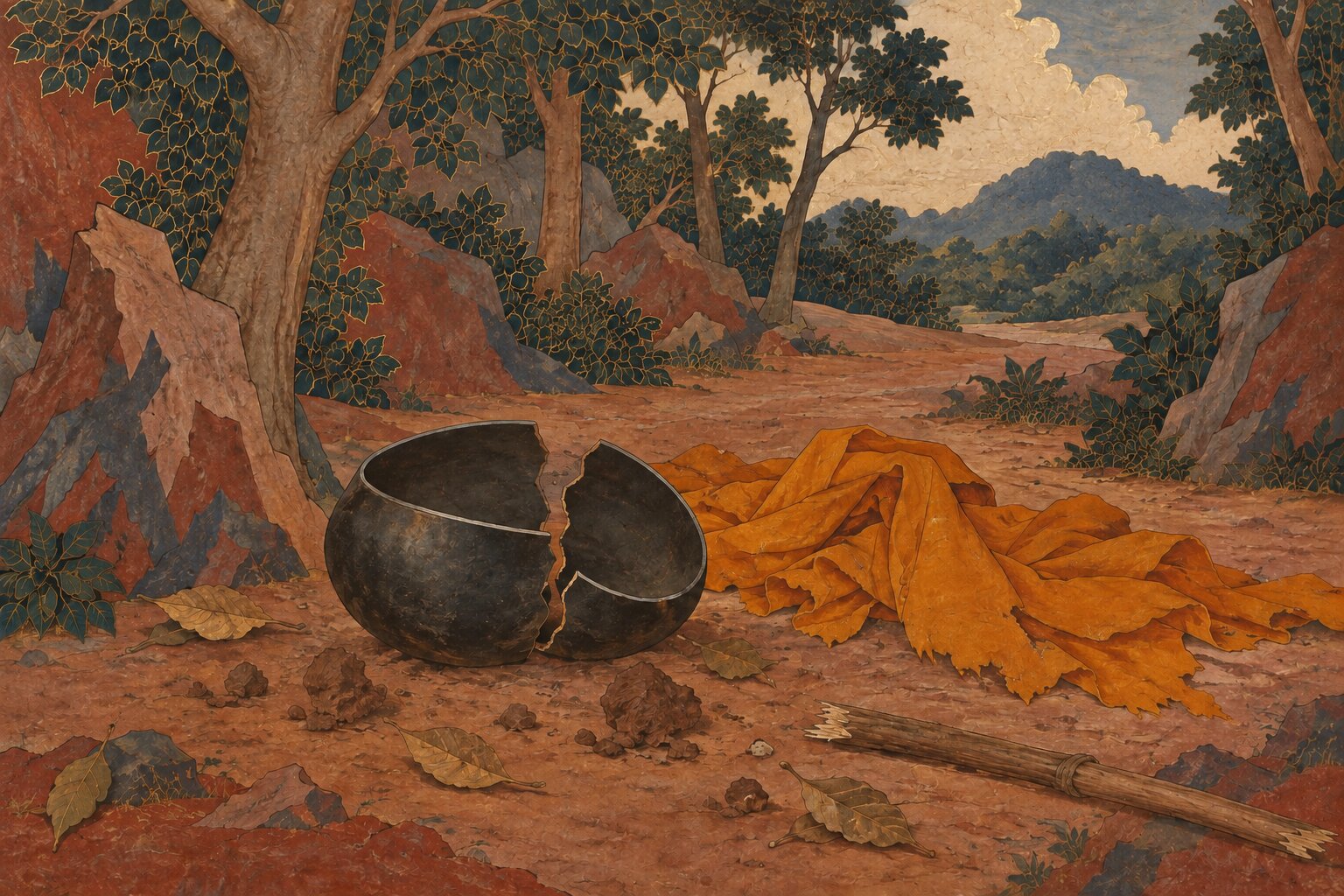
One morning on almsround in Sāvatthī someone threw a clod of earth at him, someone else a stick, someone else a handful of gravel. Aṅgulimāla came back to the Buddha “with cracked head, bleeding, his bowl broken, and his outer robe torn.” The Buddha saw him coming from a distance and said:
Endure it, brahmin! Endure it, brahmin! You’re experiencing in this very life the result of deeds that might have caused you to be tormented in hell for many years, many hundreds or thousands of years.
“Brahmin” here is not a caste but a title. The last chapter of the Dhammapada gives the word to the one who has finished the path, and it is exactly that man, already free, on whom the stones are falling.
The common picture of karma is a vending machine: put in an act, get out its result, always the same one at the same price, and once it is paid the account is closed. The redemptive reading of the story adds a hope to that picture — that changing one’s life might cancel what is still owed. The sutta says neither. Aṅgulimāla’s past was not erased by his ordination, nor by his awakening; the stones came anyway, and they came afterward. But the price was not fixed either: what might have been thousands of years in hell arrives as a few stones on a road. What had changed was the person receiving them. A bandit who has stones thrown at him throws something back. This man walks back to the monastery with his head split open and throws nothing.
It is an uncomfortable passage, and that is worth saying plainly. It invites the reading that he had it coming, and the text gives no license for that: it does not say who threw the stones, and it neither approves of them nor condemns them. What it describes is not a punishment handed down from outside, but consequences reaching someone who is no longer adding to them. Aṅgulimāla puts it himself in his verses, with an almost bookkeeping precision: “The result of my deeds has already struck me, so I enjoy my food free of debt.” The word is aṇaṇa, debt-free. The debt was not forgiven; it was paid, by someone who was no longer running up another.
That is the difference between this story and the vending machine. Transformation does not erase consequences. It changes who is there to meet them.
Harmless
The sutta closes with the verses Aṅgulimāla spoke later, alone, in the bliss of release. One of them returns to his name:
My name is ‘Harmless’,
though I used to be harmful.
The name I bear today is true,
for I do no harm to anyone.
According to the commentaries, Ahiṃsaka was the name he was given at birth; the verse says only that it is true now. The Pali is saccanāma, “true-named”, and it shares its root with the act of truth for the woman in labor: sacca, truth. The two things Aṅgulimāla managed as a monk — to help someone with a sentence that was true, and to carry a name that no longer lied — rested on the same thing.
Two more verses return to an image the Dhammapada also keeps, as its verses 172 and 173:
He who once was heedless,
but turned to heedfulness,
shines upon this world,
like the moon freed from clouds.Someone whose bad deed
is supplanted by the good,
shines upon this world,
like the moon freed from clouds.
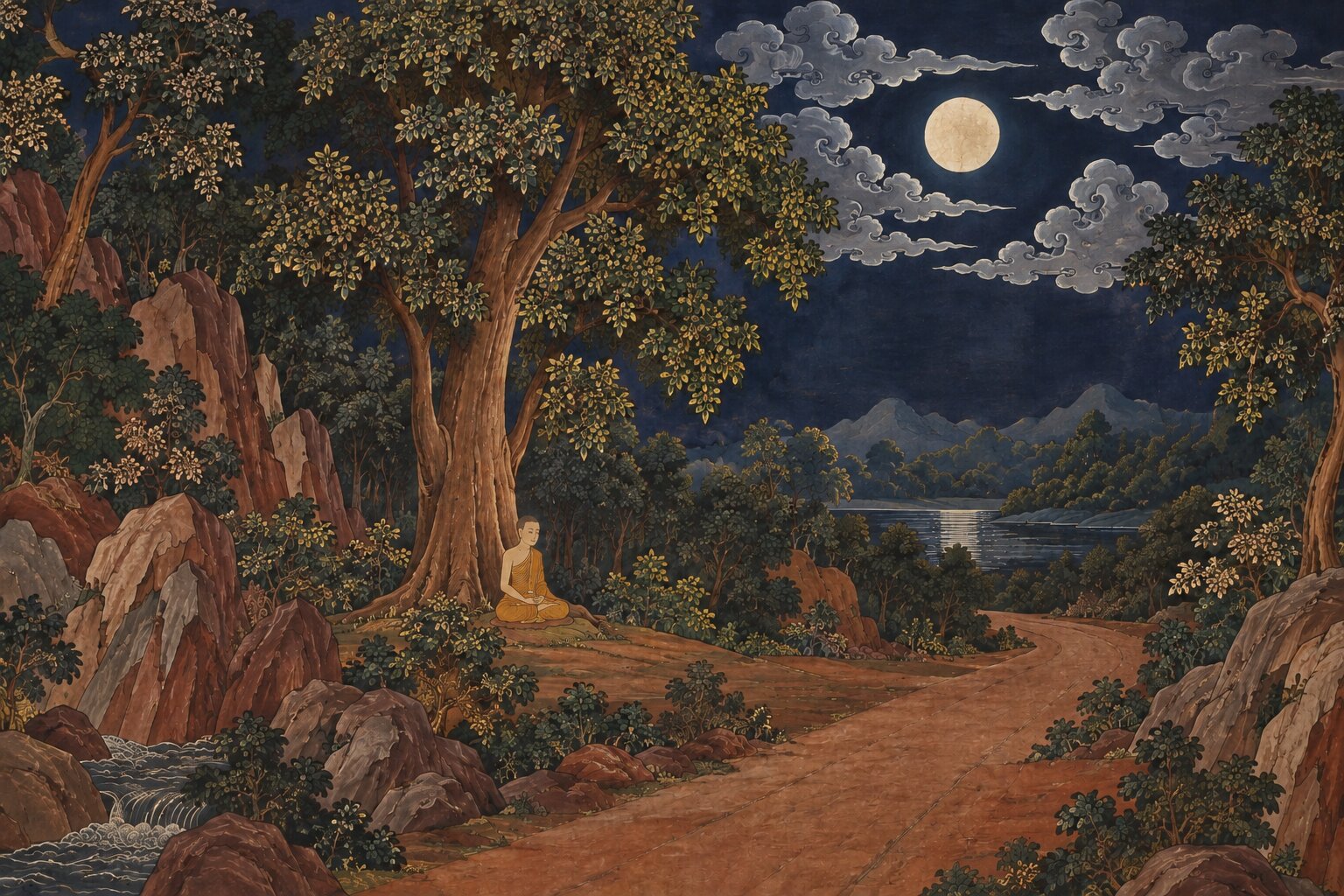
Sujato’s “supplanted” is a fair reading, but the Pali verb, pidhīyati, is more concrete: it means to be covered over, closed, as a pot is closed with a lid. The bad deed does not vanish; the good is laid over it. It is the same moon, as it happens, that the thief left in Ryōkan’s window, though here nobody leaves it — it comes out when the clouds move off.
Nothing Aṅgulimāla had done was undone. What changed was who was there to receive it, and a name that had been a lie for years became, at last, true.