

Taigu Ryōkan was a Japanese Zen monk who spent nearly all of his adult life owning almost nothing, and one of the best-known stories about him is the one in which a thief finds this out. The thief broke into his hut, the story goes, looked for something worth taking and came up empty — and then left with what little there was, helped along, in every version, by the man he was robbing. Ryōkan wrote a poem of three lines about it, and those three lines say something more exact about poverty than most of what has been written on the subject at far greater length.
The great fool of Mount Kugami
He was born in 1758 in Izumozaki, a port town on the Echigo coast in what is now Niigata Prefecture, the eldest son of the village headman — which is to say that the office was his to inherit, and that he did not inherit it. At around eighteen he left home for the monastery, and not long afterward followed the Sōtō master Kokusen to the temple of Entsū-ji at Tamashima, on the Inland Sea, where he trained for more than ten years.
At the end of that training Kokusen gave him the certificate by which a teacher acknowledges a student’s understanding, and with it, as was the custom, a verse. Its first line opens on the first character of Ryōkan’s name and closes on the second:
良也如愚道転寛
Ryō — like a fool, and the Way grows ever wider.
The 良 of Ryōkan means “good”; the 寛 means “wide”, in the sense of roomy, lenient, generous. The line is doing two things at once: it says the student looks like a fool, and it says the road he walks is living up to the second half of his name. The sobriquet he carried for the rest of his life shares a word with that line — Taigu, 大愚, “great fool”.
After his teacher’s death he spent some years on the road and then came home to Echigo, where he never took charge of a temple. He lived by begging, carrying his bowl through the villages below the mountain; he wrote poems in Japanese and in classical Chinese; and he left behind, in the memory of the region, an image that sits a little oddly on a Zen master — a monk who spent whole afternoons playing temari, the thread-wound ball, with the village children. For about twenty years from 1797 his home was Gogō-an, a hut on Mount Kugami near the temple of Kokujō-ji.
The name of the hut is already an inventory. An earlier monk had lived in it on five gō of rice a day from the temple — a gō is a little under a fifth of a liter — and the hut kept the ration as its name: the five-gō hut.
The story goes
The story of the thief is told several ways, and none of them can be offered as documented fact. It is a traditional anecdote, and like most of its kind it has changed shape depending on who was doing the telling.
In the version most English readers meet first — the one Nyogen Senzaki and Paul Reps included in Zen Flesh, Zen Bones — the thief gets into the hut while Ryōkan is out. The monk comes back to find him with nothing, since there was nothing to take, and offers him the only thing he has: the clothes he is wearing. The thief, bewildered, takes them and goes. Ryōkan sits down naked and looks at the moon.
In the version told in Japan, the thief comes at night and finds Ryōkan lying down. There is nothing here either, apart from the futon the monk is sleeping on, so the thief starts to pull it out from under him. Ryōkan pretends to stay asleep and, at the right moment, rolls over so that it comes away easily.
The two versions disagree on the details and agree on everything that matters. In both, the monk defends nothing, because there is nothing to defend; in both, he helps the thief finish the robbery; and in both, once the thief has gone, something is left that could not be carried off. That is what the poem is about.
The poem
盗人に とり残されし 窓の月
nusubito ni / torinokosareshi / mado no tsuki
What the thief
did not carry off —
the moon in the window.
It is worth reading word by word, because nearly all of the poem lives in a single verb. Nusubito is the thief, and ni marks him as the one who did what follows. Mado no tsuki is the window’s moon — the moon as it looks from inside, framed. Between them sits torinokosareshi, from the verb torinokosu, which joins “take” to “leave” and is used, for instance, of fruit still on the tree once the harvest is in. It does not mean simply “to leave”. It means to leave one thing while taking everything else.
So the robbery is inside the word. The poem does not say that the thief failed to take the moon, as though the moon were a consolation the monk allows himself after the loss. It says something drier: the thief took what there was, and this is what remained. Grammatically, the poem has no main verb at all. It is a single noun with a long modifier — the window’s moon, left behind by the thief — and nothing in it happens. It reads less like an anecdote than like the last line of an inventory.
One more detail. In haiku, the moon on its own, with nothing further specified, is an autumn word. The poem takes place, then, in the season when bedding begins to matter.
What a hermit owns
It is easy, from somewhere comfortable, to turn this story into a lesson about how little a person really needs. That is worth resisting for a moment, because Ryōkan’s poverty was real. He was cold and sometimes hungry, he begged through the winters of one of the snowiest regions in Japan, and he depended for his meals on farmers who had little enough themselves. Admiring that from a distance costs nothing, and treating someone else’s poverty as an aesthetic virtue is one of the more comfortable ways of not looking at it.
Granted all of that, the story is not about poverty as suffering. It is about something else, and Ryōkan left a fairly precise account of what. In one of his poems in classical Chinese — the one that opens by confessing that all his life he was too idle to make his way in the world — he lists his entire estate:
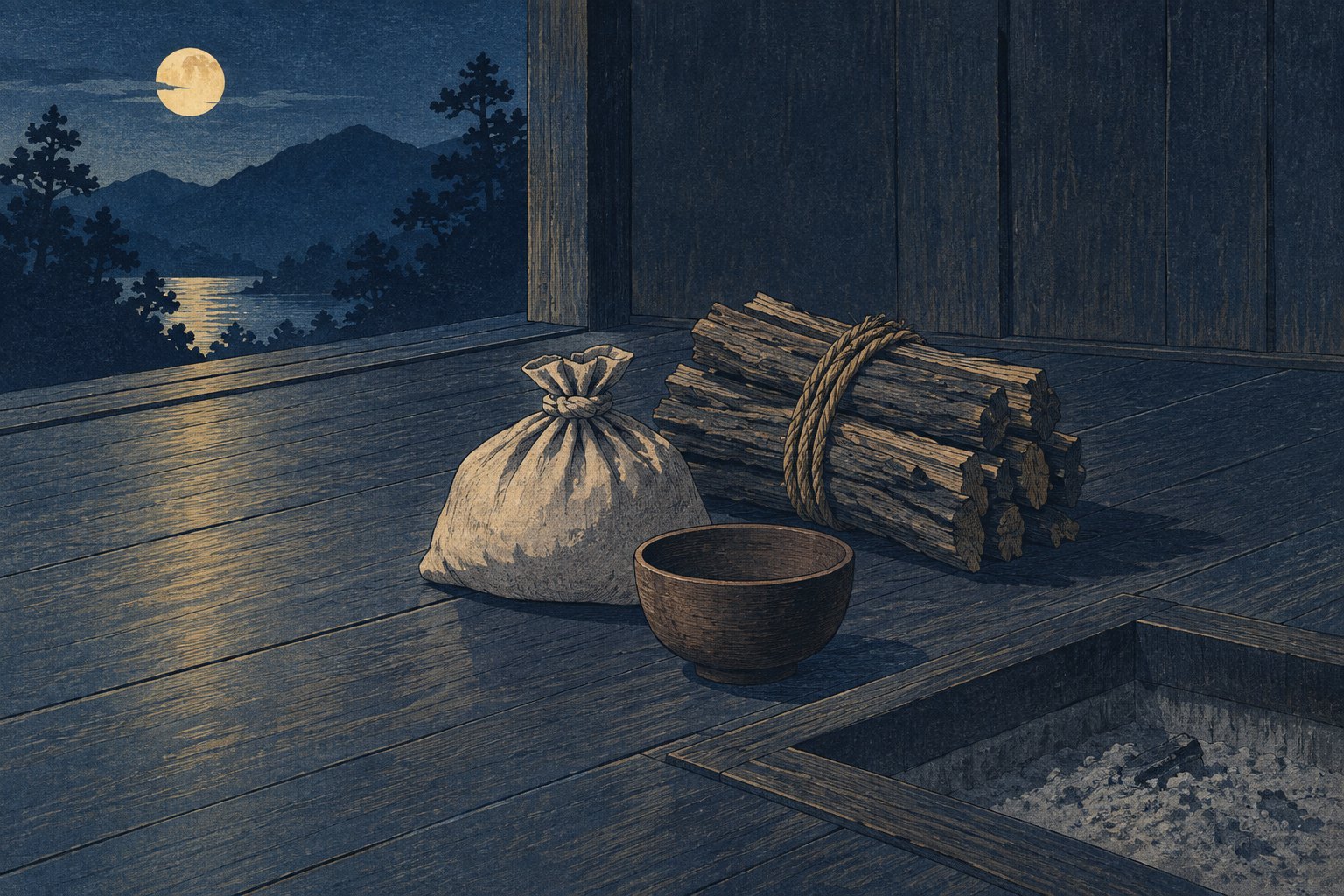
嚢中三升米 炉辺一束薪
In the bag, three shō of rice;
by the hearth, one bundle of firewood.
Three shō is thirty gō — six days of the ration his hut was named for. That is the whole of it.
And a man with that estate cannot be robbed in any way that matters — not because he is invulnerable, but because he has turned so little of his life into something that can be taken. Everything a person owns is also a door through which something can be lost, and most of us live surrounded by such doors: the house and what is in it, money, position, reputation, the picture other people carry of us. All of it has to be watched. A lock protects objects, but it is also the visible shape of a worry that never quite goes out.
The Pali tradition has a word for the opposite condition. Akiñcana — literally “without a something” — is the one who has nothing, and the Dhammapada uses it, in verse 421, for the person who has nothing behind, nothing ahead and nothing in between, and clings to nothing. The word covers both senses at once: not having, and not holding on. That is what the thief found in the five-gō hut — not an empty house so much as a man no longer fastened to what was in it. Which is why a robbery that would have been a loss in any other house became, in this one, something closer to a gift. The one thing of value was not stored anywhere in the hut, and there was no way to carry it out through the door.
Hermit Scriptures
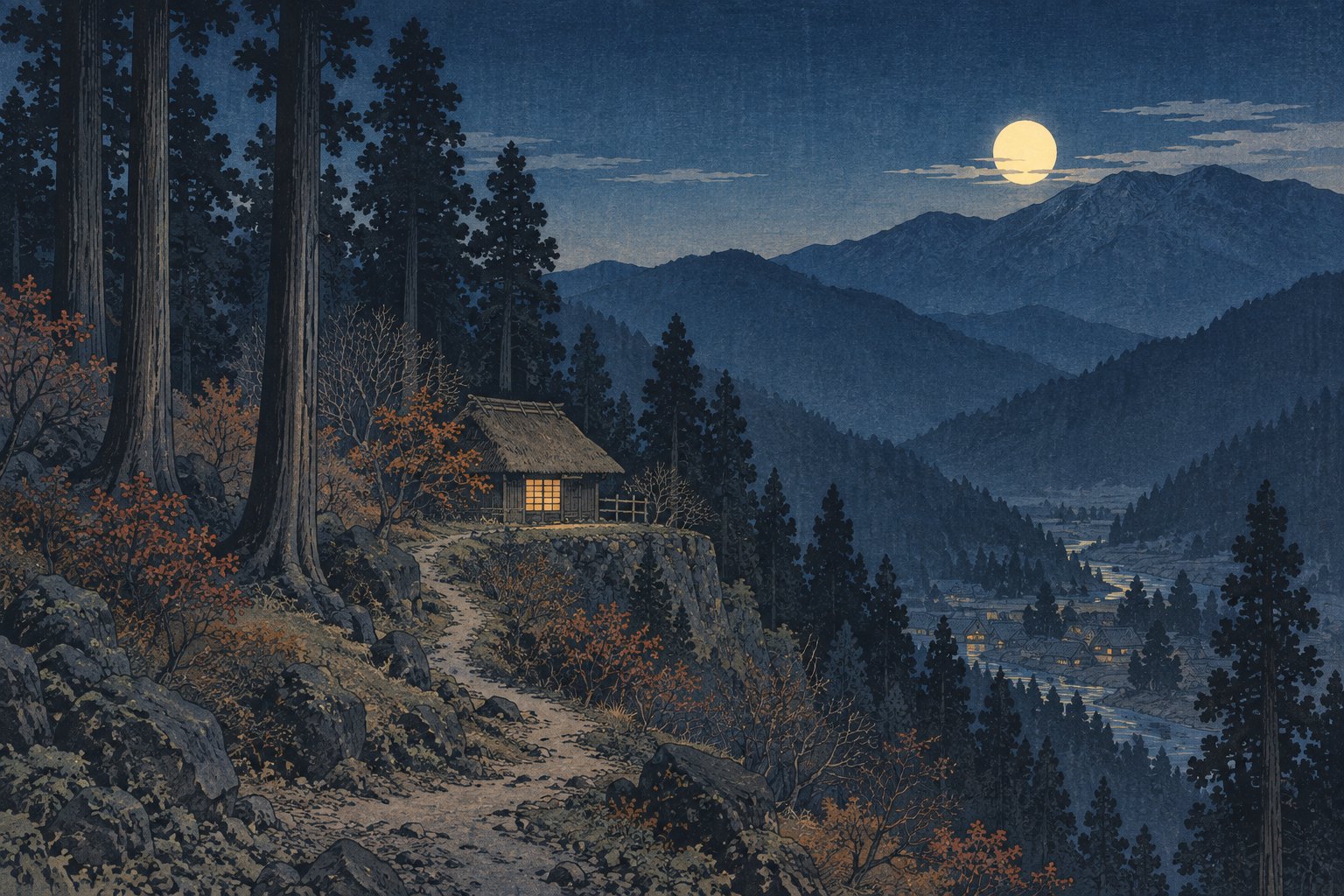
A site called Hermit Scriptures owes its readers some account of the word. “Hermit” comes, by way of Latin, from the Greek erēmos, “desert”, and the usual picture is of someone who has withdrawn from other people. Ryōkan does not fit it well. His hut was on the mountain, but he came down to the village nearly every day — to beg, to talk with the farmers, to play with the children until it got dark. His solitude was not a retreat from the world but a way of being in it with empty hands. What made him a hermit was not the distance he kept from people but how little he was carrying when he came near them.
That may be the most useful definition available for the name of this site, and it does not require anyone to move up a mountain. The person writing here is not a monk and does not live in a hut. But the question the thief’s story raises works just as well in a city: of everything you have, what could someone who came in tonight carry off, and what would still be in the window afterward. What remains is what is worth writing about.
The name
One last thing, which is where the name at the top of these pages comes from. Ryōkan was one of my first ways into Buddhism — his poems more than anything else. Around that time I used his name once as a nickname online, for no better reason than that the book happened to be next to me, and it stuck: friends began to associate it with me, and it has been mine ever since. It is the same name, without the macron.
The thief left with what he could carry. What stayed in the window belonged to no one, and for that reason no one could take it: it was there for anyone who kept still long enough to see it.