

Dāna is the Pali word for generosity, and in a Buddhist country it most often means something concrete: food, carried to a monastery in the morning and handed to the monks before their one meal of the day. This is an account of one such morning at Wat Pah Nanachat — what we brought, how it was received, and what the offering is understood to be for, which turns out to be a more careful question than the act itself suggests.
Wat Pah Nanachat is the international forest monastery founded by Ajahn Chah for foreigners drawn to the monastic training laid down by the Buddha. The working language is English, and it sits in the countryside of Ubon Ratchathani province in the northeast of Thailand, about half an hour from the city. I had lived there for a month as a lay guest some time before — what that month taught me about pain is told elsewhere on this site — and on this visit we came only for the morning, and on a Thursday. Weekdays are quiet. Saturday and Sunday are when Thai lay Buddhists come in numbers, bringing food and the basic necessities the monks are not permitted to buy for themselves, so a weekday offering is a smaller and more intimate affair.
What we brought
Sandwiches, mostly — tomato, soy, sandwich spread, butter, lettuce, and scrambled eggs, assembled that morning and carried out in trays. There is nothing ceremonial about the food itself. Thai families usually bring rice and curries, soy milk and small, sweet treats.
The almsround
Well before we arrived, at first light, the monks had already left the monastery on pindabat — the almsround, in which they walk fixed routes through the surrounding villages with their bowls, and anyone who wishes to give steps out in front of their house to do so. An individual offering is often as humble as a handful of rice. Collected along a whole route, and pooled with what every other route brings back, it becomes a banquet, and at Wat Pah Nanachat it is enough to feed the entire community of monks and every lay visitor present that day, since the monks share what remains.
The offering, and what it is for
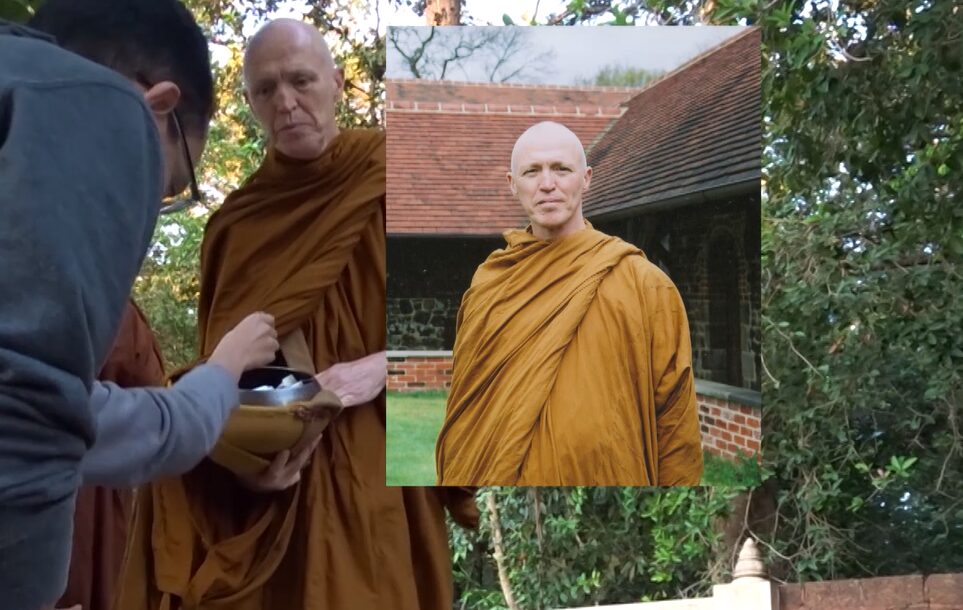
At the head of the line receiving the food that morning was Ajahn Sucitto, a well-known monk born in England. The formal offering is brief — the food is presented, the monk receives it — and it is preceded by something that is easy to miss if you do not know to look for it: the givers pause to dedicate what they are about to give.
The reason for the pause is that intention is doing most of the work. Thai culture holds, broadly, that giving to monks is an act of great merit that will generate good karma for the giver, and the Buddha did speak often and warmly of the benefits of generosity and of sharing. Both of those things are true. But the point the tradition actually presses is not the act. It is the intention with which the act is carried out, and the dedication exists to bring that intention into view at the moment it matters — so that the person offering is aware of what they are doing, and why.
There are people who give simply because they understand it to be good for their luck. Giving in order to receive something back does nothing to purify the mind, and the tradition never recommends it. The real sense of dāna arises from compassion, and from the altruistic wish to support the practice, teaching and preservation of the Dhamma — the Buddha’s teaching — for its own sake.
After the offering
Visitors and resident laypeople alike help prepare and lay out the food. The resident laypeople are those who, with the abbot’s permission, live inside the monastery for a set period. Once the donated food has been prepared and arranged, it is formally handed to the monks, who receive it and set it on the table behind them. From that point on nobody touches it until the monks have taken their meal and shared what is left.
The chant heard in the video at this point is a verse from the Tirokudda Sutta, a short text from the Khuddakapatha that is customarily recited after the laity have given dāna. It is a dedication of merit. It is not, strictly, a transfer of merit — merit is not the kind of thing that can be handed from one person to another — but rather an outpouring of goodwill, and a call to all who can hear it to gather in virtue.
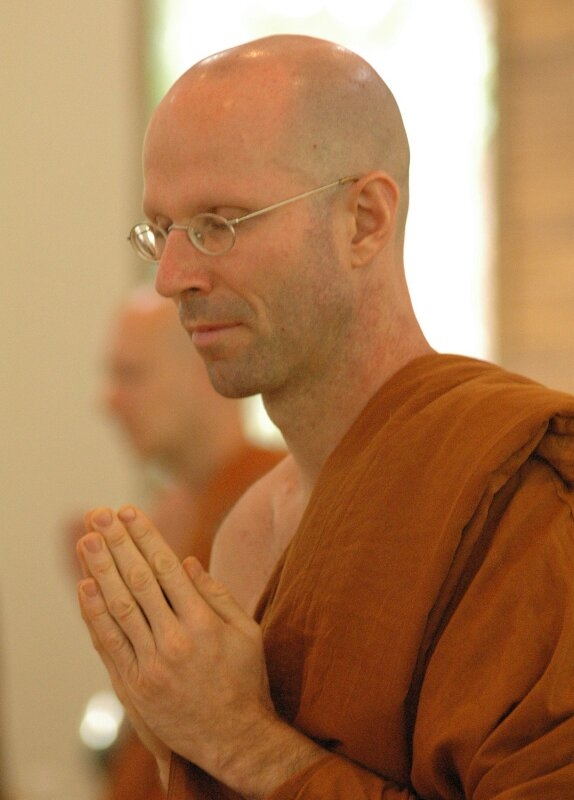
Usually the abbot gives a Dhamma talk at this point. On this occasion the abbot, Ajahn Kevali, was away from the monastery, so there was none. The talk is given in Thai, since the great majority of the lay visitors are Thai — Ajahn Kevali, who is German by birth, speaks it excellently.
Who eats first
Once the monks have taken their food and set the rest out for everyone else, the resident laypeople — the ones dressed entirely in white — go first. They have undertaken the eight precepts for the duration of their stay, one of which is to eat only once a day, so this is their meal. Last come those of us who are only visiting, because we will go home afterward and eat again in the course of the day.
The end of the morning
After eating, one lay Buddhist settled her meal with a period of walking meditation, and it would be hard to choose a better place for it — the monastery induces a calm and a quiet that are made for practice. Near where she walked stands a sign that reads: “Abandoning what is harmful — what is morally unwholesome — is more important than doing good.”
That is the order Buddhism recommends. First and most important in any spiritual effort is to overcome — to stop doing — whatever harms ourselves or others, and only once the negative has been set down is the whole of one’s effort free for the positive.
It was a peaceful morning, and we left having contributed something, however small, to the support of the Sangha, the monastic community. But the sign is the part that stays. Generosity belongs to the doing of good, and the monastery keeps a plain notice of what comes before it.