

For the three months of the rainy season, Theravada monks do not travel. Each stays in the monastery where the retreat began and leaves it only for a few days at a time, and only for particular reasons. In Thailand the retreat is called phansa, and Ok Phansa — “leaving the phansa” — is the day it ends, on the full moon of the eleventh lunar month. It is a day of crowded temples, processions and lights on the rivers. But its formal name in the Thai calendar is a different one, Wan Mahā Pavāraṇā, “the day of the great invitation”, and what that name remembers happens not in the streets but inside the monasteries: each monk, starting with the most senior, asks the community to tell him what faults it has seen in him.
In 2026 Ok Phansa falls on Monday, October 26. Because it follows the lunar calendar the date moves from year to year, though it nearly always lands in October; the Tourism Authority of Thailand announces it well ahead, along with what each province is holding.
Why the monks stay put
The rule has an unceremonious origin. The chapter of the Vinaya — the code of monastic discipline — on the rains residence opens with a complaint. At first the Buddha had laid down no retreat at all, and the monks wandered in the cold season, the hot season and the rains alike. People began to grumble. How could these ascetics go traveling in the rains, trampling the green grass, harming what the text calls one-sensed life — plants — and killing small creatures in great numbers? Even the ascetics of other sects, they said, settle down for the rainy season. Even the birds build a nest in the top of a tree and stay put while it rains.
The monks took the complaint to the Buddha, and he established the retreat. The argument was not a doctrinal one; it was the argument of anyone who has watched a party of strangers tramp across a sodden field. A good many of the Vinaya’s rules began this way, with something people saw and objected to, and this one shows it more than most: the first thing the Buddha asked of his monks was to be no less sensible than the birds.
Ever since, the retreat has begun on the day after the full moon of the eighth lunar month, usually in July, and has lasted three months. A monk may leave, but for seven days at most and only on specific business — to nurse a sick monk, to look after his mother or father if they fall ill, to go when a lay supporter invites the monks to hear the teaching — and he must be back before the seven days are out. If he stays away longer, the text is brief about it: that rains does not count for him.
Counting a life in rains
Whether a rains counts matters, because the Pali word, vassa, means “rain” and also “year”. Thai took it by way of Sanskrit as phansa, double meaning intact, and a monk’s seniority is still measured in it: nobody asks a monk how many years he has been ordained, but how many phansa he has. A man of sixty who ordained three rains ago is, inside the community, a monk of three, and sits below a man of twenty-five who has five. In Thai the start of the retreat is Khao Phansa, “entering the rains”, and the end is Ok Phansa, “leaving” them. A monk’s year begins and ends at a door.
In English-language writing about Thailand the retreat is usually called “Buddhist Lent”. The translation is not a careless one. These are three months in which a great many lay people give something up as well — they keep the precepts more carefully and go to the temple more often, and since 2003 a national campaign has asked drinkers to stop for the whole season. For generations, too, young Thai men have ordained for exactly the length of one retreat. But the word falls short at the point that matters most. Lent is a season of fasting and penance that prepares for a feast. The vassa is not a fast but a staying still — what the monks give up for three months is not food but the road — and it does not end in a feast. It ends in a ceremony at which every monk asks to be corrected.
A rains spent in silence
That ceremony has an origin story too, and it is better than the first. The Vinaya chapter devoted to it tells of a group of monks, all friends, who were about to spend the rains together at a monastery in Kosala and wondered beforehand how to get through it in harmony, without quarrels and without trouble over food. Their answer was not to speak to one another. Whoever came back first from almsround set out the seats, the water for washing feet and the bowl for leftovers; whoever came back last ate what was left if he wanted it, put everything away and swept the dining hall. Whoever found a water pot empty filled it, and if it was too heavy for one, he beckoned someone over with a wave of the hand and the two of them filled it together, without a word. That was how they spent the three months.
When it was over they went to see the Buddha, who asked them, as was his custom with arriving monks, whether they had had a comfortable rains, lived in harmony and found almsfood without difficulty. They said they had, and told him how. His answer was unusually hard. Living in discomfort, he said, these men claimed to have lived in comfort; they had lived together like cattle, like sheep, like rivals, and they called it peace. And he forbade what they had done — the mūgabbata, literally the “vow of the mute”, which the text describes as a practice of other sects. Anyone who takes it up, he said, commits an offense.
This is not a verdict against silence, and it is worth saying so on a site with hermits in its name. Elsewhere the Buddha tells his monks that when they are gathered together there are two things for them to do: talk about the Dhamma, or keep noble silence (Majjhima Nikāya 26). The silence of the meditator and the silence of the one who lives alone belong to the tradition from the start. What he rebukes in Kosala is something else — a silence agreed on so that nobody has to deal with anybody. Those monks had not quarreled in three months, not because they got on, but because they had arranged their common life so that there was never an occasion to fall out. It was peace by avoidance, and the images the Buddha reaches for, cattle and sheep, catch rather exactly both what was restful about it and what was poor.
The invitation
Having rebuked them, the Buddha laid down in its place the ceremony that has closed every retreat since: the pavāraṇā, the invitation. At the end of the rains each monk invites the community to point out his faults on three grounds — what they have seen him do, what they have heard about him, and what they suspect. The text sets the form as well. The most senior monk arranges his robe over one shoulder, squats on his heels, raises his joined palms and says:
Friends, I invite the Sangha to tell me what it has seen, heard or suspected. Let the venerables speak to me, out of compassion. Seeing it, I will make amends.
He says it three times. Then the next most senior says it, and the next, down to the youngest, who uses the same words and changes only the form of address: where the elder says “friends”, the junior says “venerable sirs”. (The formula is rendered here from the Pali; Bhikkhu Brahmali’s complete English translation of the Vinaya is on SuttaCentral.)
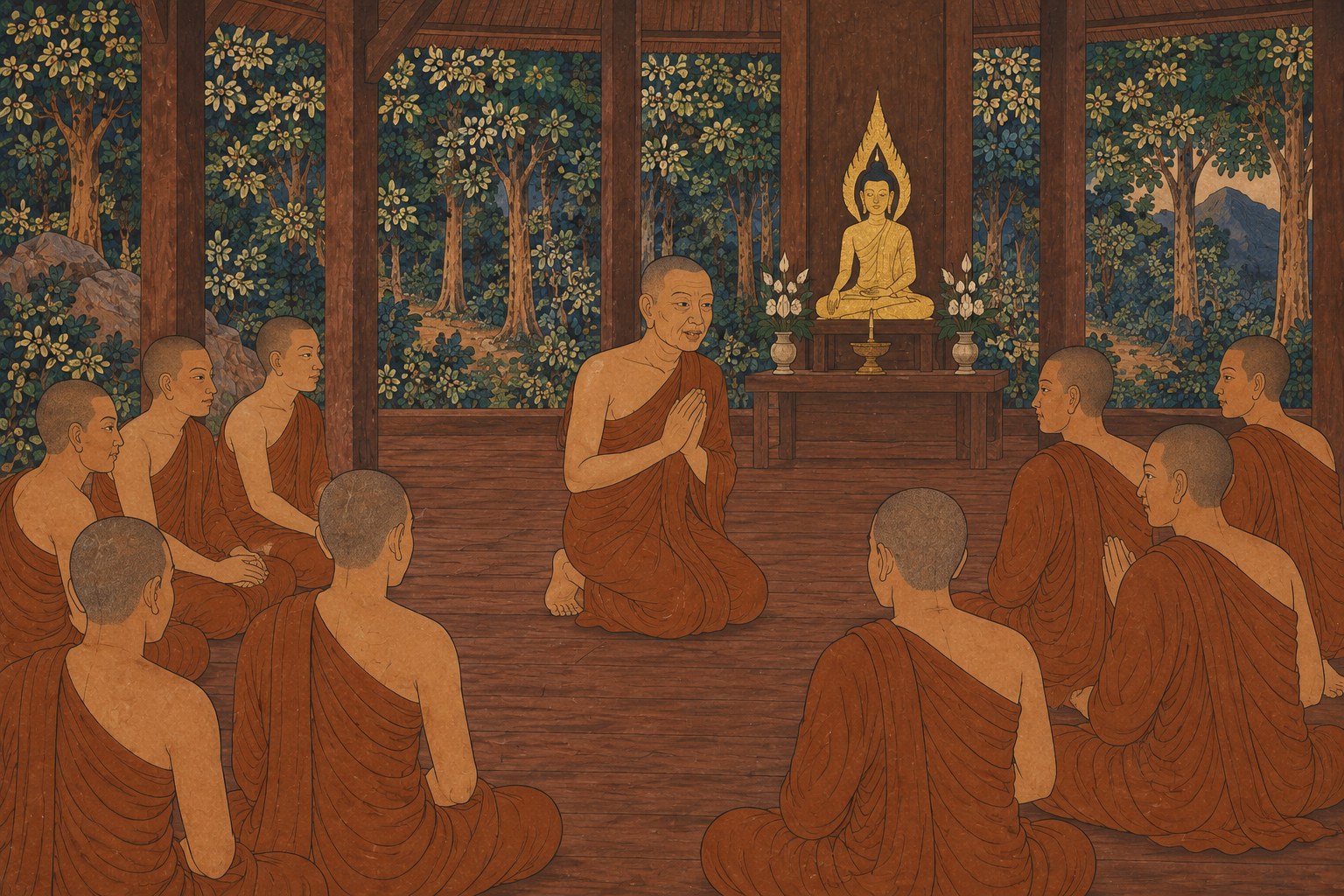
The formula is worth reading slowly, because each part of it closes a way out. The first to ask for correction is the most senior, the one with the most authority and so the most to lose; the ceremony is not a device for elders to correct juniors, but something everyone does, beginning at the top. The invitation covers what others merely suspect, not only what they could prove, so nobody is asked to bring evidence. Whoever speaks does so, in the formula’s own words, out of compassion, which names criticism as a kindness on the part of the one who gives it rather than an attack to be endured. And the promise at the end is exact. The monk does not undertake to accept everything he is told. He undertakes to look at it, and to put right what he sees.
The word itself says something. Elsewhere in the same Vinaya, when the Sakyan layman Mahānāma wants to invite the monks to ask him for any medicine they need for four months, the verb he uses is this one, pavāreti. It is the host’s invitation — the pantry opened, and whatever is needed there for the taking. At the end of the rains each monk does with his own conduct what Mahānāma did with his medicines: he puts it at the others’ disposal.
The Vinaya keeps a very human detail, too. At first everyone stayed squatting until the last monk had finished, and an old monk, weak with age, fainted while he waited. The Buddha then allowed each monk to sit down once he had made his own invitation. As for what it is all for, the text puts it in three phrases: the ceremony is for living in accord with one another, for clearing oneself of offenses, and for putting the training first.
Asked for, not delivered
Outside a monastery almost nobody does this. Criticism usually arrives unrequested — in an argument, in a performance review, in the remark someone decides to make — and whoever receives it is already defending against it before fully understanding it, because criticism nobody asked for looks a great deal like an attack. The pavāraṇā reverses the order. When a person has asked to be told their faults, what they hear afterward comes in through a door they opened themselves, and the defense was set down in the act of asking. The words can be exactly the same, and still they land differently.
The ceremony also has a date. It does not wait for someone to work up the nerve, or for a conflict serious enough to justify it; it comes every year at the end of the rains, and it comes for everyone. That is the difference between the peace of the monks in Kosala, which consisted in never touching anything, and a peace that leaves one day a year open for whatever needs to be said.
The day the worlds were opened
On the morning after Ok Phansa, temples across the country hold Tak Bat Devo, an offering of food to the monks in memory of the Buddha’s descent from the world of the gods. Devo is short for devorohaṇa, “the descent from the gods”, and the day has a popular Thai name that sums it up: Wan Phra Chao Poet Lok, the day the Buddha opened the world.
The story is not in the canon. It comes from the commentary on the Dhammapada, from the tale attached to verse 181, and it is later tradition — though a tradition everyone in Thailand knows. According to the commentary, after performing the twin miracle at Sāvatthī, fire and water streaming from his body at once, the Buddha went up to the Tāvatiṃsa heaven, the heaven of the Thirty-Three, and spent an entire rains retreat there teaching the Abhidhamma to his mother, who had died seven days after his birth and been reborn among the gods. When the rains were over, the text says, the Buddha made the invitation — the commentary uses the same verb, pavāretvā — and told Sakka, king of the gods, that he was going back to the world of human beings. Sakka made three ladders appear, one of gold, one of jewels and one of silver, their feet at the gate of the city of Saṅkassa and their tops on the summit of Mount Sineru. The gods came down by the golden one, Brahmā and his retinue by the silver, and the Buddha by the one in the middle, the ladder of jewels, on the day of the great invitation.
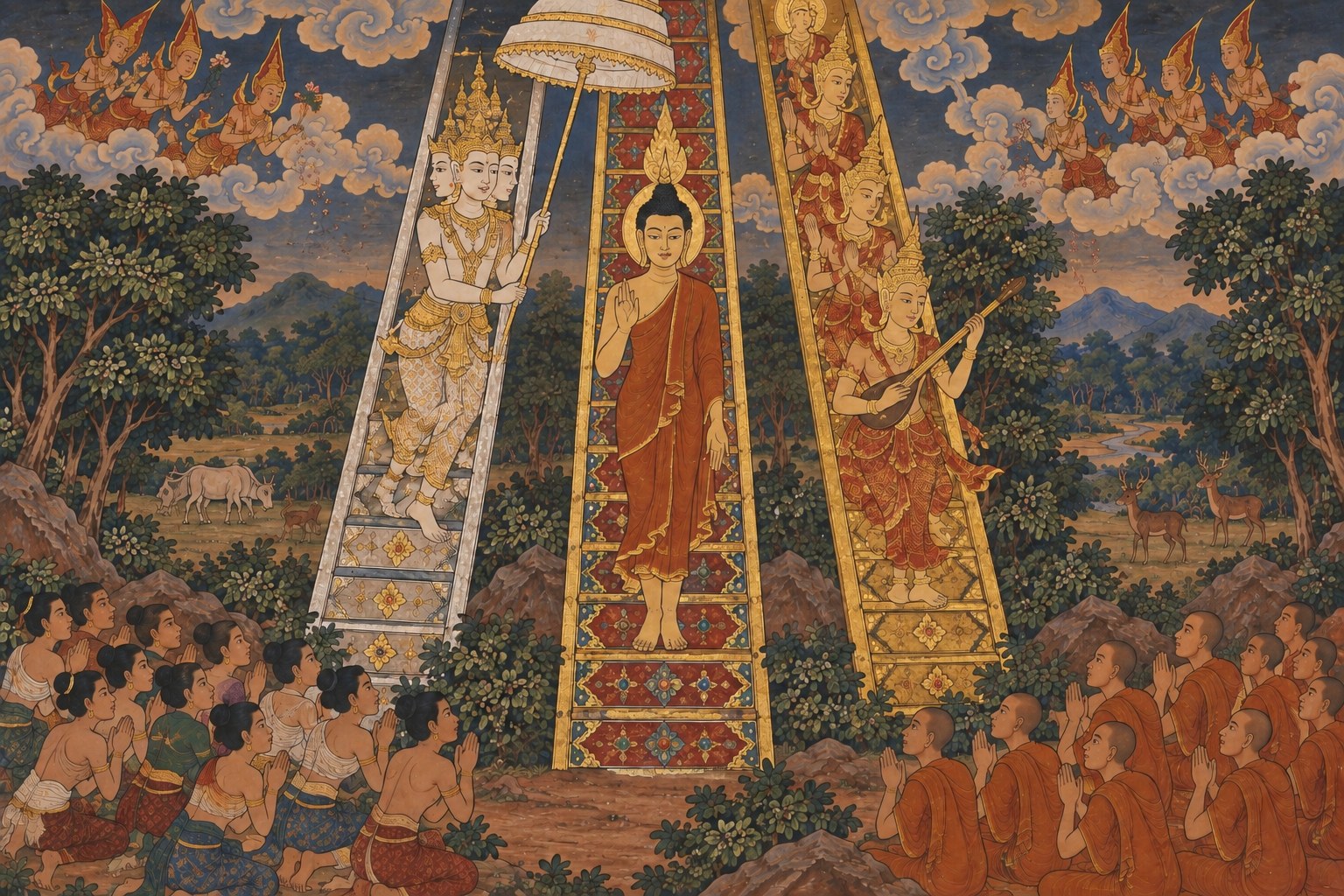
At the moment of the descent, the commentary goes on, the Buddha looked up, and all the way to the world of Brahmā everything became a single open courtyard; he looked down, as far as the deepest hell, and it was the same. “The gods saw human beings, and human beings saw the gods; all of them saw one another face to face.” That moment gives the day its popular name. And the coincidence is hard to miss: the day on which, by tradition, the worlds were opened to one another is the same day on which every monk opens himself to the others’ view.
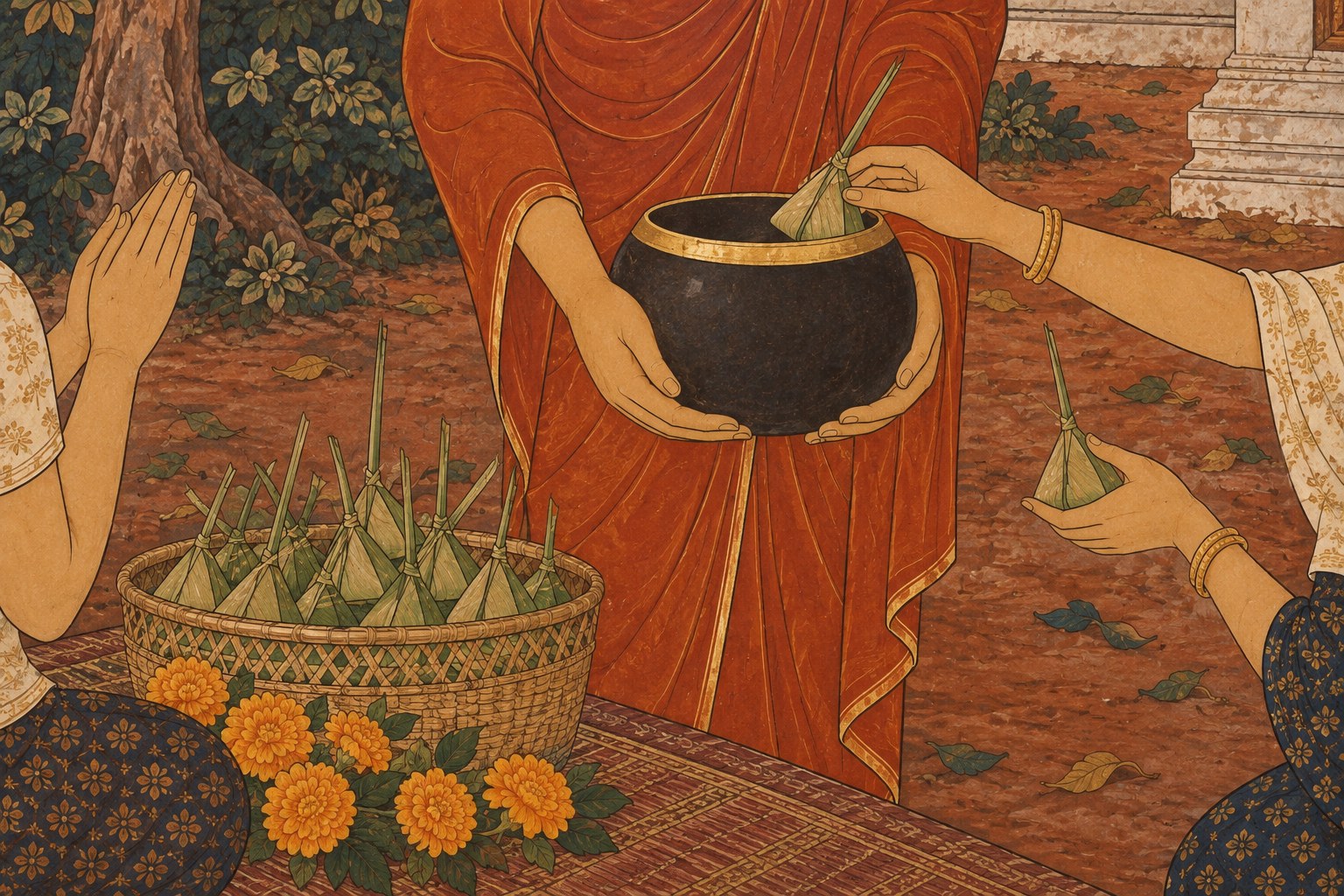
Tak Bat Devo acts it out in its own way. The monks file out to receive food as on any almsround, but on this morning they come as if down from heaven, and where there is a hill, they really do come down: at Wat Sangkat Rattana Khiri in Uthai Thani province, hundreds of monks descend the four hundred and more steps of Sakae Krang hill to the grounds where the crowd is waiting. The food of the day is khao tom luk yon, sticky rice wrapped in palm leaf with a long leaf tail. The explanation usually given is that at Saṅkassa the crowd was so vast that people could not get near the Buddha’s bowl and threw their wrapped offerings from a distance; yon means “to throw”. The parcels are placed in the bowls by hand now, but they keep their tails.
Lights on the river, and the month of robes
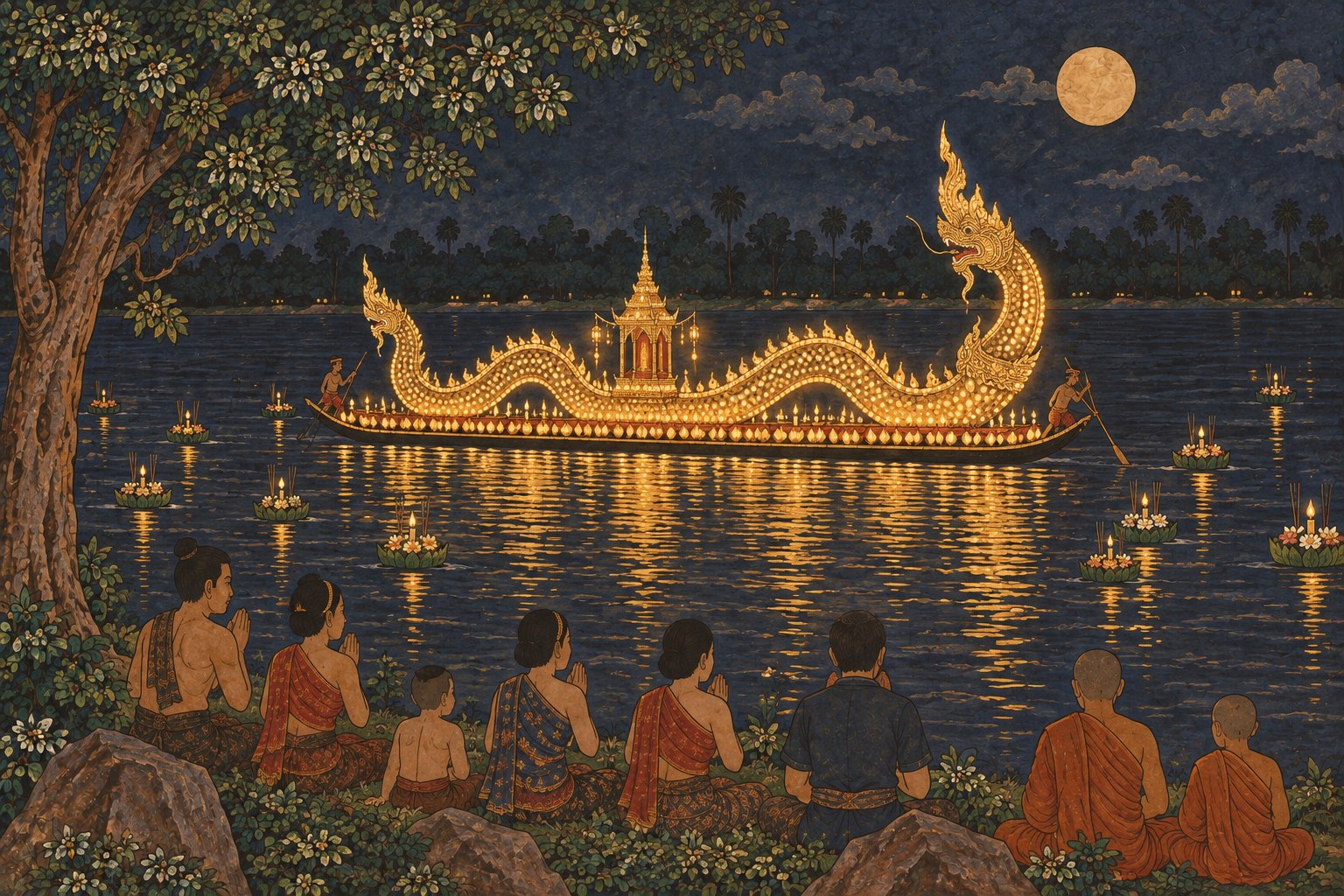
In the northeast, along the Mekong, the night of Ok Phansa has a festival of its own. In Nakhon Phanom it is Lai Ruea Fai, the procession of fire boats: great frames covered in lights, many of them in the shape of the nāga, the serpent of the river, set moving on the water after dark. Explanations differ from place to place — an offering of light to the Buddha, a gesture of respect to the river — and, as with so many Thai festivals, they sit side by side without anyone feeling the need to choose.
In the monasteries, meanwhile, another season begins. The month after Ok Phansa is the month of kathina, the offering of cloth for robes, which can be made only in that window and closes at the next full moon. It too has its story in the Vinaya. Thirty monks from Pāvā — every one of them a forest dweller who ate only what came on almsround and owned only three robes, sewn from rags — were traveling to spend the rains with the Buddha, failed to reach him in time, and had to keep the retreat at Sāketa, some eighty kilometers short. They spent it disconsolate, thinking how close he was and that they could not see him. When the rains were over and they had made the invitation, they set out while it was still raining, through mud and standing water, and reached Sāvatthī exhausted, their robes soaked through. The kathina begins with that arrival.
A monk counts his life in rains, and every one of them ends the same way: with the most senior monk in the hall squatting on his heels, palms joined, asking three times to be told what the others have seen.