

Ask why people meditate and you will mostly hear about stress, focus and sleep. Ask the tradition the practice comes from and you get a different answer entirely, and a much larger one.
In its own terms, Buddhist meditation is undertaken to realize nibbāna, and so to escape the evils inherent in existence: aging, sickness, death, and the rest. Everything else is a by-product.
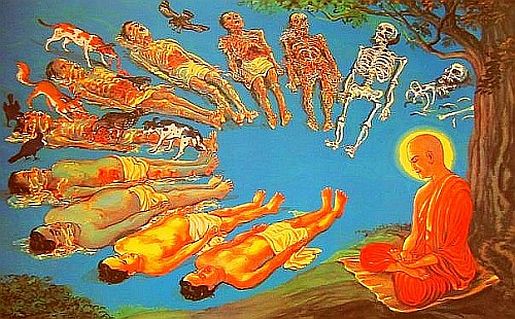
The canonical argument
The clearest statement of this I know is Mahasi Sayadaw’s, in Buddhist Meditation and Its Forty Subjects. What follows is his argument in my own words.
Every living being wants to live without harm — peacefully, happily, in some prosperity, and without aging, sickness or death. The hope is universal and it is always disappointed. Every life contains aging, sickness, sorrow and lamentation, because every life contains dangers, physical suffering and mental pain. And after all of it comes death.
But death is not an ending. Because of attachment there is birth again, and the new life is subject to aging and everything else in its turn. So the cycle repeats from one life to the next, through every kind of vicissitude, without stopping.
Look for the root of this and it becomes obvious: because there is birth, we are chained to aging, sickness, death and the rest. If those are to be avoided, birth itself has to be prevented.
And rebirth can only take place because of the attachment present in this life. A new birth is nothing more than the arising of a new consciousness, produced by clinging to a sense object at the moment of the previous death. Where there is no attachment there can be no rebirth — so if no new birth is wanted, every effort has to go toward freedom from attachment.

Attachment to life persists for two reasons: not perceiving the defects of body and mind, and not realizing that nibbāna is far superior to them.
Mahasi Sayadaw illustrates it with a man living in a barren, desolate, dangerous country. He naturally thinks well of it and is deeply attached to it, because he has no real knowledge of its defects, and no knowledge that any better condition exists anywhere else. Let him learn the facts and the country stops attracting him; he is ready to leave immediately.
It works the same way with a life. What is needed is to perceive the defects of the mind and body that constitute this one, and to understand personally the superiority of nibbāna — with the aim of removing attachment to life altogether. That knowledge is acquired through the proper practice of meditation. Which is why anyone who wants to escape aging and death, and to realize nibbāna for themselves, should take up the practice.
Ryokan’s view
That is the canonical definition, and it is worth sitting with, because in the age of I want it here and now we tend to put all the emphasis on the immediate, short-term benefits of practice and forget what it is actually for. Those benefits are real, and a good deal smaller than they are usually advertised to be.
But Buddhism is flexible in how it presents itself. The essential objective is the final state of nibbāna — and since that is something which initially requires the quality of faith, because it has to be realized personally before it can be understood, it is treated as legitimate to shift the emphasis onto benefits that are more easily perceived by people who are not Buddhist and therefore have no faith in the Buddha’s teaching to draw on.
Because even when the motivation is not entirely pure, a practice built on superficial goals is more beneficial than no practice at all.
This is exactly why so many Buddhist meditation groups have opened their doors to members of other religions. The compassionate nature of Buddhism is open to all beings; if we can share a little happiness and peace with others, it is our duty as Buddhists to do it.
Happiness never decreases by being shared.
And finally: motivations change over time, according to how far our understanding has matured. If someone starts meditating because it is relaxing, that does not mean they will not later find a higher reason. Exposure to the practice is what makes it possible to recognize the basic nature of a human being and of life — and out of that recognition, the original motive changes completely, and brings the practitioner toward the path of final liberation.
Source
The doctrinal argument above follows Mahasi Sayadaw, Buddhist Meditation and Its Forty Subjects, restated in my own words rather than quoted.
If you are at the beginning of this and the practicalities matter more than the destination right now, that is a perfectly good place to start — the beginner’s guide covers posture, the breath, and the first fifteen minutes.