

Two teachers, at most a generation apart, walked the same roads of the Ganges plain and preached before the same kings and the same merchants. The Jain scriptures know those kings under other names — Bimbisāra is their Śreṇika, Ajātasattu their Kūṇika — and the Pali canon knows Mahāvīra well, though as a rival, under the name Nigaṇṭha Nātaputta. They left behind two religions that look very alike from a distance and disagree at the root. The previous post walked through the world of wandering ascetics that both came out of; this one is about what they share and where they part.
A word on method before starting. Almost everything the Pali canon says about the Jains is a rival’s portrait, and has to be read as one. What follows tries to describe Jainism from Jain sources and from the scholars who have studied them most closely — Paul Dundas and Padmanabh S. Jaini above all — in terms a Jain reader would recognize as their own. (Quotations from the Pali canon are from Bhikkhu Sujato’s translations, on SuttaCentral. Jain texts are summarized rather than quoted.)
A founder who founded nothing
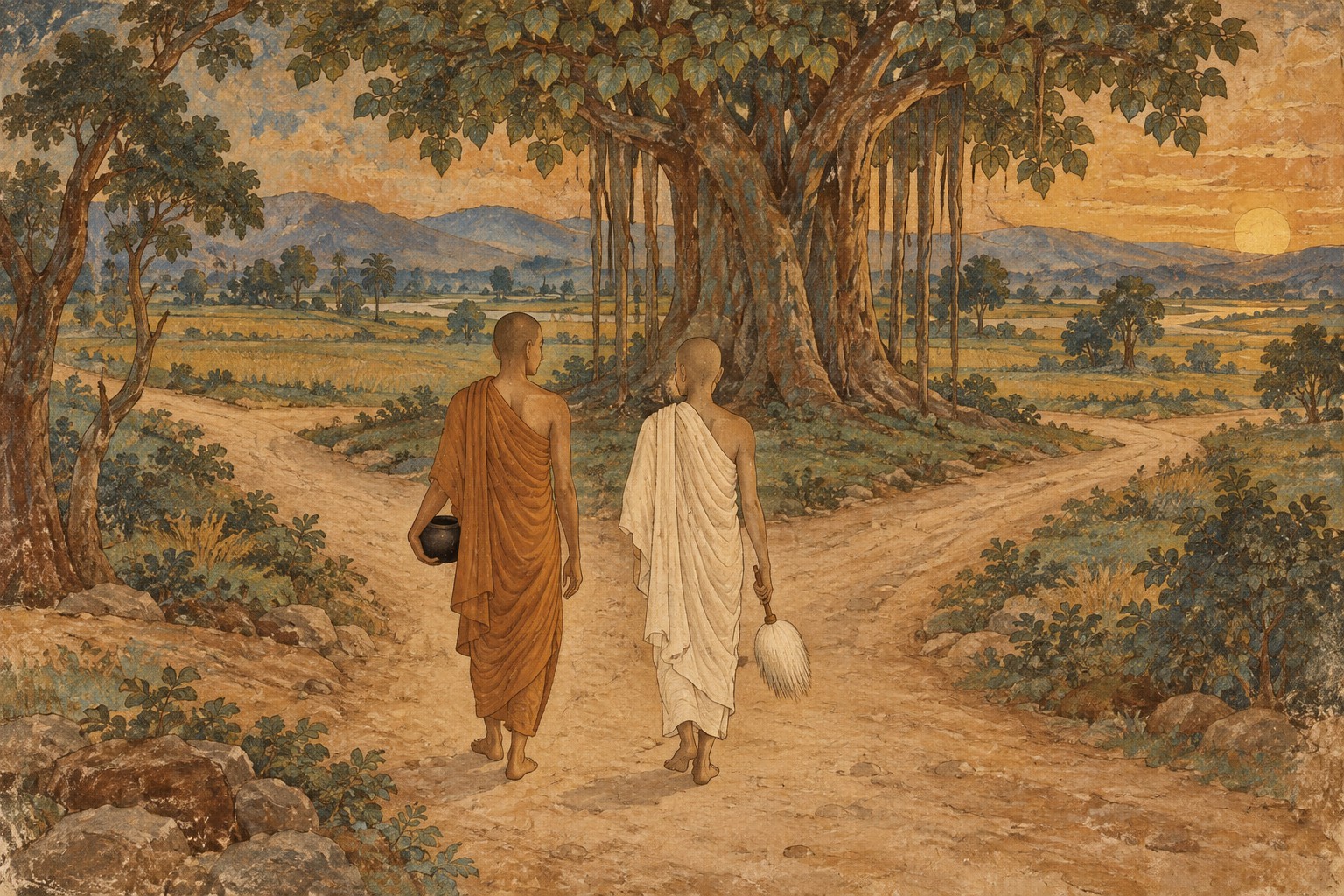
For Jains, Mahāvīra founded no religion. He is the twenty-fourth and last of the tīrthaṅkaras, the “ford-makers”, a long line of teachers reaching back into an almost mythical past, and what he did was teach again, in his own age, a truth that was already there. His immediate predecessor, Pārśva, whom tradition places some two hundred and fifty years earlier, may well have been a historical figure, and his community was still alive in Mahāvīra’s day.
A text of the Jain canon, the Uttarādhyayana, preserves a memory of the two communities living side by side. In its twenty-third chapter, Keśi, a monk of Pārśva’s tradition, and Gautama, Mahāvīra’s chief disciple, meet at Śrāvastī — the Sāvatthī of the Pali canon — and compare their rules. Pārśva’s tradition taught four vows: not to harm any living being, not to lie, not to take what has not been given, and not to own anything. Mahāvīra’s taught five, because it made chastity a vow of its own. When Keśi asks why two teachings with the same aim should differ, Gautama answers that the difference lies in the disciples: those of Pārśva’s time were straightforward and wise, and could keep the rule without every point being spelled out, while those of Mahāvīra’s time were less straightforward and needed chastity named separately. Keśi accepts the explanation and takes the five vows.
This ties off a loose end from the previous post. When King Ajātasattu tells the Buddha what Nātaputta had answered him, he calls it the “fourfold restraint”, cātuyāma. That is the same name the Jain tradition gives to Pārśva’s four vows (cāujjāma in Prakrit), even though what the king remembers is not that list. The Indologist Hermann Jacobi, who translated several of the oldest Jain texts into English, saw in this detail one of the signs that Pārśva was historical: the Buddhists could only have picked up the name from his followers. Some Jain scholars find the point less conclusive, but the case for a community older than Mahāvīra does not rest on it alone.
Buddhism has a line of its own. In one discourse (DN 14) the Buddha speaks of six Buddhas before him and tells the life of the first of them with the same episodes as his own. Both traditions present their teacher as the latest in a line, not as the inventor of something new.
Who died first?
The Pali canon tells of Nātaputta’s death three times, in three different discourses (DN 29, DN 33 and MN 104), and always in the same words: the Jain teacher had recently died at Pāvā, and his followers had split into two factions, “continually wounding each other with barbed words”, while his white-clothed lay disciples looked on, disillusioned. In each account the Buddha is still alive, and the news becomes an occasion to teach his own monks how not to end up the same way.
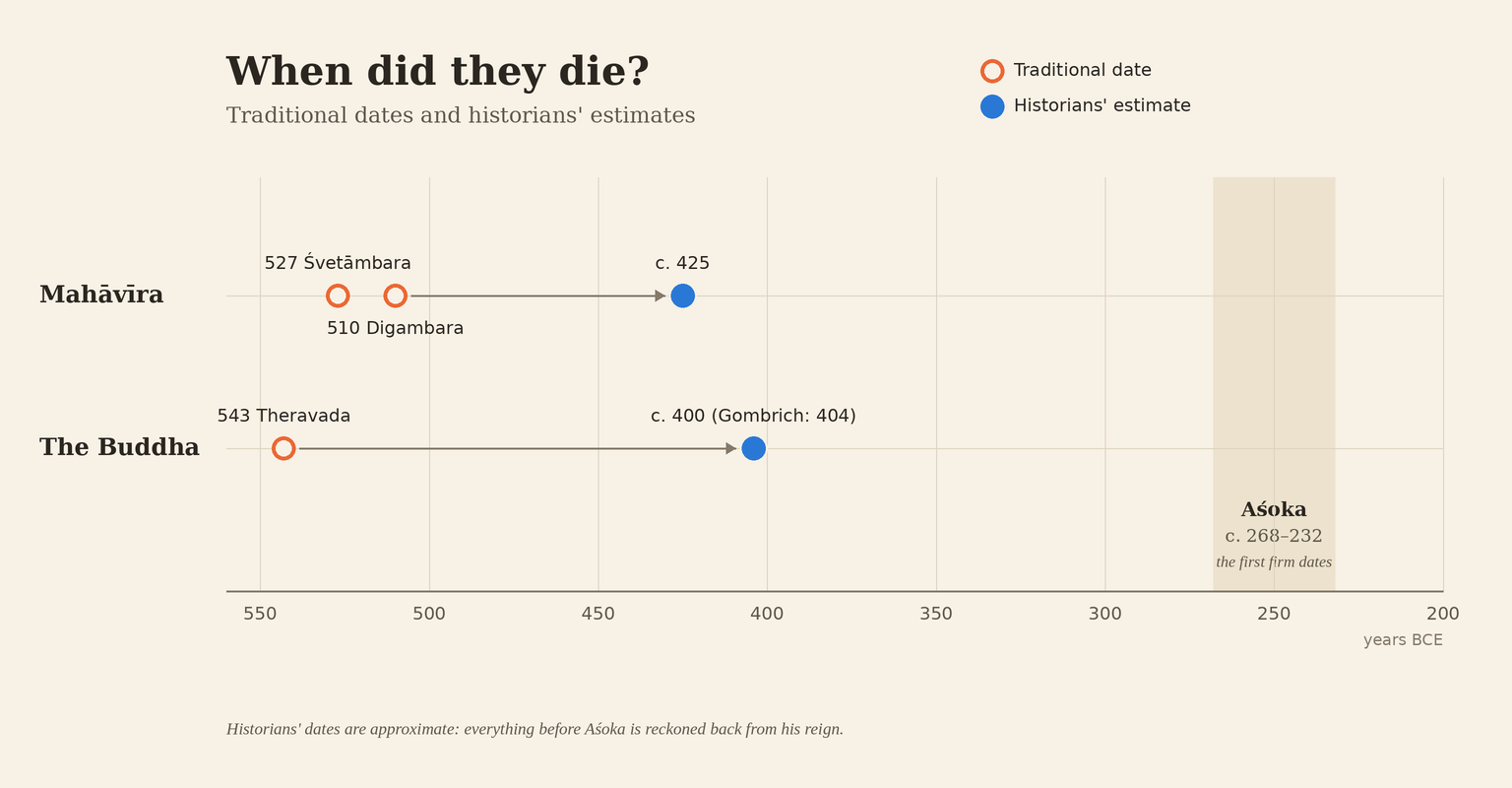
The Jain tradition places Mahāvīra’s death at another Pāvā, in Magadha, and the traditional dates on both sides tell the story the other way round: by them, he outlived the Buddha. Śvetāmbara Jains put Mahāvīra’s death in 527 BCE (Digambaras in 510), and Theravada Buddhism puts the Buddha’s in 543 BCE, which is why the Thai calendar reads 2569 in 2026.
Historians put both men considerably later. Many Indologists now date Mahāvīra’s death to around 425 BCE, as Dundas notes, and the Buddha’s to around 400; Richard Gombrich has argued for 404 as the most likely year. None of these figures is secure. The first person in this story with a firm date is Aśoka, and everything before him is reckoned backward from him, using chronicles written centuries later. But taken as they stand, the historians’ dates side with the order the Pali canon gives: Mahāvīra would have died first.
What they share
From where the brahmins stood, Buddhists and Jains were on the same side, and they have a great deal in common:
- Both reject the authority of the Vedas, the sacrifice, and birth as the measure of a person.
- Both teach karma, rebirth, and a liberation that ends them.
- Both teachers were of the warrior class and left home at about thirty: the Buddha at twenty-nine, in his own words in DN 16; Mahāvīra at thirty, according to the Jain tradition.
- Both taught in the spoken languages of the region rather than in the Sanskrit of the brahmins, and their canons were kept in Middle Indic languages: Pali and Ardhamāgadhī.
- Both built a fourfold community of monks, nuns, laymen and laywomen.
- Both keep a retreat during the rainy season (cāturmāsa, “the four months”, among the Jains) and observance days twice a month (the Jain poṣadha, the Buddhist uposatha). The Vinaya itself says that Buddhism took up both because others already kept them: the observance days because ascetics of other schools gathered to teach on the eighth, fourteenth and fifteenth of each lunar fortnight and won people over that way (Kd 2), and the rains retreat because people complained that even ascetics of other schools, and even the birds in the treetops, settled down for the season (Kd 3).
- They share a vocabulary. Jina, “victor”, is the word “Jain” comes from, and the Buddha uses it of himself when an ascetic, Upaka, asks him about his teacher: “The victors are those who, like me, have reached the ending of defilements” (MN 26). Arahant is the arihanta of Jainism’s most often recited prayer; buddha and tathāgata appear in the Sūtrakṛtāṅga, one of the oldest Jain texts; and the Vinaya calls the Buddhas “great heroes”, mahāvīra.
Where they part
The self
For Jainism, every living being has a soul, jīva, eternal and individual, whose nature is boundless knowledge, perception, bliss and energy. In ordinary existence that nature is veiled by karma; liberation means the soul, freed at last from all karma, rising to the summit of the universe and remaining there, omniscient, forever. There are infinitely many souls, and none dissolves into the others.
The Buddha, in his second discourse (SN 22.59), puts everything that might pass for a self through one simple test: “Form is not-self. For if form were self, it wouldn’t lead to affliction. And you could compel form: ‘May my form be like this! May it not be like that!'” The same goes for feeling, perception, choices and consciousness: none of it obeys, and so none of it is a self. The difference is not one of nuance. For the Jains, liberation is the soul set free at last; for the Buddha, it is ceasing to take for a self what never was one.
Karma
Both speak of karma, but they are not speaking of the same thing. For Jainism, karma is matter: an extremely subtle matter that flows toward the soul with every act of body, speech and mind, and sticks to it. The passions — anger, pride, deceit, greed — are the glue, and they decide how firmly and for how long it stays. Jains call that inflow āsrava. It is the same word as the Pali āsava, which in the suttas names the defilements of the mind — the “defilements” whose ending, the Buddha told Upaka, makes a victor. One word, on two neighboring paths, for two different things.
For the Buddha, karma is intention: “It is intention that I call deeds” (AN 6.63). One discourse (MN 56) stages the difference. A Jain ascetic explains to the Buddha that Nātaputta distinguishes three “rods” by which harm is done — of body, of speech and of mind — and that the rod of the body is the most blameworthy. The Buddha answers that of the three kinds of deed, the deed of the mind is the most blameworthy. Upāli, a wealthy Jain layman, sets out to refute him on his teacher’s behalf and comes back convinced of the opposite. The sutta ends with Nātaputta spewing hot blood when he hears the news — which is, once again, the rival’s portrait.
Nor would it be fair to say that intention counts for nothing among the Jains: it is the passions that decide how much karma binds and for how long. But in Jainism the act itself also weighs, not only the wanting, and that is why outward care — where one steps, what one eats, how one drinks — stands at the center of the practice. For the Buddha, what binds is intention, and everything is decided in the mind.
The path
If karma is matter stuck to the soul, getting free requires two things: shutting out what is coming in, and shedding what is already attached. The first is done through restraint; the second, above all, through austerity, tapas, which burns off the karma already accumulated. That is the reason for Jain asceticism, and the Buddha knew it from the inside. During the six years he spent searching before his awakening, he followed a discipline the canon describes in detail (MN 12): “I went naked, ignoring conventions. I licked my hands, and didn’t come or stop when asked. I didn’t consent to food brought to me, or food prepared specially for me, or an invitation for a meal.” And: “I tore out hair and beard.” The list reads very much like the Jain discipline of the time, and part of it is still alive: Jain ascetics still pull out their hair by hand.
The Buddha left all that behind, and several discourses argue directly with those who had not. In one (MN 14), Jain ascetics practicing standing up, refusing to sit, tell him: “Reverend Gotama, pleasure is not gained through pleasure; pleasure is gained through pain.” In another (MN 101) they set out their doctrine: “Everything this individual person experiences — pleasurable, painful, or neutral — is because of past deeds. So, due to eliminating past deeds by fervent mortification, and not doing any new deeds, there’s nothing to come up in the future.” The middle way of the first sermon (SN 56.11), which avoids both the extreme of indulgence and the extreme of self-mortification, reads more clearly against this background. It is not a compromise between two opinions but an answer to ascetics of flesh and blood; and the effort it puts in their place, neither slack nor strained, is the effort of Soṇa’s lute.
“Jainism is self-mortification” is, for all that, the Buddhist polemic, not a description. Jain austerity has six outward forms — fasting, eating less, limiting what one accepts, giving up rich tastes, withdrawing to secluded places, bearing bodily hardship — and six inward ones: expiation, humility, service to others, study, letting go of the body, and meditation (Tattvārtha Sūtra 9.19–20). Half of that list could hang on the wall of any Buddhist monastery.
Non-violence
Both traditions teach not to harm, but Jain ahiṃsā reaches much further. For Jains, life — and so the capacity to be harmed — belongs not only to animals but also to beings with a single sense: plants, and beings whose bodies are earth, water, fire or air. Hence the small broom with which ascetics clear the ground of anything living before they sit or step, the cloth over the mouth that some of them wear, the boiled water, the custom of not eating after sunset, when one can no longer see what is on the plate. The Vinaya knows a smaller version of the same care: it allows monks to carry a water filter (Kd 15), because they must not use water with living beings in it.
Truth
Over the centuries, Jain philosophy developed the doctrine of anekāntavāda, which might be rendered “the doctrine of many sides”: reality is complex, every point of view grasps something true from where it stands, and none grasps the whole. Faced with the great speculative questions of his time — whether the world is eternal or not, whether a realized one exists after death — the Buddha took another line: he set them aside, because they do not lead to liberation.
The two attitudes meet in a single story. The blind men and the elephant appears for the first time in the Udāna (Ud 6.4). A king of Sāvatthī has all the people in the city who were born blind gathered together and shown an elephant: some the head, some the ear, the tusk, the trunk, the flank, the leg, the thigh, the tail or the tip of the tail. Then he asks them what an elephant is like. To those who touched the head it is like a pot; to those who touched the ear, a winnowing fan; the tusk, a plowshare; the tail, a pestle; the tip of the tail, a broom. And they end up punching each other, shouting, “Such is an elephant, not such! Such is not an elephant, such is!” The Buddha tells the story about the wanderers of other schools, who argued without end, and closes it with a verse: “Some ascetics and brahmins, it seems, cling to these things. Arguing, they dispute, the folk who see just one part.”
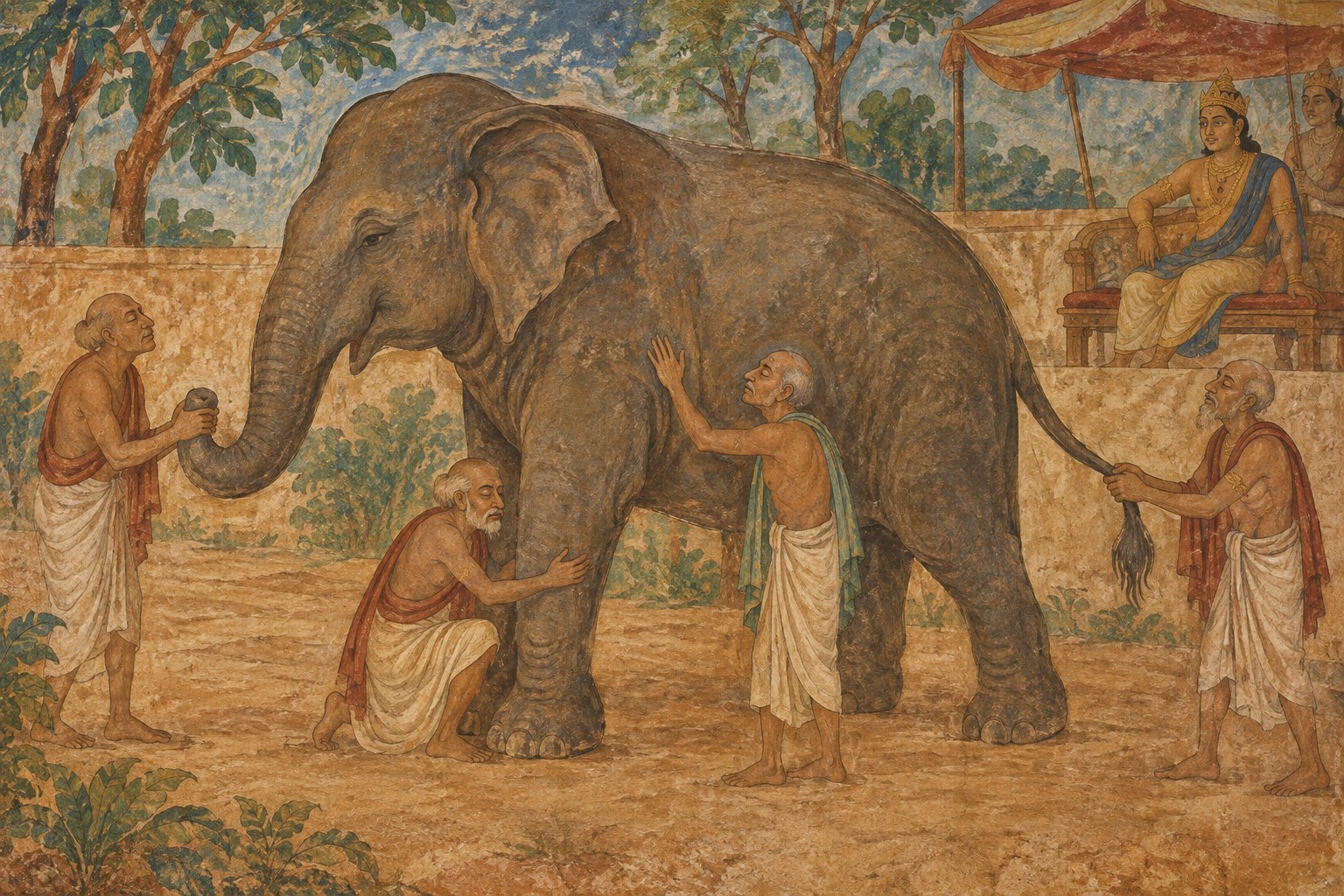
Centuries later, Jain writers made the same story the emblem of anekāntavāda. For the Buddha, the moral is that whoever touches one part should not cling to it; for the Jains, that every part is true from where it is touched. It is the same story with two morals.
Two fates
According to the Jain tradition, Chandragupta Maurya, founder of India’s first great empire, ended his life as a Jain monk in the south, at Śravaṇabeḷagoḷa, beside his teacher Bhadrabāhu. Historians debate it, but his memory is still honored there. His grandson Aśoka became the great Buddhist king.
After that, the paths truly part. Buddhism spread across Asia — Sri Lanka, Southeast Asia, China, Korea, Japan, Tibet — and in India almost vanished: by the thirteenth century, with the great northern monasteries such as Nālandā destroyed, very little of it remained. Jainism, by contrast, never left India until the modern diaspora, and never disappeared from it; the 2011 census counted close to four and a half million Jains in the country.
The usual explanation is its lay community. The Jain monk depends on lay people for everything and lives very close to them; lay Jains have vows, fasts and observance days of their own, and the religion is a matter of families and merchants as much as of ascetics. When the great Buddhist monasteries fell, much of Indian Buddhism fell with them; Jainism had never depended so heavily on its monasteries. It should be conceded that historians give other causes too — the loss of royal patronage, the strength of devotional Hinduism, the invasions — and that none is enough on its own. But the heart of it is close to what came up in the post on custom and conviction: the custom of a lay community holds up what the conviction of a few cannot hold up alone.
In the forest
Anyone who has spent time at a forest monastery in Thailand will have seen something that recalls Jain austerity. Many monks of that tradition keep the dhutaṅga, optional ascetic practices: eating once a day and from a single bowl, living at the foot of a tree or in a charnel ground, spending the night sitting up rather than lying down, wandering the forest for months from place to place. From the outside the practices look alike. The difference is in the theory. No one imposes them, they do not burn off accumulated karma, and their whole purpose is simplicity and contentment with little; they are taken up while they help and set down when they stop helping.
The bowl stays full
When Upāli, the wealthy Jain layman, declared himself a follower of the Buddha, the Buddha told him something no one would expect from a teacher who had just won a disciple from his rival: “For a long time now, householder, your family has been a well-spring of support for the Jain ascetics. You should consider giving to them when they come.” Upāli, the sutta says, was all the more delighted. The two paths disagreed at the root — on the self, on karma, on the way to freedom — and still the bowl stayed full.