

The Soṇa Sutta, the fifty-fifth discourse in the Book of the Sixes of the Aṅguttara Nikāya, tells how the Buddha taught a monk who was trying too hard, and how he did it with a question about a stringed instrument. The image that came out of that conversation — a string that should be neither too tight nor too slack — is one of the most quoted in Buddhism, and it is almost always quoted as permission to ease off. The sutta says something more exact. A tuned string is not halfway between a snapped string and a silent one. It is under tension, sometimes a great deal of it, and the right tension is not a midpoint to be calculated but a point to be found by ear.
The softest feet in Campā
The sutta calls him simply Soṇa. The Vinaya, the monastic code, tells the same story at greater length in its chapter on footwear, and gives his full name: Soṇa Koḷivisa, the son of a wealthy merchant of Campā, raised in such comfort that hair had grown on the soles of his feet. When King Bimbisāra summoned him to court, his parents warned him that what the king wanted was to see those feet.
On that visit Soṇa heard the Buddha teach, understood that a life lived at home could not be a spiritual life “complete and pure as a polished shell,” and asked for ordination. Soon afterward he was living in Sītavana, the Cool Grove, outside Rājagaha, and practicing walking meditation — caṅkama, the slow pacing back and forth along a straight path that is part of every forest monk’s day — with so much energy that his feet split open. The path, the text says, was smeared with blood like a place where cattle are slaughtered.
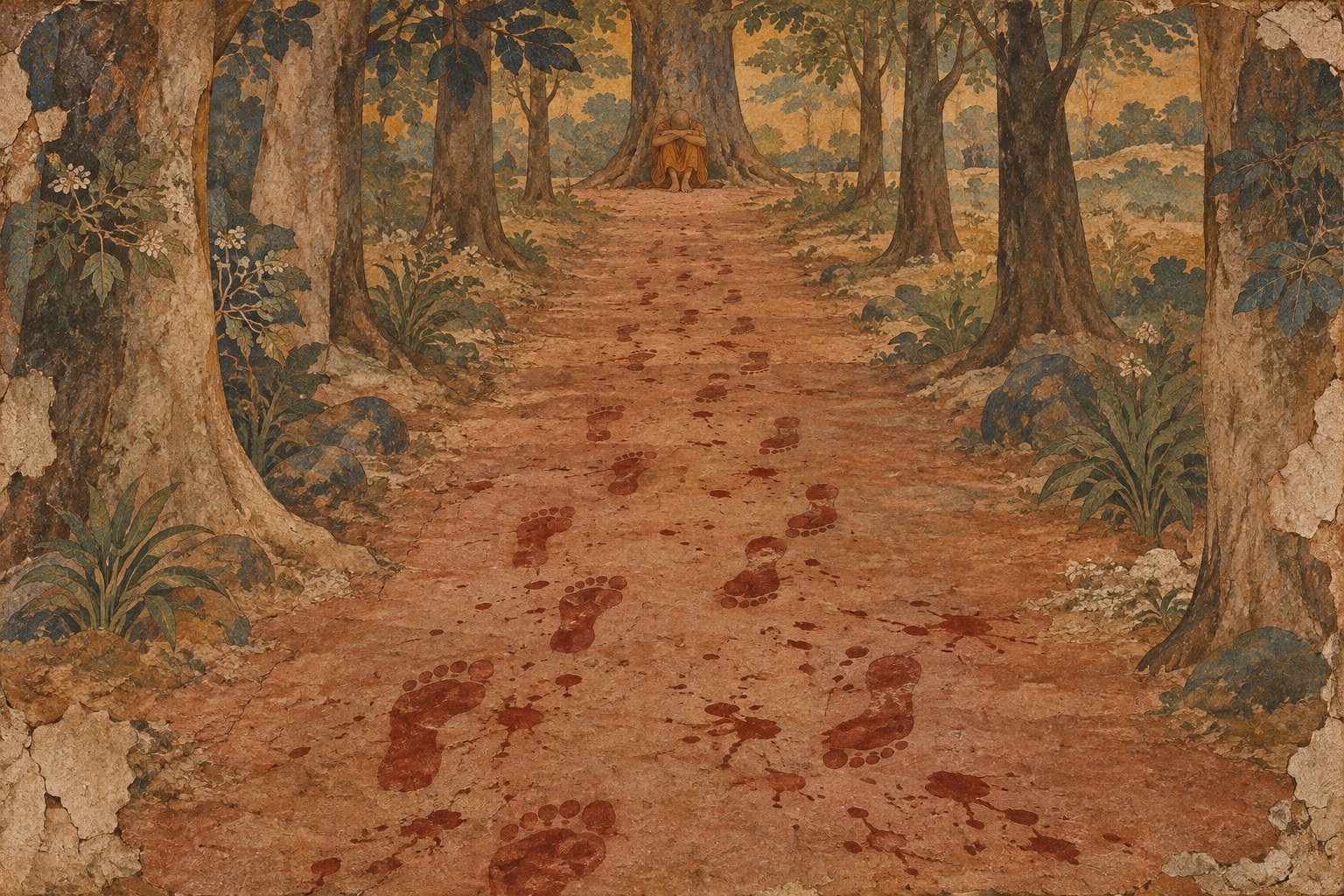
It was then, alone, that a thought came to him, which the sutta records like this (quotations from the suttas and the Theragāthā here are from Bhikkhu Sujato’s translations, on SuttaCentral):
I am one of the Buddha’s most energetic disciples. Yet my mind is not freed from defilements by not grasping. But my family has wealth. I could enjoy that wealth and make merit. Why don’t I resign the training and return to a lesser life, so I can enjoy my wealth and make merit?
It is worth looking at how that thought is built, because it is not quite the thought of someone giving up. Soṇa does not think about resting or enjoying himself; he thinks about making merit — about doing good another way. And it opens with a portrait of himself as one of the most energetic. The way out that occurs to someone who has pushed too hard rarely presents itself as quitting. It presents itself as a better plan.
A question about a harp
The Buddha knew the thought and went to see him. In the Vinaya’s version he first passes the bloodied path with a group of monks and asks whose it is. Then, seated in front of Soṇa, he says nothing about meditation. He asks about the life Soṇa had left:
“What do you think, Soṇa? When you were still a layman, weren’t you a good player of the arched harp?”
“Yes, sir.”
“When your harp’s strings were tuned too tight, was it resonant and playable?”
“No, sir.”
“When your harp’s strings were tuned too slack, was it resonant and playable?”
“No, sir.”
“But when your harp’s strings were tuned neither too tight nor too slack, but fixed at an even tension, was it resonant and playable?”
“Yes, sir.”
“In the same way, Soṇa, when energy is too forceful it leads to restlessness. When energy is too slack it leads to laziness. So, Soṇa, you should focus on energy and serenity, find a balance of the faculties, and learn the character of this situation.”
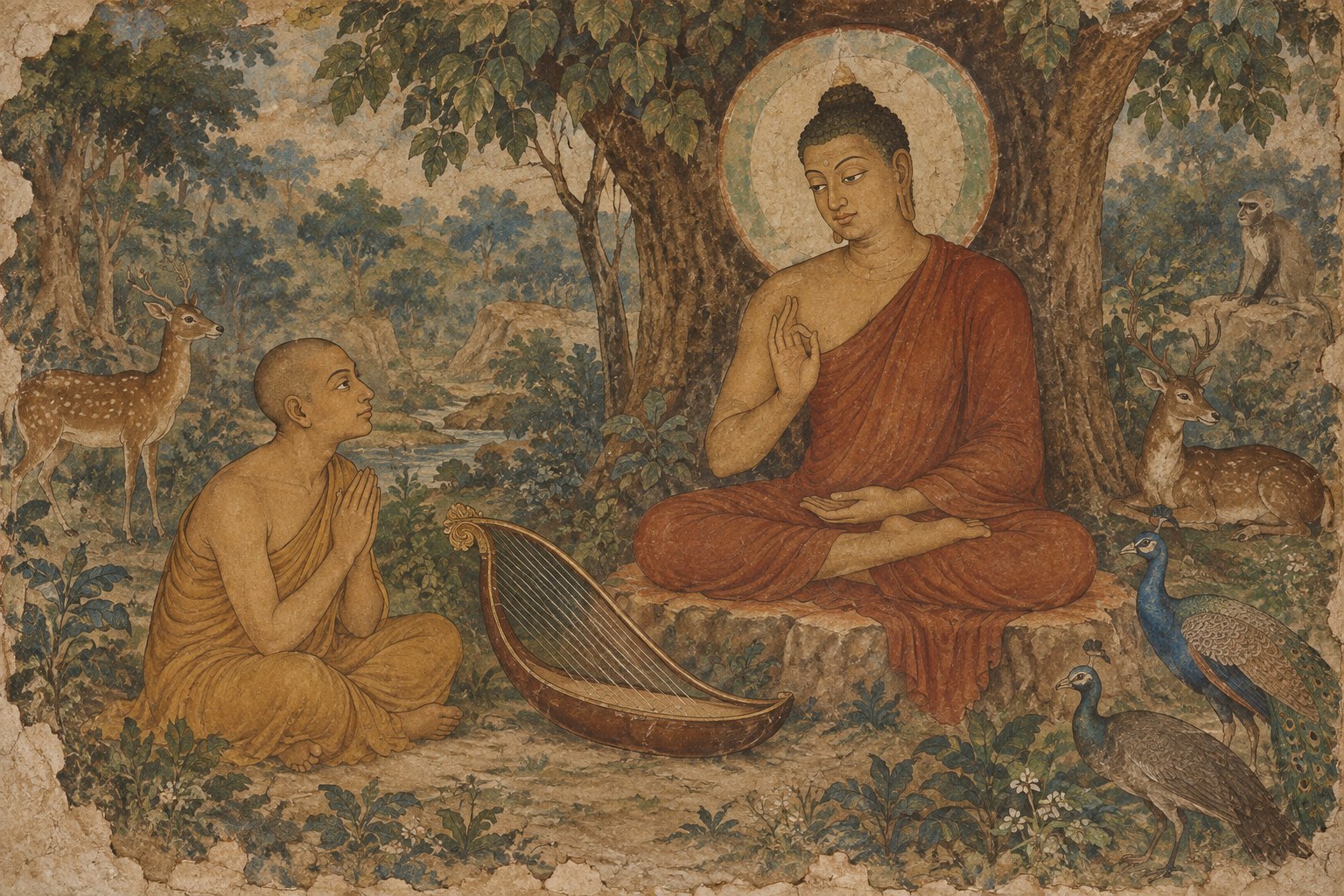
A word about the instrument, since Sujato’s “arched harp” will surprise anyone who knows this as the simile of the lute — which is what most translations say, and what the title of this piece says too, because that is how the story is known. The vīṇā of the Buddha’s time was not a lute. It was an arched harp: a small boat-shaped body held in the lap, with a curved neck rising from it like a bow and several strings stretched between the two. That is how it appears in the oldest Buddhist reliefs in India, at Bharhut in the second century BCE. The name passed, centuries later, to other instruments, among them the long-necked lute of South India still called the veena, and the wrong picture traveled with the name.
Notice, too, what the Buddha actually asks. Not whether the harp sounded pretty, but whether it was saravatī, resonant, and kammaññā, playable — a word built on kamma, “work”, meaning fit for work, workable. It is not a word reserved for instruments. The suttas use the same root for the concentrated mind, “pliable, workable, steady, and imperturbable” in the Sāmaññaphala Sutta (DN 2), and for gold in the hands of a good goldsmith, in a discourse worth reading beside this one (AN 3.102). The goldsmith fans the fire from time to time, sprinkles the gold with water from time to time, and simply watches it from time to time; do only one of the three and the gold burns, or cools, or never refines. Alternated as the metal requires, the gold becomes “pliable, workable, and radiant, not brittle.” The tuned string, the concentrated mind and the worked gold share a single quality: something can be done with them.
Tuned, not halfway
The Middle Way is usually explained as a philosophical position. In the first discourse the Buddha presents it as the path that avoids two extremes, indulgence in sensual pleasure and self-mortification, and that is true and it matters. But in Soṇa’s story the Middle Way is not a thesis about life. It is a practical, almost technical question about the energy with which a person sits or walks, and here the image of the string says something the word “middle” hides.
A tuned string is not halfway between a slack one and a broken one. It is taut — a slack string makes no sound at all — and the tension it needs depends on the instrument, the string, the note it has to give, and even the weather: heat and humidity shift it, and musicians retune before every piece and sometimes in the middle of one. Nobody tunes by measuring. You tune by ear. That seems to be what the last phrase of the advice is asking for — tattha ca nimittaṁ gaṇhāhi, “learn the character of this situation”, or more literally “take up the sign there”: learn to recognize what the right tension feels like, because there is no number that will tell you, and if there were, it would be a different number tomorrow.
That the lesson was not “try less” the texts make plain. After the advice, Soṇa lived “alone, withdrawn, diligent, keen, and resolute” — the stock phrase the canon uses for any monk who takes the practice seriously — and soon reached the goal. Later, in the list where the Buddha names the foremost of his disciples in each quality, the foremost among the energetic is Soṇa Koḷivisa (AN 1.205). And in the verses attributed to him in the Theragāthā (Thag 13.1), Soṇa remembers the harp —
When my energy was over-exerted,
the supreme Teacher in the world
created the simile of the arched harp for me.
— immediately after a verse with nothing slack about it:
The straight path has been explained—
go on it and don’t turn back.
Urge yourself on
and take yourself to extinguishment.
The monk who had to learn to loosen the string never stopped pushing himself. He learned to push in a way that made a sound.
There is even a textual detail pointing the same way. Where the Vinaya reads vīriyasamataṁ, “evenness of energy”, the edition of the sutta on SuttaCentral reads vīriyasamathaṁ, which is why Sujato has “energy and serenity”. The difference is one letter, an h that aspirates the consonant, and both readings make sense. Neither of them says “less energy”.
Two ways to go out of tune
The sutta is precise about what each mistake produces. Too much energy leads to uddhacca, restlessness — the same word that names part of one of the five hindrances to meditation — and too little leads to kosajja, laziness. What makes both hard to catch is that neither looks like a mistake from the inside. Overstriving looks very much like virtue: it feels like commitment and seriousness, and it produces a tight face and shoulders, headaches, a mind that speeds up instead of settling, and, sooner or later, quitting. Slackness looks very much like relaxation: it feels like letting go, like not forcing, and it produces drowsiness and a pleasant fog in which nothing happens. Hardly anyone stays at one extreme. The usual pattern is to swing between them.
Buddhaghosa, in the Visuddhimagga, turned the second part of the advice — balance the faculties — into a short manual. The faculties are balanced in pairs. Faith against understanding, because faith without understanding trusts without grounds, and understanding without faith turns merely clever. Energy against concentration, because concentration tends toward idleness and energy toward agitation, and only together do they avoid both. Mindfulness, sati, is the exception: there is never too much of it, because it is what keeps the mind from tipping to either side (Visuddhimagga IV, in Ñāṇamoli’s translation). It is the same string, seen from the inside.
I know the swing from my own practice. When I started meditating, in the stretches when motivation ran high I overexerted myself: I set ambitious practice goals I could not sustain, and when I could not keep up with them, a period of low motivation followed that dragged the practice the other way. It was the textbook oscillation, though I would not have called it that then. What changed it was understanding that a practice cannot run on motivation. A well-planned structure — a practice that grows by deliberate increments — and discipline and consistency in place of enthusiasm gave me far better results than any burst of fervor ever did. The turtle that serves as this site’s mascot is a wink at exactly that: the fable of the tortoise and the hare, and my own move from the over-eager hare I began as to a slower, steadier practice. How Long Should You Meditate? makes the same case for consistency over intensity, and in Working With Pain in Meditation the pain of my first weeks at Wat Pah Nanachat came, in large part, from having raised the intensity of my practice too quickly.
Outside the monastery
Psychology has its own version of the string, and it is worth telling carefully because it is usually told wrong. In management books and stress workshops it appears as the Yerkes–Dodson law: an inverted U, on which performance rises with arousal, pressure or stress up to an optimal point and falls away after it. The original paper, by Robert Yerkes and John Dodson, was published in 1908 and was about something narrower. Forty dancing mice had to learn to choose between two boxes, one light and one dark, and received an electric shock when they chose wrong. The researchers varied the strength of the shock and the difficulty of the discrimination. When the discrimination was easy, the stronger the shock, the faster the mice learned; when it was hard, they learned best with moderate or weak shocks. The authors’ conclusion was about the difficulty of the task, not about stress in general. It was later generations of researchers and textbook writers who turned the result into a law about anxiety, motivation and pressure, mostly without saying so and often crediting Yerkes and Dodson with claims they never made — as the Norwegian psychologist Karl Halvor Teigen showed in a 1994 paper whose title says it all: “Yerkes-Dodson: A Law for All Seasons.”
The intuition survives the correction. That too much pressure spoils difficult work and too little produces nothing is something anyone can confirm; what does not exist is a precise curve telling you where the point is. And the original detail, oddly enough, is the one closest to Soṇa: the finer the task, the more harm excess pressure does. Few tasks are as fine as watching one’s own mind.
The lay version of Soṇa’s feet has had a name since the 1970s. The clinical psychologist Herbert Freudenberger began writing about “burn-out” in a 1974 paper drawn from what he saw among the volunteer staff of a free clinic for people with addictions, himself included — people who were not there for money but because they believed in the work, and who wore themselves out for exactly that reason. It should be conceded that the term has a narrower meaning now: the World Health Organization describes burnout as an occupational phenomenon rather than a medical condition, and asks that it not be applied to other areas of life. But the shape of the thing is recognizable outside an office. It is usually the most committed person who burns out, not the most indifferent, and the way out they imagine rarely presents itself as defeat. It presents itself, as Soṇa’s did, as a more sensible way of doing good.
The string in the murals
There is another way of telling the story of the string, and it is the one more people know. Temple murals in Thailand and across Southeast Asia paint, again and again, a scene from the Buddha’s life before his awakening: the Bodhisatta, wasted by years of fasting and austerities, sits in the forest, and in the sky above him the god Indra — Phra In, as Thais call him, the Sakka of the Pali texts — plays a three-stringed lute. The first string, too tight, snaps; the second, too slack, makes no sound; the middle one, well tuned, rings clear. Hearing it, the Bodhisatta understands that self-torment leads nowhere and gives up the austerities. Western readers are more likely to remember it from the cinema: in Bernardo Bertolucci’s Little Buddha (1993), Siddhartha overhears a musician on a passing boat telling his pupil that a string tightened too far will snap and one left too slack will not play.
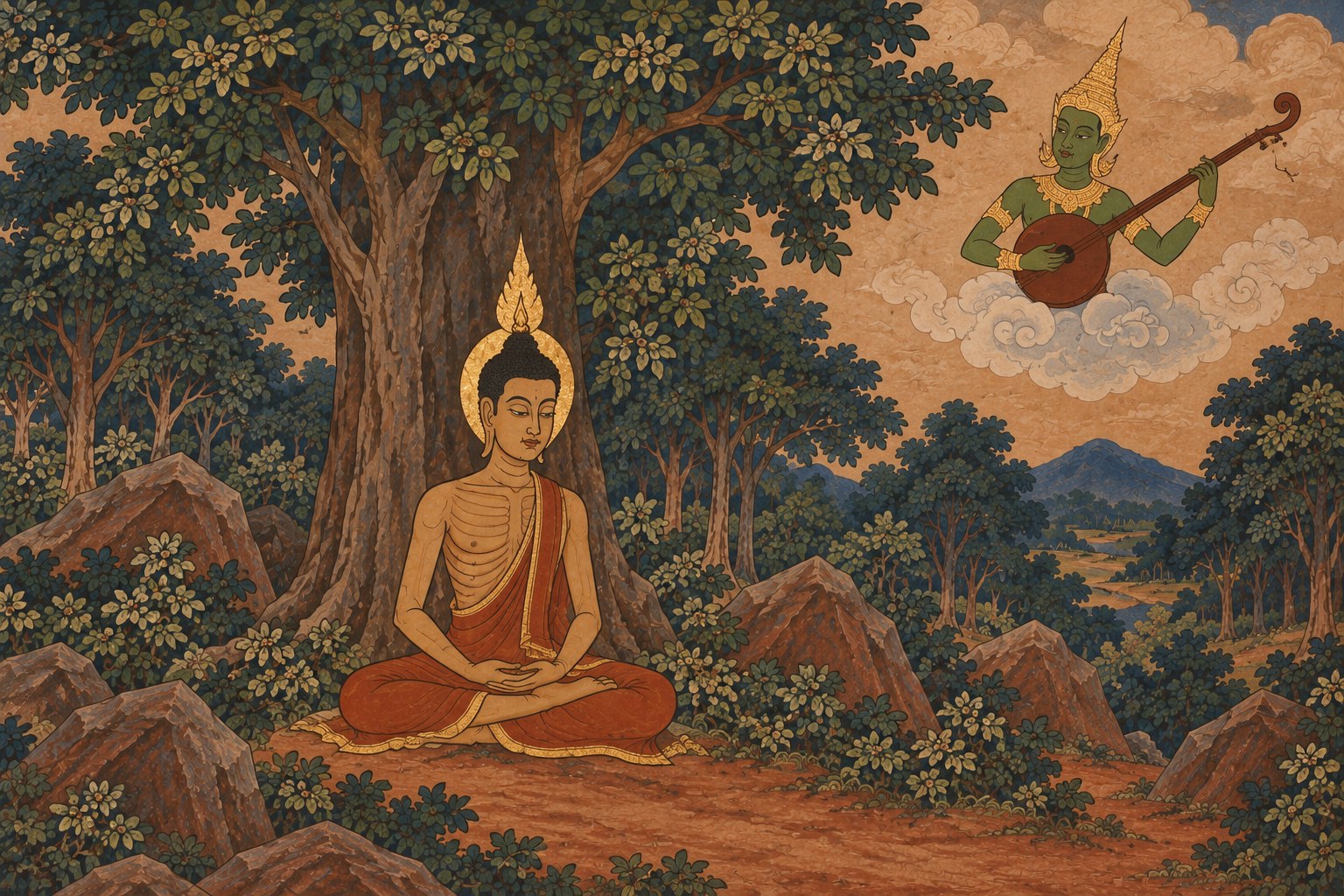
Neither version is in the Pali canon. There the Bodhisatta gives up the austerities on his own, remembering a moment of calm he once knew sitting in the shade of a tree while his father worked (MN 36), and no string is involved. Where the string does appear is here, in the mouth of the Buddha after his awakening, addressed to a monk making a mistake much like the one he had once made himself. Later tradition gave the Buddha a music lesson. The canon has him give one.
Sandals
The Vinaya does not end the story with Soṇa’s awakening, but with a pair of sandals. When Soṇa came to declare to the Buddha that he had reached the goal, the Buddha told him: “You are delicate, Soṇa. I allow you to wear sandals with a single sole.” Soṇa would not take them. When he went forth, he said, he had left behind eighty cartloads of gold coins and a troop of seven elephants, and people would say that after leaving all that he was now attached to a pair of single-soled sandals. If the Buddha allowed them to the whole community of monks, he would wear them too; if not, neither would he. The Buddha gave the monks a teaching and allowed them to everyone. (The Vinaya passages here are rendered from the Pali; Bhikkhu Brahmali’s translation is on SuttaCentral.)
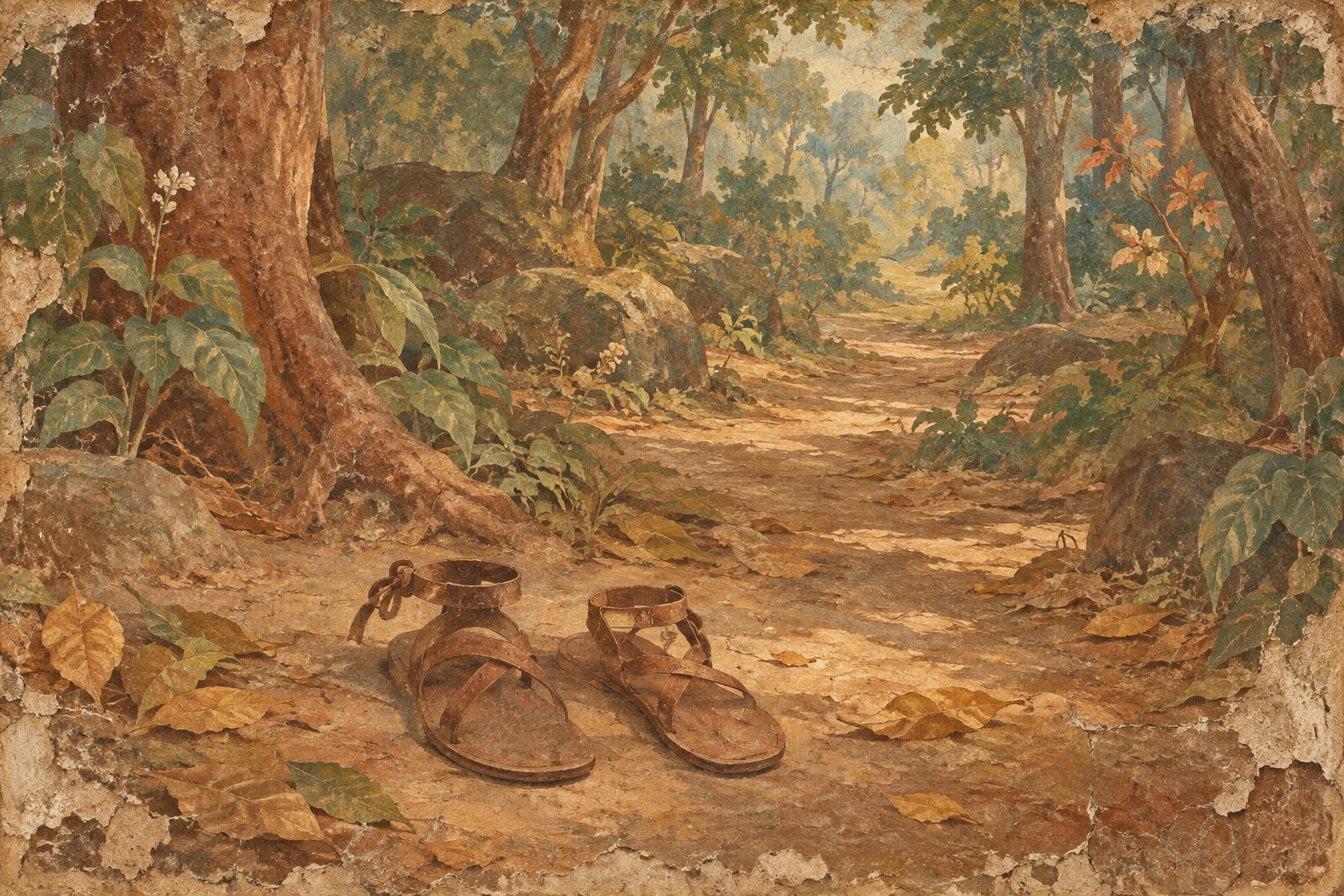
There is something exact about that ending. The thought that nearly made Soṇa give up began with a portrait of himself as one of the most energetic disciples; the monk who comes back at the end refuses to be an exception and accepts the relief only once it belongs to everyone. Monks have been allowed sandals ever since, and the permission comes from a pair of feet that split open on a walking path in the Cool Grove. What the Buddha taught Soṇa with a harp was not to try less, but to listen for whether the string rings.