

On the night of the full moon in the twelfth lunar month, people all over Thailand go down to rivers, canals and ponds and set a krathong on the water: a small float made from a slice of banana trunk, ringed with banana leaves folded into lotus petals, with flowers, three sticks of incense and a candle in the middle. The candle is lit, a wish is made or a pardon asked, and the float is let go. That is what loy (also written loi) means — to float, to let the water take it. Ask what it is all for and the answers come several at a time, often from the same person in the same breath. Loy Krathong is usually described as a Buddhist festival, and in part it is one, but by adoption. The lights on the water are older than the Buddhist reasons later given for them, and the person who explained this best was a king of Siam.
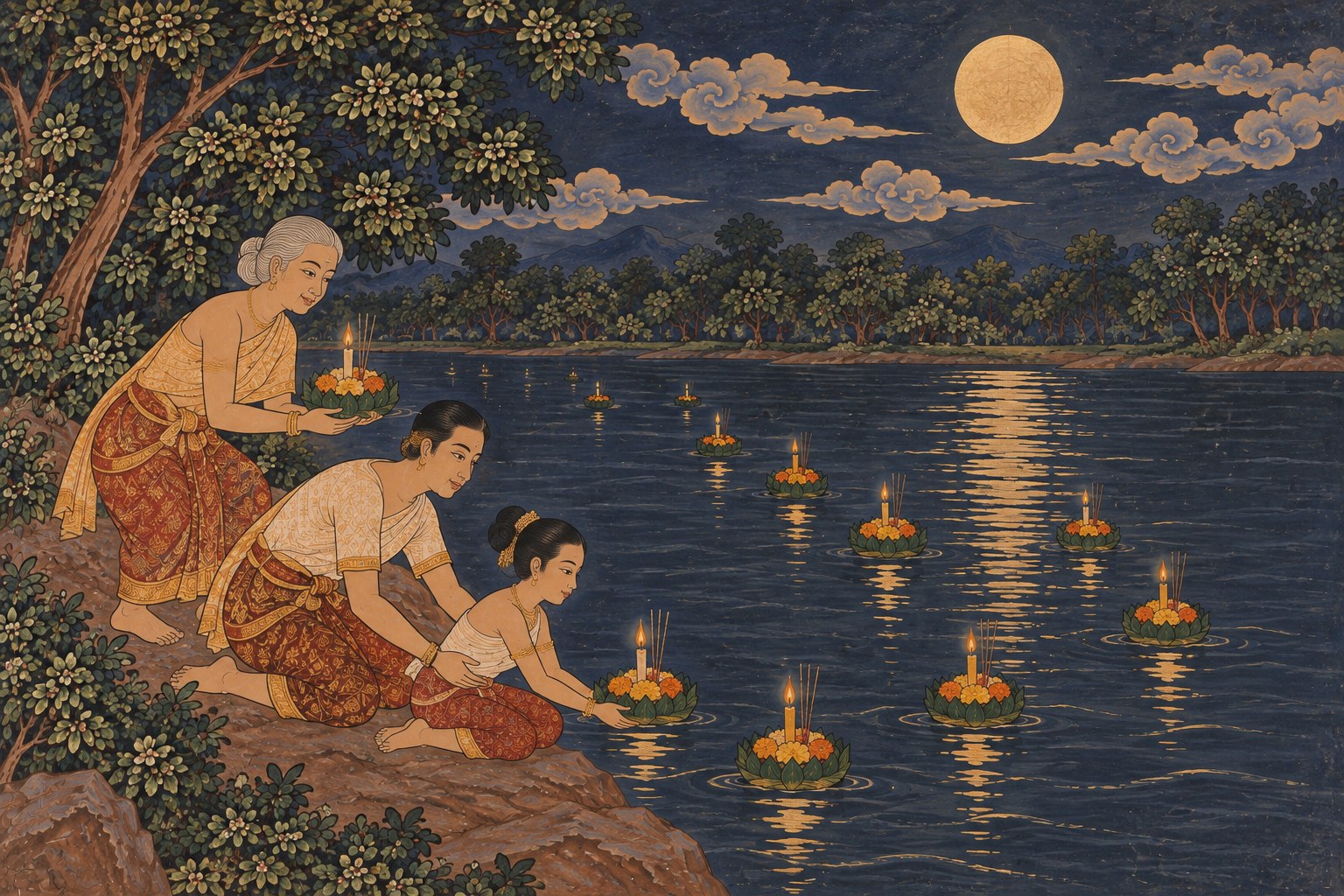
In 2026 Loy Krathong falls on Tuesday, November 24. Because it follows the lunar calendar the date moves from year to year, though it nearly always lands in November; the Tourism Authority of Thailand announces it well ahead, along with what each province is holding. In the monasteries the same night is an uposatha, an observance day like that of every other full moon — the monks recite their code of discipline, and lay people who so wish keep the eight precepts — and it is also the last day of the month of kathina, the offering of robe-cloth that opened at Ok Phansa. No text in the Pali Canon mentions the festival.
Four answers on one riverbank
The most common answer is an apology. The krathong is offered to Phra Mae Khongkha, the mother goddess of the waters — her name is the Ganges, Gaṅgā — in thanks for a year’s water and in apology for having used and fouled it. Another answer is Buddhist: the floats honor a footprint the Buddha left on the bank of a river in India, the Nammadā. A third is more practical. A lock of hair goes into the krathong, or a few nail clippings, or a coin, and the year’s bad luck goes downstream with them; in Thai this is loi khro, floating away misfortune. The fourth answer is rarely given, though it lies beneath the other three: lamps on the water began as a rite of the brahmins.
Nobody in Thailand feels obliged to choose between these, and there is no reason to hold that against anyone. Thai Buddhism lives in layers — the Buddha images for each day of the week, the spirit house at the gate of almost every home, the temples of Ayutthaya — and people carry all of them at once without feeling a contradiction. But layers have dates, and in this case someone took the trouble to sort them.
In the 1880s King Chulalongkorn, Rama V, wrote a book on the royal ceremonies of each month of the year. (Passages from it, and from the Pali commentaries, are rendered here from the originals; sutta quotations follow Bhikkhu Sujato’s translations on SuttaCentral.) The twelfth month’s ceremony appears in the old Palace Law of Ayutthaya as chong priang, lot chut, loi khom: raising lamps to the tops of poles, lowering them, and setting lamps afloat on the water. By the old accounts, the king explains, the lamps were raised in honor of the three gods, Shiva, Vishnu and Brahma, and that was the original sense, “from the time when the lore of the brahmins was followed.” Once the kings had taken up Buddhism, the lamps were said instead to honor the relic kept in the Cūḷāmaṇi shrine in the heaven of the Thirty-Three, and the Buddha’s footprint on a sandbank of the Nammadā River, “where all the nāgas venerate it” (the nāgas are the serpent beings of the waters). Even so, he adds, the rite remained the brahmins’ own: the candles in the lamps were smeared with priang, tallow from the joints of a cow, which the brahmins brought to the king. About setting lamps and krathongs adrift on the river he says something else: that as it was done in his day it could not be counted as a royal ceremony at all, since no rite of monks or of brahmins had any part in it. It was a happy festival that belonged to everyone — though, as will appear further on, he suspected that it had begun as a brahmin custom.
A footprint on the Nammadā
The footprint has a story of its own, and it is found not in the suttas but in their commentaries, compiled in Pali in Sri Lanka nearly a thousand years after the Buddha. In the Saṃyutta Nikāya (SN 35.88), a monk named Puṇṇa tells the Buddha that he is going to live in Sunāparanta. “The people of Sunāparanta are wild and rough, Puṇṇa,” the Buddha warns him, and asks what he will think of them if they abuse and insult him. That they are gracious, Puṇṇa answers, “since they don’t hit me with their fists.” And if they do hit him? That they are gracious, since they don’t throw stones. The dialogue climbs from fists to stones, from stones to clubs, from clubs to knives and on to death, and at the end of it the Buddha lets him go. The commentary tells what came after. The Buddha went to visit him and stayed seven days in Sunāparanta, and on the way back he came to the bank of the Nammadā, the river now called the Narmada, in central India. The nāga king who lived in the river came out to meet him, brought him into his realm and honored him, and as the Buddha was leaving asked him for something to venerate. The Buddha left his footprint on the bank. “When the waves come in, it is covered; when they go out, it is uncovered,” the text says, and it received great honor.
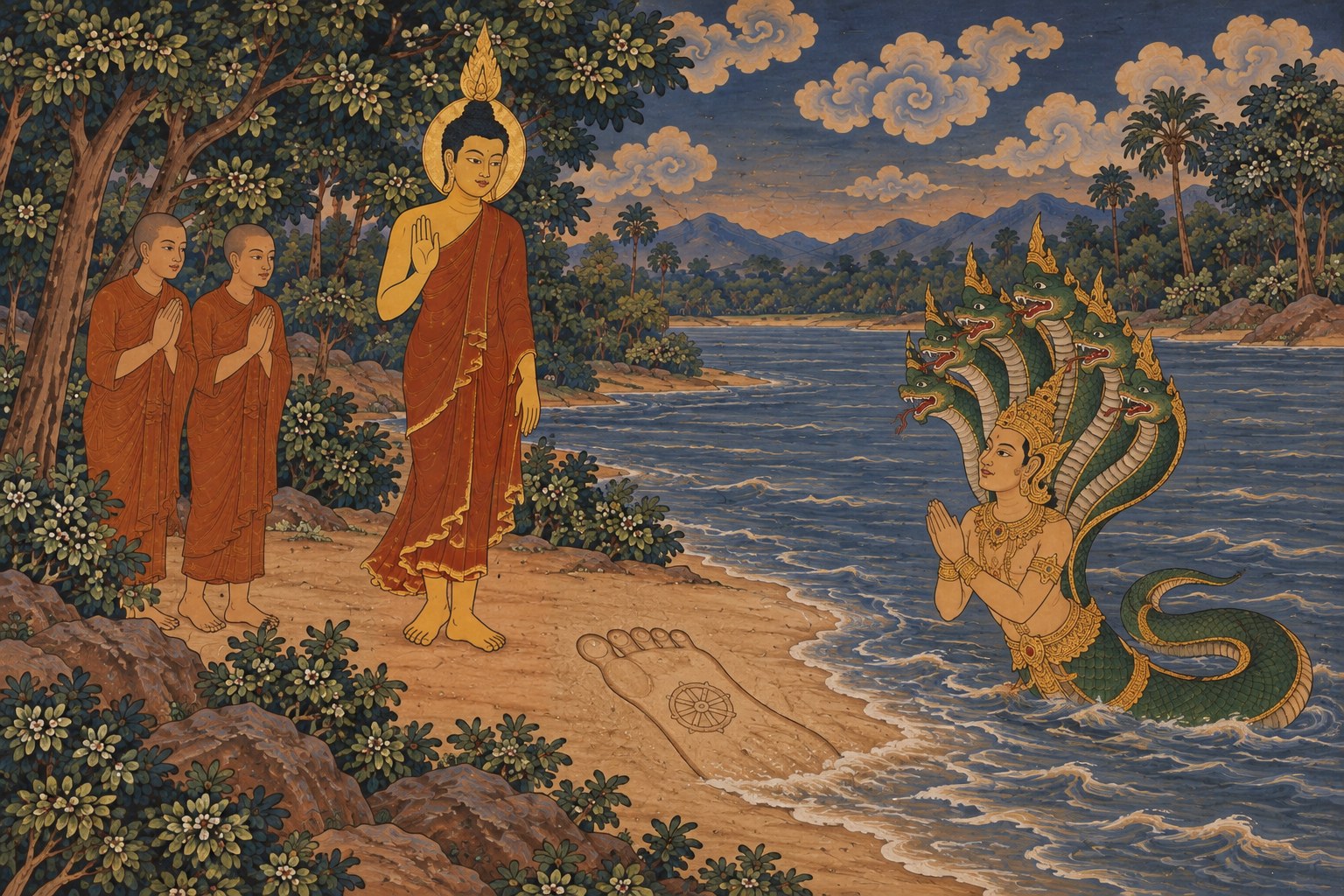
The image suits the krathong almost too well: a footprint at a river’s edge, covered and uncovered by the water, venerated by beings who live in the water. A candle sent downstream is an offering that travels toward a shore like that one. But it is a story from the commentaries, not the canon, and it was attached to a rite that already existed. That does not make it false, or any less Buddhist. Giving the customs it found a new addressee is something Buddhism has done from the start, and the uposatha the monks keep that night began the same way. According to the Vinaya, wanderers of other sects gathered at the new moon, the full moon and the quarter days to teach, people went to listen, and the wanderers gained supporters; King Bimbisāra, who had noticed, went to the Buddha and suggested that his monks gather on those days too.
Nang Noppamat’s lotus
The story taught in schools is a different one, and it is the one the festival’s beauty contests are named for. In the days of Sukhothai, the first Thai kingdom, a lady of the court named Nang Noppamat made for a king the story calls Phra Ruang the first krathong in the shape of a lotus, and the king was so pleased that he decreed it be done that way every year. The story comes from a book that bears her name, Nang Noppamat, also called Tamrap Thao Si Chulalak, and is presented as the lady’s own work.
The story had good backing, it has to be said. Chulalongkorn himself, in his book on the ceremonies, took it as evidence that the royal outings on the river in the twelfth month went back to Sukhothai. And what he says there about the season is still the best explanation of why the festival falls when it does: in the twelfth month “the water in the river is clear and full to the banks, the rainy season is over, and in the middle of the month the moon shines bright; it is the fitting time to make merry on the river at night.”
The book, however, is not from Sukhothai. When it was first printed, in 1914, Prince Damrong — Chulalongkorn’s half-brother, and the founder of modern Thai historical writing — remarked that anyone reading it with attention could tell from its language that it had been written in Bangkok, between the second and third reigns of the present dynasty, which is to say in the first half of the nineteenth century; among other slips, he noted, it mentions the Americans, a nation that did not exist in Phra Ruang’s day. The historians Chris Baker and Pasuk Phongpaichit treat it as a literary fiction of the Bangkok period, and Thailand’s Fine Arts Department has said plainly that Nang Noppamat never existed and did not invent Loy Krathong.
Those were also the years when the court competed over the biggest krathong. In 1825 and 1826, according to a chronicler Chulalongkorn quotes, Rama III had the princes and senior officials build giant krathongs for him: rafts of banana trunk eight or nine cubits wide, rising ten or eleven cubits to their tips, each built to outdo the others, some in the shape of Mount Meru and its four continents. When he learned what they cost, he put a stop to them. What is old about the festival is not its origin story but the lights: lamps on the water in the twelfth month were already in the Palace Law of Ayutthaya. Nang Noppamat’s lotus gave them, much later, an author and a Thai pedigree.
Yi Peng: lanterns for a lock of hair
In the north, in the lands of the old kingdom of Lanna, the same full moon is called Yi Peng — yi is “two” and peng “full moon,” because the Lanna calendar runs two months ahead of Bangkok’s and its second month is everyone else’s twelfth. Besides the krathongs on the rivers, in Chiang Mai and the towns around it lanterns are hung at temples and houses, and khom loi are released: paper lanterns carried up into the sky by the hot air of a flame.
The lanterns have their Buddhist reading too, and it points to the same relic Chulalongkorn named. According to the introduction to the Jātaka commentary, after leaving home by night, the future Buddha crossed the river Anomā on horseback and, standing on its sandbank, reflected that this hair of his was not fit for an ascetic. There was no one else worthy of cutting it, so he cut it himself with his sword, topknot and diadem together, and threw it into the air: “If I am to become a Buddha, let it stay in the sky; if not, let it fall to the ground.” The hair hung in the sky, and Sakka, king of the gods, received it in a jeweled casket and enshrined it in the heaven of the Thirty-Three, in the shrine called from then on the Cūḷāmaṇi, the “crest jewel.” The verses that close the canon’s account of the Buddha’s death (DN 16) add that “one tooth is venerated by the gods of the Third Heaven” — the Pali, tidiva, being one of the names of that same heaven of the Thirty-Three.
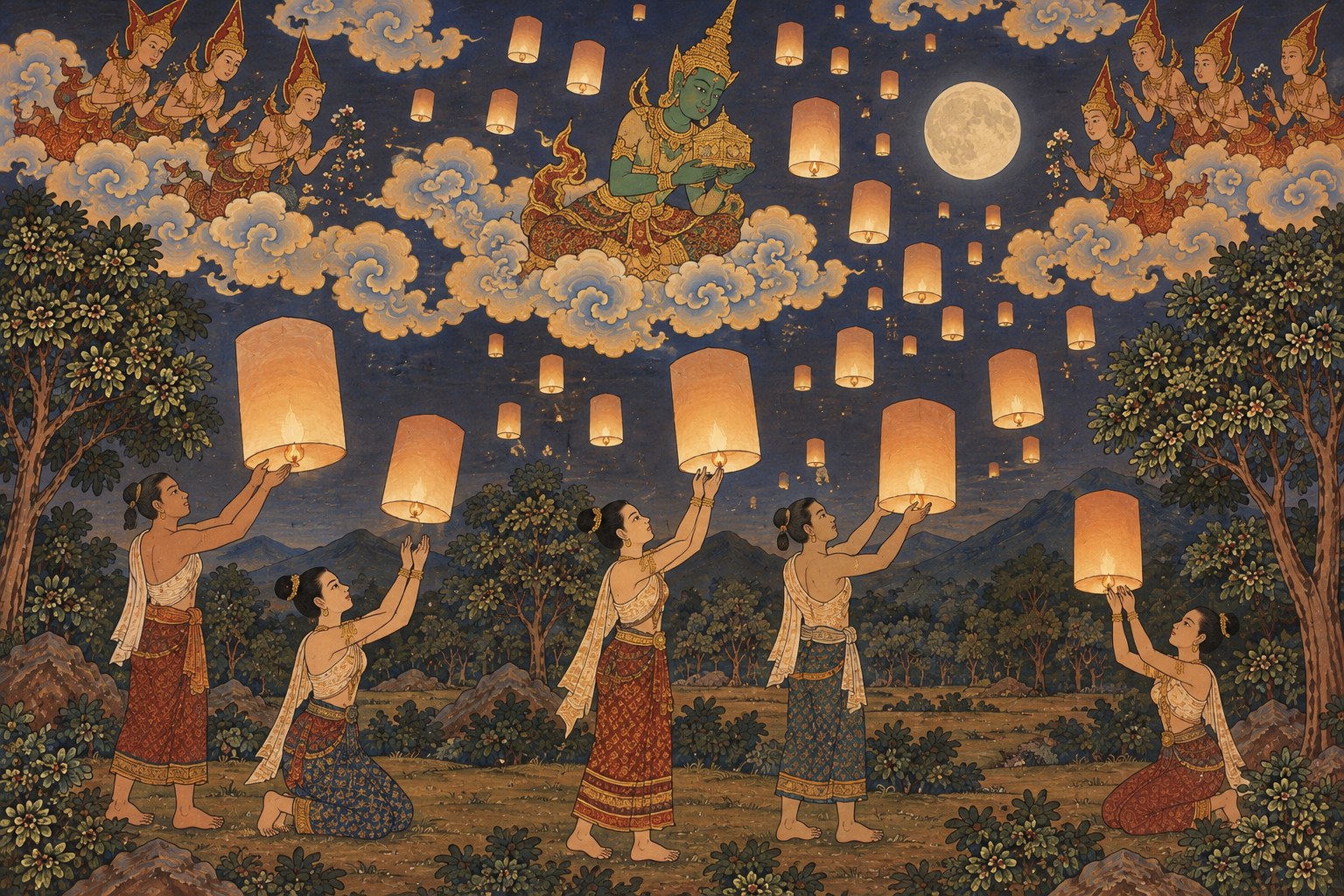
A lantern, unlike a krathong, does not go down the river; it goes up. The krathong travels toward a footprint at a river’s edge, the lantern toward a lock of hair kept in heaven. What goes up comes down somewhere, though. The mass releases at Chiang Mai now draw visitors from around the world, the authorities worry about fires and litter, and in some years dozens of flights at the city’s airport have been canceled or rescheduled over the nights of the festival.
The morning after
Of the four answers, the apology to the water is the only one that can be checked, and it is checked at dawn. In Bangkok, city crews work the canals and the river through the night and into the early morning, lifting krathongs out of the water, and every year the city publishes the count: 639,828 in 2023, 514,590 in 2024, 391,027 in 2025. Of last year’s, 83 percent were made of natural materials — banana trunk and leaves, flowers — which are shredded and turned into fertilizer; 7 percent were foam, which goes to landfill; and 10 percent were bread.
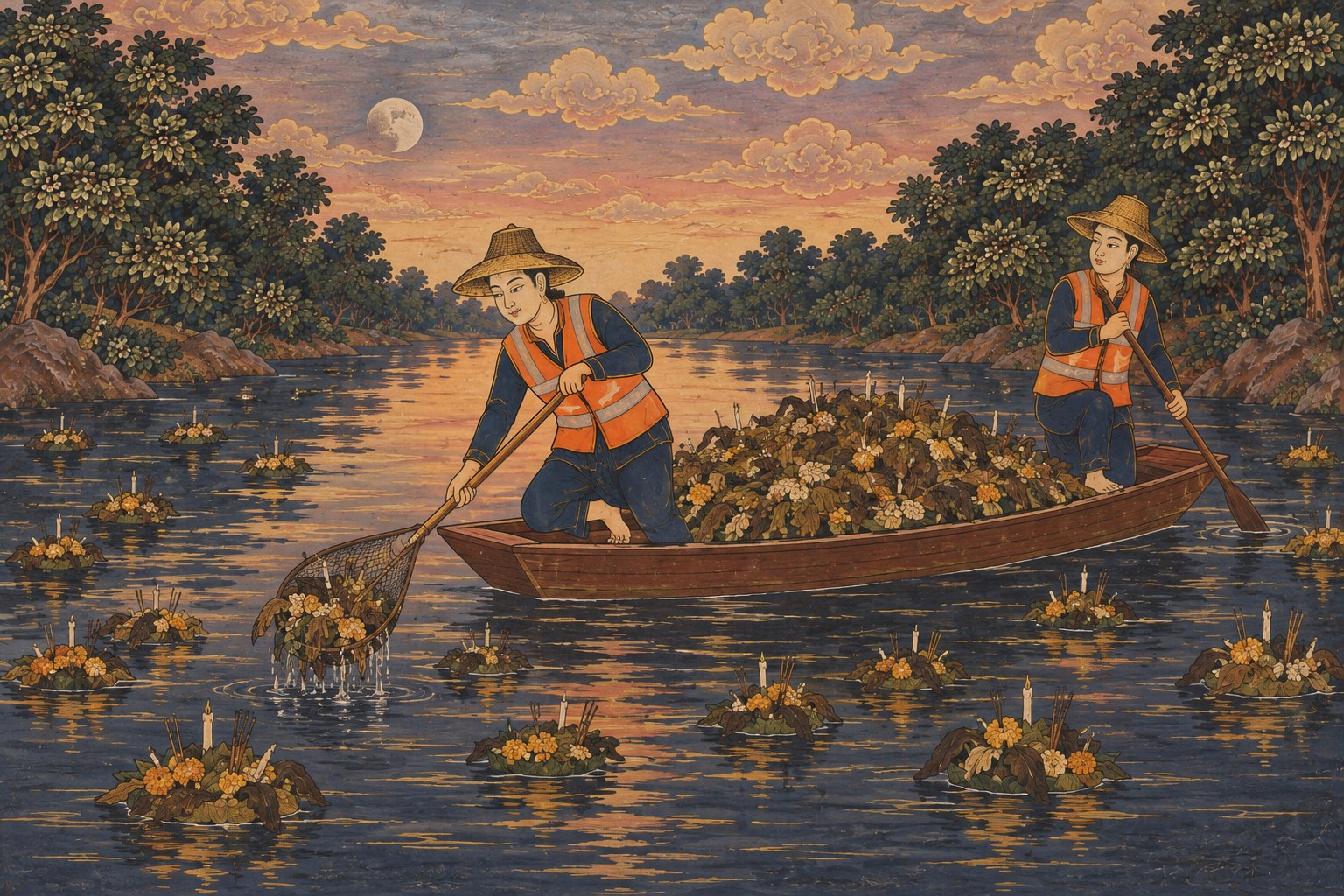
Bread looks like the cleanest choice, since the fish eat it, and in small amounts it is. When there is too much, the fish cannot keep up, the rest sinks and rots, and as it decomposes it uses up the oxygen in the water. In 2023, in a pond in Bangkok’s Santiphap Park where about 4,000 of the 6,810 krathongs collected were made of bread, almost all the fish died, according to the city administration; the city and the Pollution Control Department now ask people not to use bread at all. The apology to the river is a lovely idea. But by its own logic it is a promise to stop fouling the river, and the promise is kept or broken not by the gesture but by what the krathong is made of.
What the river can carry
The third answer, letting the river take away bad luck, is the one with the oldest Buddhist rebuttal, and the rebuttal is blunt. In the Majjhima Nikāya (MN 7), a brahmin named Bhāradvāja of Sundarikā asks the Buddha whether he goes to bathe in the Bāhukā River. “Brahmin, why go to the Bāhukā River?” the Buddha replies. “What can the Bāhukā River do?” The brahmin explains that many people deem it a river that leads to heaven and bestows merit, “and many people rinse off their bad deeds in the Bāhukā River.” The Pali verb is pavāheti, literally “to let the current carry off,” which is just what loi khro says. Chulalongkorn, puzzling over the Palace Law’s lamps sent “into the water,” suspected something similar: that they belonged to the brahmin custom of setting things adrift to carry off sins, misfortune and sorrow — “which,” he adds, “corresponds to Loy Krathong.”
The Buddha answers in verse. A fool can plunge into the Bāhukā, or at Gayā or Payāga, again and again, “but it won’t purify their dark deeds.” And then:
It’s here alone that you should bathe, brahmin,
making yourself a sanctuary for all creatures.
And if you speak no lies,
nor harm any living creature,
nor steal anything not given,
and you’re faithful and not stingy:
what’s the point of going to Gayā?
For any well may be your Gayā!
In the Therīgāthā, the Verses of the Senior Nuns (Thig 12.1), Puṇṇikā, a slave who carried water and who had to go down into the river every day in the cold for fear of her masters’ beatings, meets a brahmin who plunges into the cold water to wash off his bad deeds. Would they not all go to heaven, then, she asks him — “all the frogs and the turtles … and other water-dwellers too,” and the butchers and fishermen and executioners with them? Then she makes a finer objection: “If these rivers had carried away your bad deeds in the past, they would also carry away your good deeds.”
It would be easy to stop here and read Loy Krathong as the superstition the Buddha argued against. It would also be unfair. One need not believe that the river carries off karma to set something on it, and what many people do that night is closer to marking a decision: the rains are over, the water is starting to fall, the harvest is coming, and one puts something on the river on purpose and watches it go. A gesture can do that — give an intention a date and a shape. What the texts deny is not the gesture but the transaction, the idea that the water does the work. Puṇṇikā does not tell the brahmin to stop bathing. She tells him that if he fears suffering, he should not do bad deeds, “either openly or in secret.”
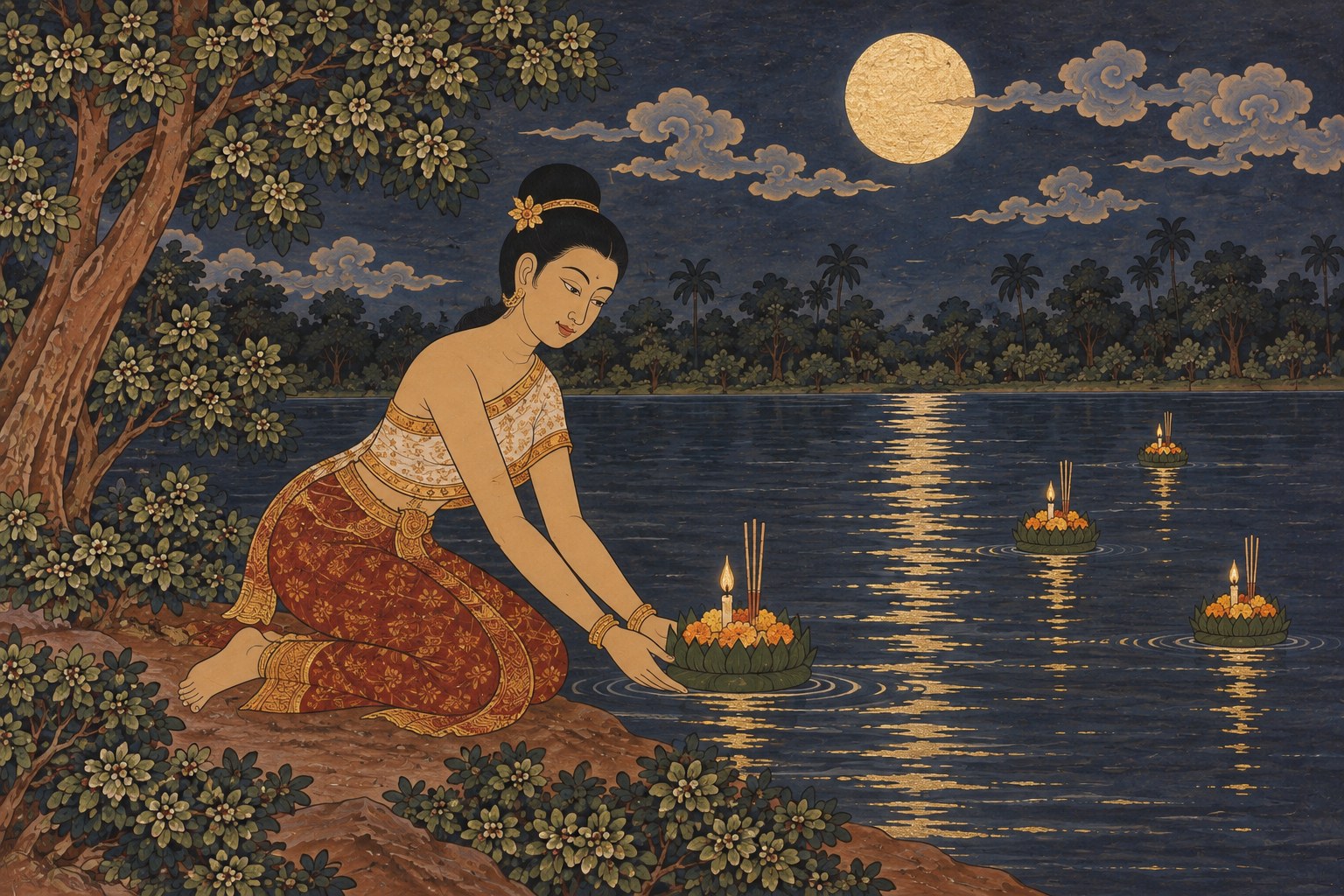
The commentary on MN 7 explains what the Buddha was answering. Bhāradvāja believed that whoever bathed at the full moon of the month of Phagguna was cleansed of the evil done in the whole year: he had, like Thailand, one full-moon night a year for the water to carry the year away. The Buddha’s verse names it: “For the pure in heart it’s always the spring festival or the sabbath.” Sujato’s “spring festival” is phaggu, that bathing day, and his “sabbath” is the uposatha. That night, while the rivers of Thailand fill with lights, the monasteries keep the uposatha as at every other full moon. By the verse’s reckoning, they have not missed the festival.