

There was a monk in the Buddha’s time named Thera — the word means “elder,” which is why the translation quoted here calls him Senior — who lived alone and praised living alone. He went into the village for alms alone, came back alone, sat in private alone and did his walking meditation alone. By any outward measure he was doing what a hermit is supposed to do. Other monks told the Buddha about him, and the Buddha sent for him (quotations from the suttas here are from Bhikkhu Sujato’s translations, on SuttaCentral):
“Is it really true, Senior, that you live alone and praise living alone?”
“Yes, sir.”
“But in what way do you live alone and praise living alone?”
Thera told him: alone to the village, alone back, alone sitting, alone walking. The Buddha’s reply, in a short discourse of the Saṃyutta Nikāya (SN 21.10), is one of the gentlest corrections in the suttas:
That is a kind of living alone, I don’t deny it. But as to how living alone is fulfilled in detail, listen and apply your mind well, I will speak. … It’s when what’s in the past is given up, what’s in the future is relinquished, and desire and greed for present incarnations is eliminated. That’s how living alone is fulfilled in detail.
The Buddha does not tell him he is wrong to live apart. He tells him that this is only the outside of it. There is a solitude of the body, which Thera had mastered, and a solitude the body cannot supply: the one in which the past and the future do not come into the hut with you.
Most of us never get as far as Thera. Sitting alone in a room for a quarter of an hour, with no phone and nothing to do, is hard enough that a psychology experiment about it went around the world in 2014 under an easy headline: people would rather give themselves electric shocks than be alone with their thoughts. The Buddha would not have been surprised. He said the room was hard, more than once, and the suttas are frank about why. A seventeenth-century French mathematician reached a strikingly similar diagnosis, and the laboratory, read carefully, bears out a good part of it. But the answer to why the room is hard is the one the Buddha gave Thera: it is not the walls. It is what comes in with you.
Hard, said the Buddha
It would be convenient to present Buddhism as the tradition that has finally learned how to stay in the room and recommends it without reservation. The suttas are more honest than that. In the Bhayabherava Sutta, the discourse on fear and dread (MN 4), a brahmin named Jāṇussoṇi says to the Buddha something anyone who has tried to sit still could have signed:
But worthy Gotama, remote lodgings in the wilderness and the forest are challenging. It’s hard to maintain seclusion and hard to find joy in solitude. The forests seem to rob the mind of a mendicant who isn’t immersed in samādhi.
Samādhi is the deep collectedness of meditation. And the Buddha agrees: “That’s so true, brahmin! Everything you say is true, brahmin!” He had thought the same himself, he says, before his awakening. Then he describes how he dealt with it. On the nights of the lunar month regarded as most portentous, he deliberately stayed at the places people feared — the shrines in parks, in forests, at the foot of trees — to see whether the fear would come. It came:
As I was staying there a deer came by, or a peacock snapped a twig, or the wind rustled the leaves. Then I thought, “Is this that fear and dread coming?” Then I thought, “Why do I always meditate expecting that fear to come? Why don’t I get rid of that fear and dread just as it comes, while remaining just as I am?”
So if the fear found him walking, he did not stop, or sit, or lie down until he had gotten rid of it walking; and the same standing, sitting or lying down.
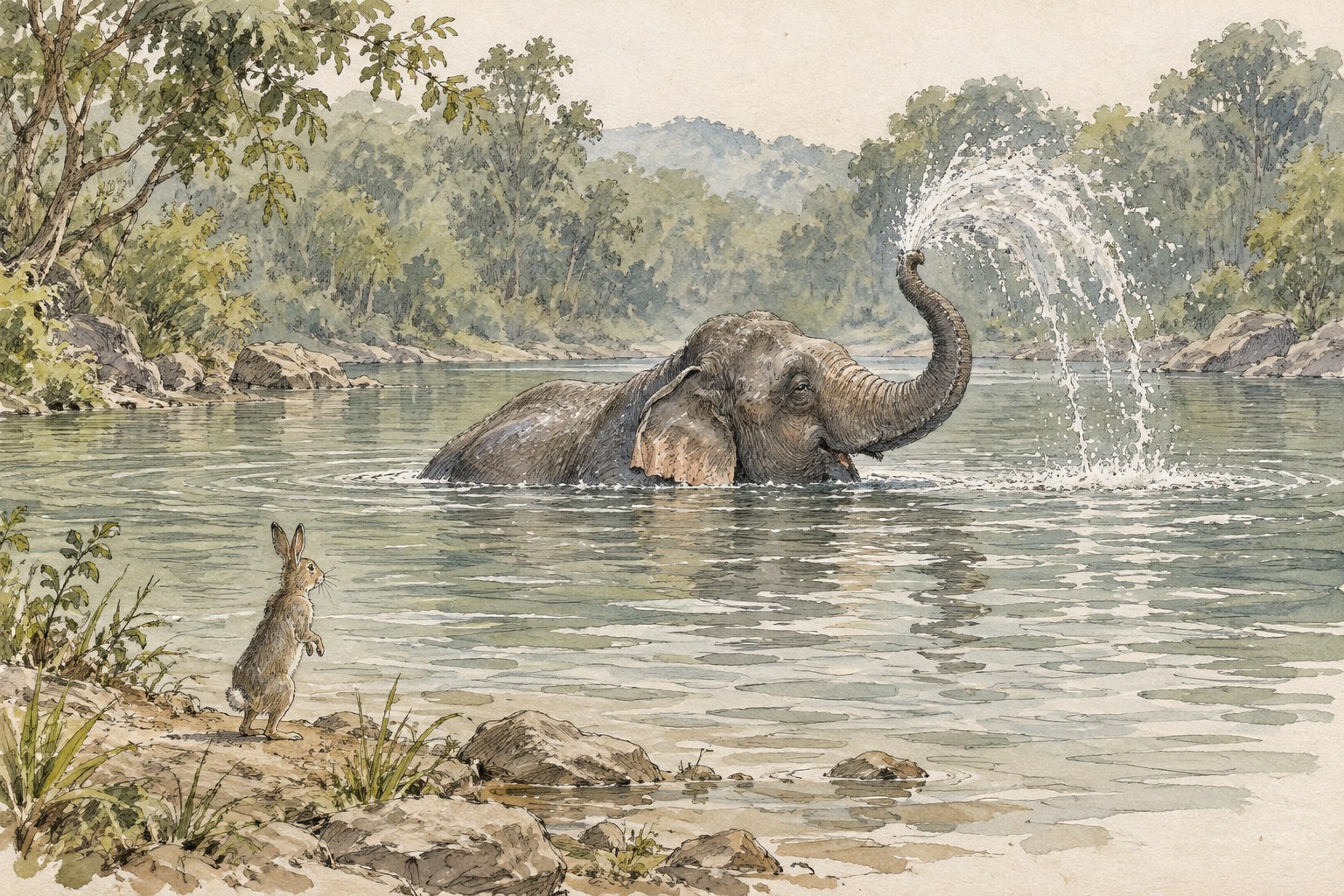
In another discourse (AN 10.99) it is a monk who wants to go off to the forest — not the Jain householder Upāli of the Upāli Sutta, whose story came up in the post on Buddhism and Jainism, but the monk of the same name whom the tradition remembers as the great authority on the monastic discipline. “Sir, I wish to frequent remote lodgings in the wilderness and the forest,” he says. And the Buddha, who praises forest life elsewhere, tells him no. Those lodgings are challenging, he repeats, and anyone who goes to them without immersion “can expect that they’ll sink down or float away.” Then he gives him a picture. A bull elephant three or three and a half meters tall comes to a large lake, plunges in, plays around washing his ears and back, drinks, and comes out when he likes, because “his large incarnation finds a footing in the depths.” Then:
Then along comes a rabbit or a cat. They’d think, “What difference is there between me and a bull elephant? Why don’t I plunge into this lake and play around while washing my ears and back?” … They jump into the lake rashly, without thinking. You can expect that they’ll sink down or float away. Why is that? Because their little incarnation finds no footing in the depths.
The Pali word Sujato renders as “rabbit” is sasa, the hare: a small animal that sees the elephant and wants to do what the elephant does. It will not be the only hare in this piece.
The discourse goes on through a long account of the whole path, from going forth to the deepest meditations — disciples who see those qualities in themselves, it says, do frequent the forest — and ends on advice with nothing heroic about it: “Come on, Upāli, stay with the Saṅgha. If you stay with the Saṅgha you’ll be comfortable.” That is not a verdict against solitude. It is a warning about sequence. Solitude is not a test of character to be passed by willpower but something a person is prepared for, and it holds up best for someone who does not begin it alone.
Pascal’s room
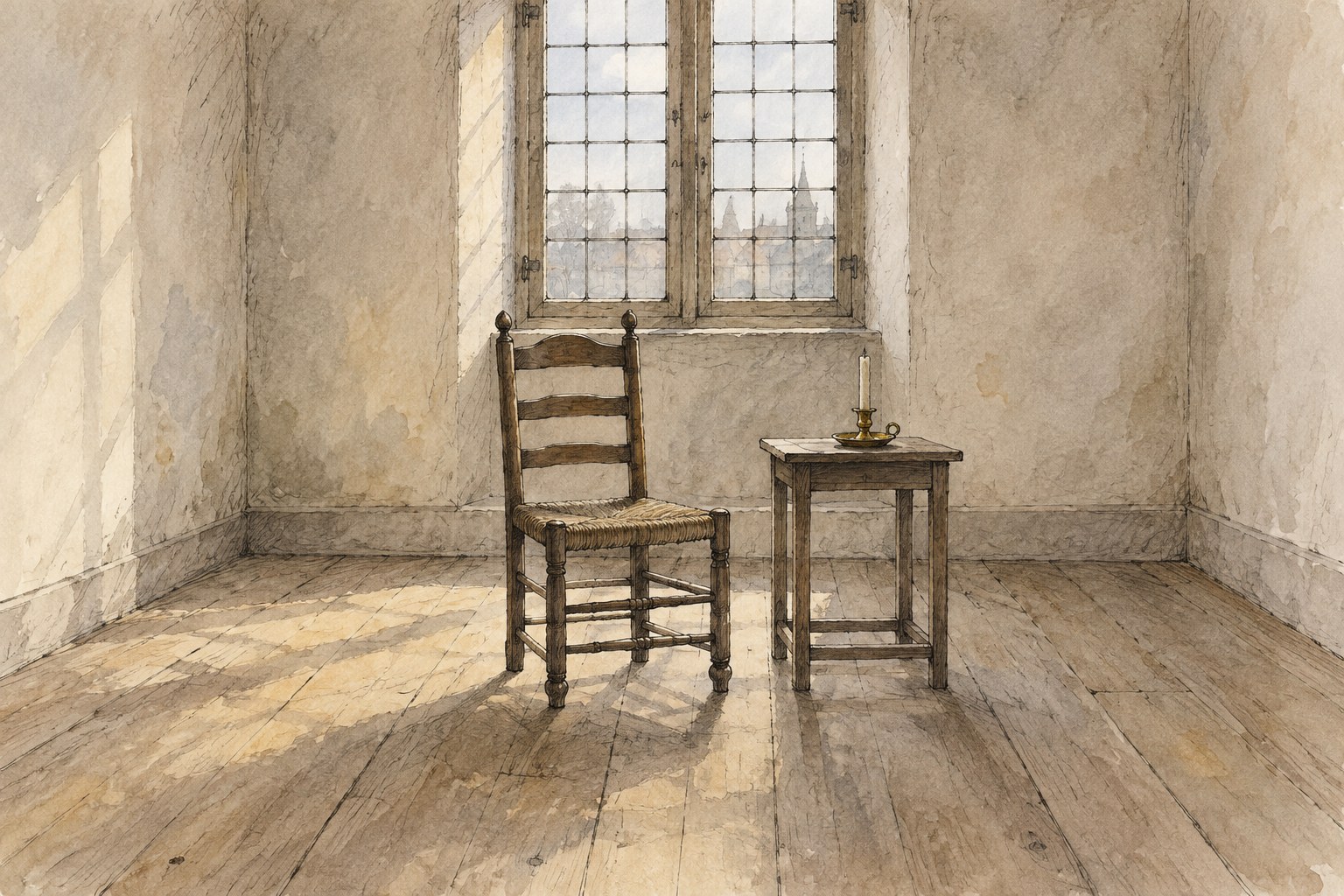
More than two thousand years later, Blaise Pascal arrived at the same complaint from a very different starting point. Among the notes he left at his death in 1662, published eight years later as the Pensées, is a sentence that gets quoted constantly and rarely in the words he used. When he set himself to consider the various agitations of men — war, the court, gambling, the hunt — he says he had often said that tout le malheur des hommes vient d’une seule chose, qui est de ne savoir pas demeurer en repos dans une chambre: all of humanity’s unhappiness comes from a single thing, which is not knowing how to stay at rest in a room (fragment 139 in Brunschvicg’s edition, 136 in Lafuma’s).
Pascal says repos, rest — not quiet, not calm, but staying put, ceasing to move. And he does not say “alone.” The version that circulates in English, about man’s inability to sit quietly in a room alone, adds the word, and it is not entirely wrong to, because that is what is left when someone stays still in a room: themselves.
The fragment belongs to the section Pascal headed Divertissement. A diversion, from the Latin divertere, is a turning aside. For Pascal, to divert oneself is not to have fun but to look the other way, and what we do not want to look at, he says, is our condition — that we are fragile, that we will die, that nothing we own protects us from either. His best-known example is hunting. Nobody chases a hare for the sake of the hare: on n’en voudrait pas s’il était offert — we would not want it if it were offered to us. The hare would not shield us from the sight of death and misery; the hunt does, because while it lasts there is no time to think about them. So people do not realize, Pascal concludes, that what they are after is the chase and not the catch. It takes very little to get us out of ourselves: the smallest thing, he writes, “a billiard table and a ball to push,” is enough.
That is the second hare. The Buddha’s wanted to do what the elephant does; Pascal’s is the quarry nobody wants. Between them they cover most of what goes wrong in the room: overreaching on the way in, and looking for something to chase once there.
It would be a mistake to recruit Pascal for more than he offers. He was not recommending meditation. He was a mathematician, a physicist and a fervent Christian, and the Pensées are the working notes for a defense of Christianity he did not live to finish. For him, what the room reveals — the misery of man without God — has only one remedy, and it is not sitting still. What he offers here is a diagnosis, not a prescription. But the diagnosis is sharp: people are not merely bored in the room; they flee it, and the flight always presents itself as something else — a post, a game, a hunt — that seems worth having for its own sake. Set beside the Buddha’s answer to Thera, it is a good description of what follows a person into the room.
Fifteen minutes and a button
In 2014 Timothy Wilson and colleagues at the University of Virginia and Harvard published a series of eleven studies in Science under a title Pascal could have chosen: “Just think.” Participants handed over their phones and anything else that might occupy them and sat alone in a sparsely furnished room for six to fifteen minutes, with nothing to do but think. Most found it hard to concentrate. In the experiment that made the news, they first sampled a mild electric shock and said whether they would pay not to feel it again; then they spent fifteen minutes alone with a button that would deliver the same shock. Among the forty-two who had said they would pay to avoid it, two-thirds of the men and a quarter of the women pressed the button at least once. One participant pressed it 190 times.
The headline is stronger than the data. A few months later Kieran Fox, Evan Thompson, Jessica Andrews-Hanna and Kalina Christoff pointed out in Frontiers in Psychology that most participants in the button experiment, 57 percent, never shocked themselves at all, and that across the studies “just thinking” had come out as mildly enjoyable rather than aversive. When Andreas Eder and his team at the University of Würzburg ran the experiment again in 2022, most of their participants pressed too, so the basic finding stands; but they pressed more at the beginning than at the end and tried new shocks more readily than the one they already knew, which looks less like fleeing an unbearable thought than like curiosity about a new gadget. A 2019 study led by Nicholas Buttrick, with 2,557 people in eleven countries, found the preference for doing over thinking everywhere it looked. And in 2022 Aya Hatano and colleagues found that people enjoy twenty minutes alone with their thoughts considerably more than they predict.
What survives is less dramatic than the headline and more useful. Nobody showed that thinking is worse than an electric shock. What turns up again and again is that we expect the room to be worse than it is, and that the moment something is within reach — a phone, a window, a button — we take it. That is Pascal’s hunt, and it will start with anything. It is also Thera’s problem seen from a laboratory: the experiment put people’s bodies alone in a room and left everything else free to come in with them.
Solitude and loneliness
So far I have written about being alone as though it were one thing, and English is unusually well equipped to say otherwise. It has two words for two opposite experiences. Spanish — the language of this site’s sister site, Escrituras Eremitas — has only one, soledad, which has to cover both what the hermit seeks and what an old man endures when nobody visits him anymore. The theologian Paul Tillich, in one of the sermons collected in The Eternal Now (1963), observed that the language had made one word for the pain of being alone and another for its glory: loneliness and solitude.
The difference is not in the room, which can be the same room. It is in whether the aloneness was chosen, and in what is missing. Someone in solitude misses no one for the time being; the solitude is full of something. Someone who is lonely misses someone, and the loneliness is that gap. The Pali texts have several words for the first kind, and none of them names a lack: viveka or paviveka, seclusion, withdrawal; ekatta, being alone; ekavihārī, one who lives alone.
It should be said plainly what this piece does not say. Loneliness is a real harm, and it is not cured by learning to enjoy it. A lonely person is not in Pascal’s room or a hermit’s hut. They are missing something, and what they are missing is company, not meditation. Everything here is about the other kind, the chosen kind, and why it is hard even when it is chosen.
The kuṭi
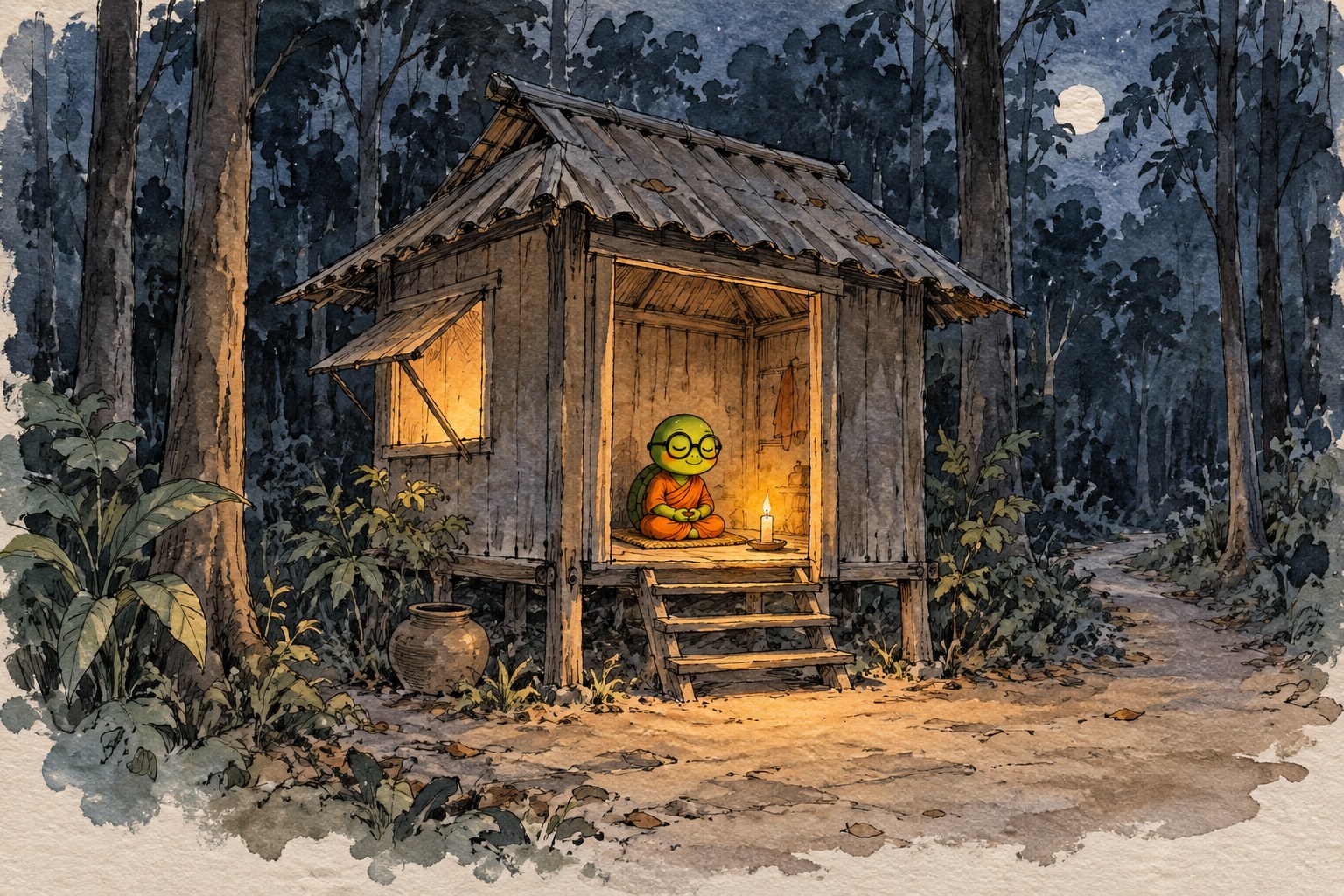
The forest monasteries of Thailand are built on the Buddha’s warning to Upāli. Each monk lives in a kuṭi, a small hut set apart from the others among the trees, often with its own path for walking meditation. He spends much of the day there and nearly all of the night, with no one in sight. But the solitude has edges: the almsround at dawn, the single meal of the day, the chanting in the hall, the shared chores. The community is never more than a few minutes’ walk away. This is Pascal’s room taken seriously. The room is there, but no one locks you in to see how long you last; it is chosen again each day, inside a Saṅgha that holds it up.
People who have tried it, in a monastery or on a retreat, tend to describe the first days alone in much the same way. First comes boredom, which is the mind looking for the hunt — something to look at, something to plan, someone to write to. Then comes restlessness, uddhacca, the same word that names part of one of the five hindrances to meditation: the body that wants to get up, the mind that jumps from a memory to a plan and from there to another. And then, if one stays, something quieter. It is not a reward or a special state. It is simply what is left when the hunt tires itself out and nothing replaces it. That is what Wilson’s experiment, with its fifteen minutes, could not see: it measured the doorway, not what is on the other side.
In my experience, solitude can be energizing under certain conditions, such as when we look forward to the practice. One of my best memories is being in a kuṭi at night, by candlelight, meditating and reflecting: one of those times when you know, while it is happening, that something special is going on. What made that night different was not the hut, which was the same as on any other night, but how little followed me into it. For a while there was nothing to chase. It was a glimpse and no more, but it made the Buddha’s answer to Thera easier to understand.
Ryōkan, the Zen monk whose name signs the writing on this site, lived that way for years in a hut on a mountain, and the story of Ryōkan and the thief is, among other things, the story of a man whose hut was emptied and who found that it was not empty.
Living alone, in detail
This brings us back to Thera, and to the question the Buddha answered for him: what exactly makes the room hard, if not the walls. Solitude in full does not mean that there is no one else in the hut. It means that the past and the future do not come in with you: the memories that get chewed over, the plans that get rehearsed, the person you take yourself to be and want to go on being. That is the company that fills Pascal’s room, and it is the hunt that carries on with no hare and no button. It is why a person can be crowded in a hut in the forest and alone in the middle of a crowd.
It is what Why Buddhism Asks You to Stop was asking for: to sit down in an empty space and watch, without judging and without analyzing. What the forest teaches is that the room does not supply the empty space. What you stop bringing into it does. Fifteen minutes, as it happens, is about the length of a first sitting; the beginner’s guide covers posture, the breath and how to get through it.
Pascal was right that hardly anyone knows how to stay at rest in a room. What the Buddha told Thera goes further: the room was never empty, and learning to stay in it is not a matter of enduring the silence but of no longer filling it. He closed the discourse with a verse about the one who has given up everything and is freed in the ending of craving: “I declare that man to be one who lives alone.”