

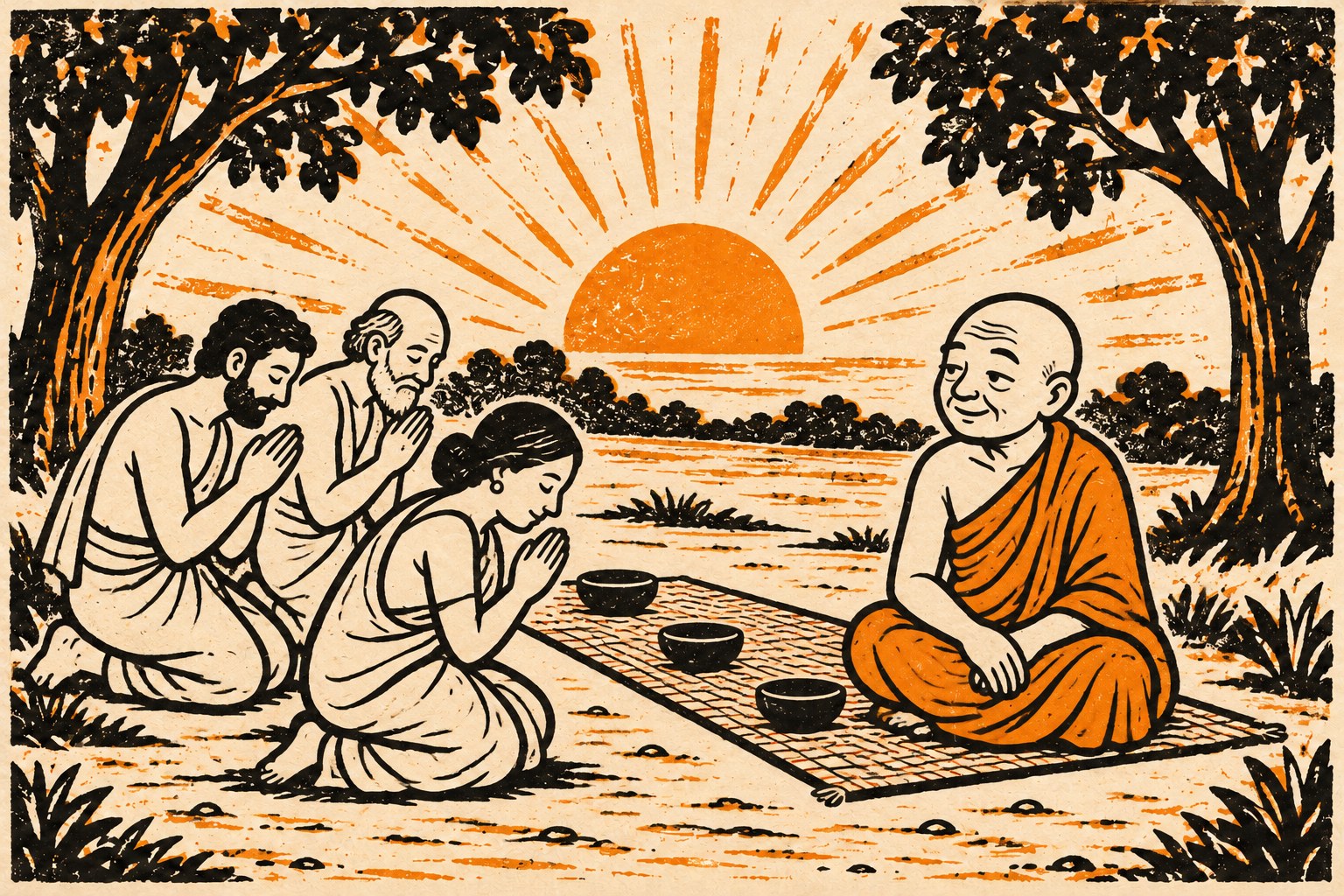
A Theravada monk who is given food does not say thank you. That holds across the tradition, in Asia and in the monasteries it has founded in the West. The giver bows, sometimes kneeling, places the rice in the bowl and steps back, and the monk receives it without a word. What follows, if anything does, is a blessing chanted in Pali. People who see it for the first time often find it rude, and some take it for something worse, the sign of a man who assumes he is owed whatever he is given.
The impression is an old one. The gratitude is there all the same, in the blessing and in the way the monk eats, and the tradition had its reasons for keeping it out of the word thanks.
A complaint from the Buddha’s time
The Vinaya, the monastic code, records a complaint very like the modern one. At one time, it says, monks ate what was offered in the dining hall without giving the anumodanā, and people grumbled: “How can the Sakyan monastics not express their appreciation in the dining hall?” The monks reported it to the Buddha, who took the people’s side. He told the monks to do it, and when they wondered whose job it was, he gave it to the most senior monk present (Cullavagga VIII.4.1; quotations from the Vinaya here are from Bhikkhu Brahmali’s translation and from the suttas Bhikkhu Sujato’s, both on SuttaCentral).
Soon afterward an association offered a meal to the Sangha, and the most senior monk present was Sāriputta, one of the Buddha’s two chief disciples. The others, reasoning that the duty was now his alone, got up and left him there. The Buddha saw him coming back on his own and asked whether the meal had gone well. “The meal went well, sir,” Sāriputta said, “but the monks all left, leaving me behind by myself.” From then on, the four or five most senior monks were to wait in the dining hall with him.
Rejoicing with the giver
Anumodanā is built from modati, to rejoice, and the prefix anu, which carries the sense of following or going along with: to rejoice with someone, or after them, in what they have done. The two standard English translations of the Vinaya, by T. W. Rhys Davids and Hermann Oldenberg in 1885 and by I. B. Horner in the 1950s, both say that the monks did not “give thanks” and that the Buddha told them to. Brahmali’s, the most recent, says they did not “express their appreciation.”
Thanks is about what I received: you did me a good turn, and I acknowledge it. Rejoicing is about what you did. A monk giving the anumodanā tells the donor that what they did was well done, and wishes them what comes of it.
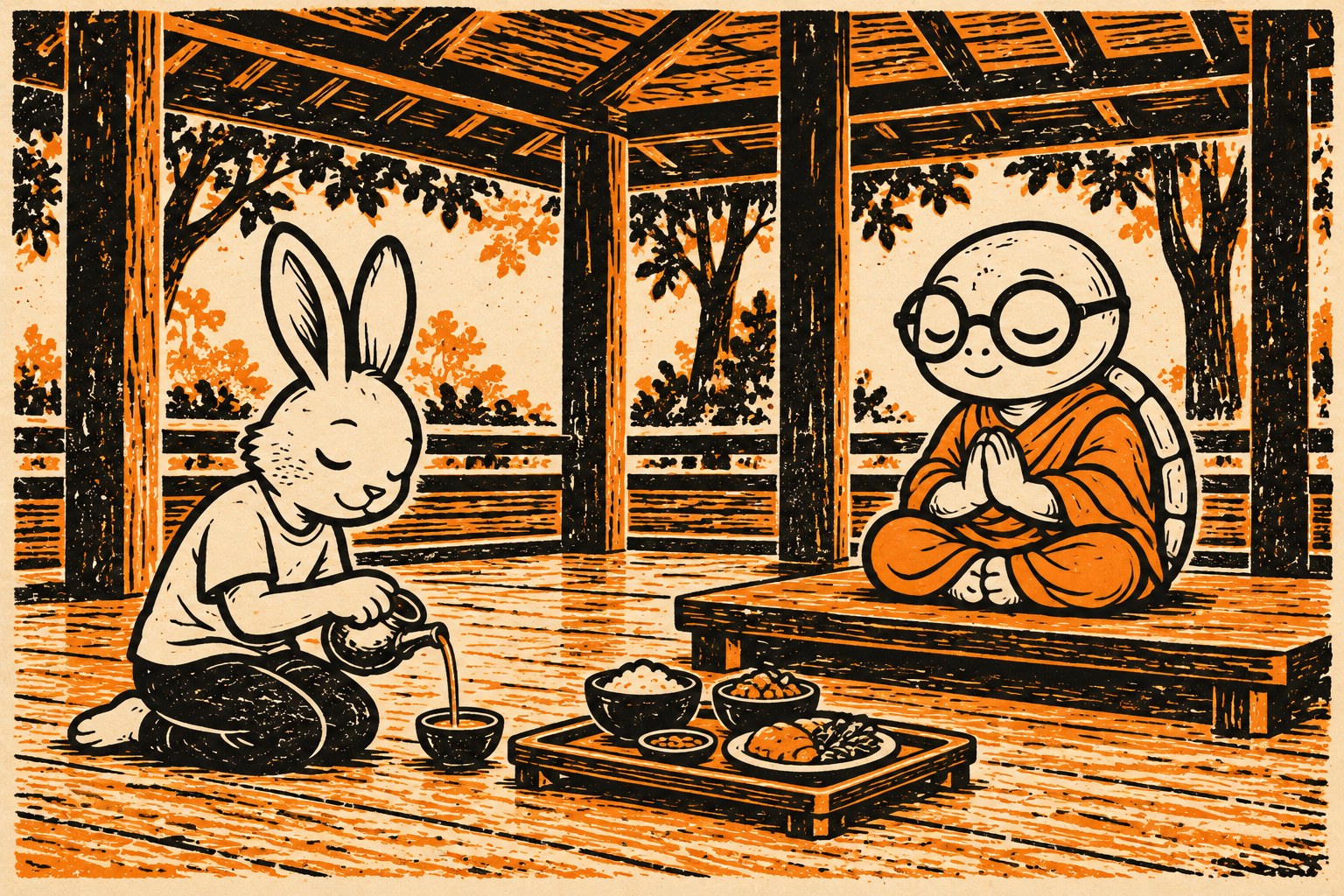
In Thailand the anumodanā usually opens with a verse from the Tirokuṭṭa Sutta, a short text in the Khuddakapāṭha: “Just as the rivers full swell the ocean seas, so too what is given here aids the departed ghosts.” While the leading monk chants it, with the good wishes that follow, the giver slowly pours water from a small vessel, dedicating the merit to the dead, a gesture the Thais call kruat nam. Then the monks chant together, wishing that every distress and disease pass the donor by, and close with a verse of the Dhammapada (109): “For one in the habit of bowing, always honoring the elders, four blessings grow: lifespan, beauty, happiness, and strength.”
The Tirokuṭṭa itself ends by turning to the people who gave, and showing them “how the mendicants can be kept strong, and how no little merit is produced by you.” A first-hand account of one such morning is in Dana at Wat Pah Nanachat.
Who is doing whom a favor
Underneath all this is the logic of merit, puñña, in which the giver is the one who benefits. Whenever the suttas list the qualities of the monastic community, they end by calling it “the supreme field of merit for the world” (SN 11.3, and many others), a field in which what is sown bears a crop.
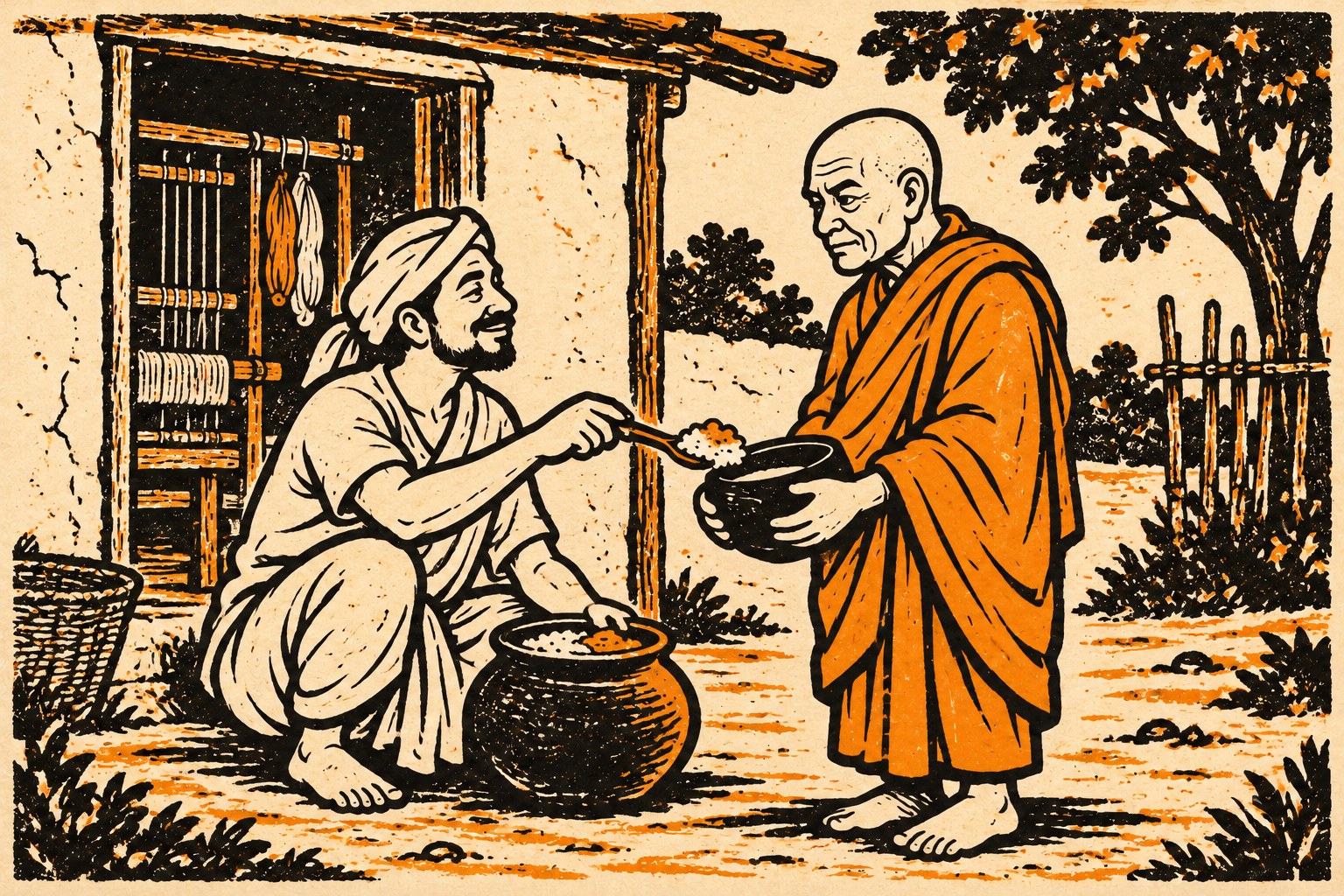
In a story in the Udāna (3.7), Mahākassapa, one of the great disciples, comes out of seven days of meditation and goes into Rājagaha for alms. Five hundred deities are eager to feed him, and he turns them all down. So Sakka, lord of the gods, takes the form of a weaver, comes out of his house to meet him, and fills his bowl with rice and “many tasty soups and sauces.” Kassapa sees through the disguise and tells him off: “This is your doing, Kosiya; don’t do such a thing again.” Sakka answers: “But Honorable Kassapa, we too need merit! We too ought to make merit.” Then he rises into the air and cries out three times, “Oh the gift, the best gift is well established in Kassapa!”
The monastic code also has a sanction for lay followers. If a lay follower tries to keep the monks from getting what they need, to harm them or to drive them from their monastery, or insults them, sets them against one another, or speaks against the Buddha, his teaching or the Sangha, the Sangha may “turn the bowl upside down” for that person (AN 8.87), which is to say, stop accepting their offerings.
What a thank-you would say
There is a second reason for the silence. An ordinary thank-you also tells the giver that something pleased us, and lets slip what we would like to see again. Between equals there is nothing wrong with that. For someone who lives on what he is given, it can slide into something the texts warn against. The first discourse of the Dīgha Nikāya (DN 1) lists the conduct for which ordinary people praise the Buddha, and one item runs: “There are some ascetics and brahmins who, while enjoying food given in faith, still engage in deceit, flattery, hinting, and belittling, and using material things to chase after other material things. The ascetic Gotama refrains from such fawning and flattery.”
The passage says nothing about thanking anyone, and it would be stretching it to make it forbid that. But the distance between warm thanks for a good meal and a hint about tomorrow’s is short, and silence at the bowl means never starting down it. The monk takes what comes, much or little, tasty or plain, without telling anyone which he prefers. The silence belongs to the offering, though. Away from it, monks are as courteous as anyone else, in whatever way local custom and their own temperament allow.
The debt
None of this excuses a monk from gratitude, which the texts rank very high. “These two individuals are rare in the world,” the Buddha says: “One who takes the initiative, and one who is grateful and thankful” (AN 2.119). Elsewhere he makes it the dividing line between people: “It is totally the level of a true person to be grateful and thankful” (AN 2.32). The Pali pair behind “grateful and thankful” is kataññū katavedī. Kataññū is, literally, one who knows what was done, what was done for them; katavedī is one who acknowledges it. The pair passed almost unchanged into Thai, where katanyu katawethi is the everyday way of talking about gratitude, above all toward one’s parents, and stands behind the custom of sons ordaining for a time to make merit for them, which Custom or Conviction looks at more closely.
A monk puts his own gratitude in two places. The first is a reflection drawn from the suttas (MN 2) and chanted daily in monasteries: almsfood is taken “Not for fun, indulgence, adornment, or decoration, but only to sustain this body, to avoid harm, and to support spiritual practice.”
The second is a sterner teaching in the Visuddhimagga, the great manual Buddhaghosa wrote in the fifth century, which distinguishes four ways of using what one is given (I.125–127, in Bhikkhu Ñāṇamoli’s translation). A monk without virtue uses it as theft, even when he eats seated among the Sangha. A virtuous monk who eats without reflecting uses it “as a debt,” which is why, the text says, almsfood should be reviewed “lump by lump,” and “if dawn breaks on him without his having reviewed it, he finds himself in the position of one who has used it as a debt.” Those still training on the path to awakening use it as heirs, and only one who has completed the path uses it as an owner.
So the monk who says nothing at the bowl goes away owing for the food, a debt a thank-you would have settled on the spot, and pays it off in how he eats and lives and in the anumodanā he chants afterward.