

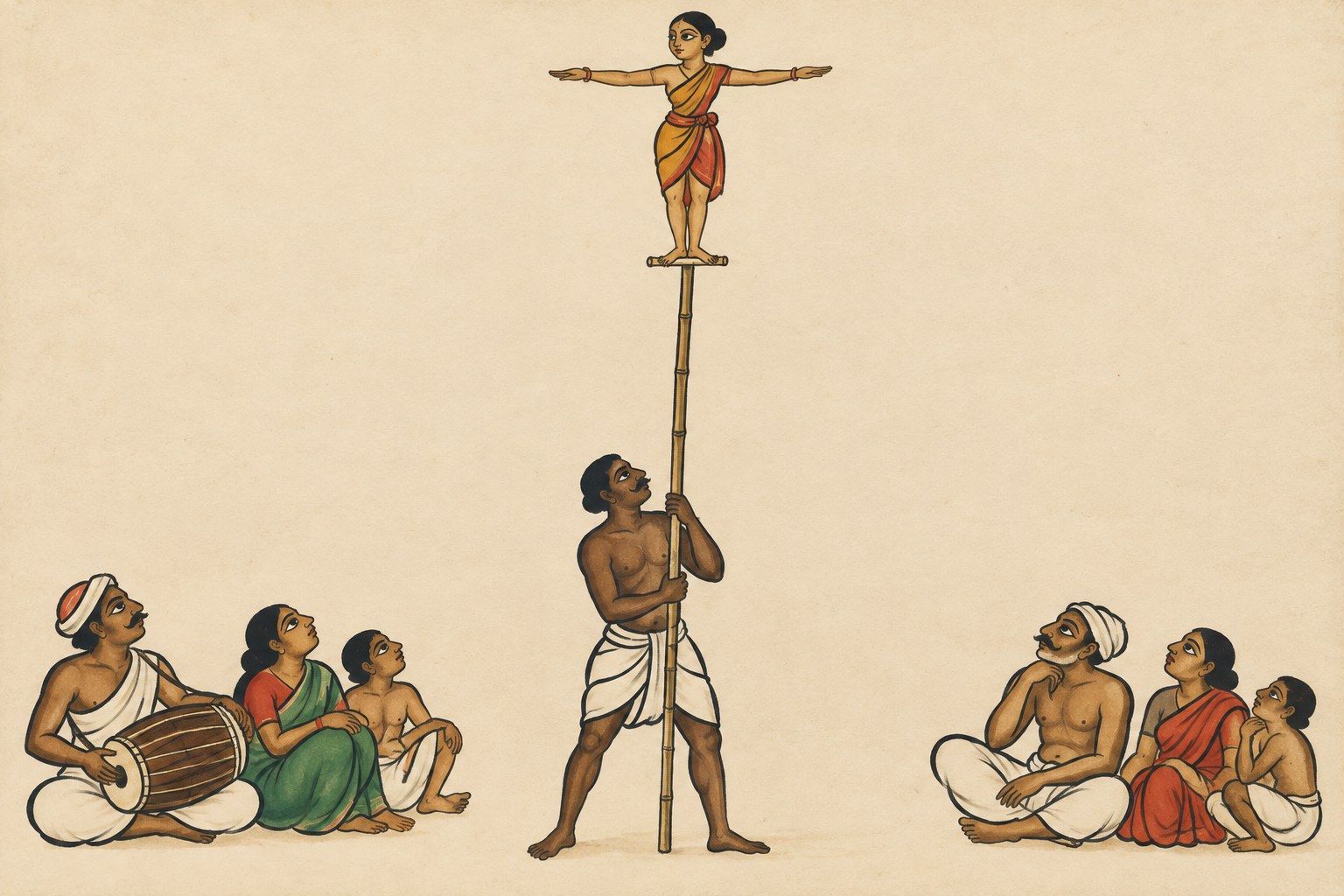
In a short discourse of the Saṃyutta Nikāya (SN 47.19), the Buddha tells a story about two acrobats. A man sets up a bamboo pole, tells his apprentice, a woman named Medakathālikā, to climb it and stand above his shoulders, and proposes a deal: you look after me and I’ll look after you, and that way we’ll do our act, collect our fee and get down safely. She tells him that is not how it will work. Each of them should look after themselves, and that way they will do their act, collect their fee and get down safely. The Buddha says she is right. Then he adds that looking after yourself, you look after others, and looking after others, you look after yourself, which sounds much like what her teacher proposed.
The sutta gets passed around today as an argument for self-care, and up to a point it is one. It also asks for more than the word usually means, and it questions the idea, held on both sides of the argument, that care given to oneself is taken from others.
Two people on one pole
The story takes only a few lines, and here it is whole (quotations from the suttas here are from Bhikkhu Sujato’s translations, on SuttaCentral):
Once upon a time, mendicants, a pole acrobat of the corpse-workers set up the bamboo pole of his tribe and said to his apprentice Medakathālikā, “Come now, dear Medakathālikā, climb up the bamboo pole and stand above my shoulders.” “Yes, tutor,” she replied. She climbed up the bamboo pole and stood above her tutor’s shoulders. Then the pole acrobat of the corpse-workers said to Medakathālikā, “You look after me, dear Medakathālikā, and I shall look after you. That’s how, guarding and looking after each other, we’ll display our skill, collect our fee, and get down safely from the bamboo pole.” When he said this, Medakathālikā said to her teacher, “That’s not how it will be, tutor! You look after yourself, and I shall look after myself. That’s how, guarding and looking after ourselves, we’ll display our skill, collect our fee, and get down safely from the bamboo pole.”
“That’s the way,” said the Buddha. “It’s just as Medakathālikā said to her tutor.”
The verb used all through the passage, rakkhati, means both to protect and to look after, and beside it stands gutta, “guarded,” the word the suttas use for guarding the doors of the senses. Both describe the work of someone keeping watch over something.
The Pali calls the man a caṇḍālavaṃsika. Sujato, like the Pali Text Society’s dictionary, reads the word as tying his trade to the caṇḍāla, the outcastes on the lowest rung of Indian society, whose work included handling the dead, and so translates “a pole acrobat of the corpse-workers.” His note admits that the terms are not easy to interpret, and the Digital Pali Dictionary takes the word simply as “acrobat.” If that reading is right, the Buddha took his example for the monks from a pair of street performers at the bottom of the social order, and in that pair the one who has it right is the apprentice, a woman correcting her teacher.
Her answer also makes practical sense on a pole. The man below cannot see the person above him, and the woman above cannot hold up the man below. If each of them sets about watching the other, neither is attending to their own balance, and both come down. The only thing he can do for her is keep his own hold steady, and the only thing she can do for him is keep her balance.
The self-care argument
More than two thousand years later, the two acrobats land in the middle of a familiar argument. On one side are the lines repeated in defense of self-care: you can’t pour from an empty cup, and airline safety briefings tell you to secure your own oxygen mask before helping anyone else. Around that idea has grown a whole industry of bath salts and apps that sells self-care as something one buys. On the other side is the opposite complaint, that self-care has become a respectable name for self-absorption, a reason to withdraw from other people.
For someone looking after a sick parent, or a nurse working back-to-back shifts, the question of how much to give and how much to keep back decides how long they can keep going.
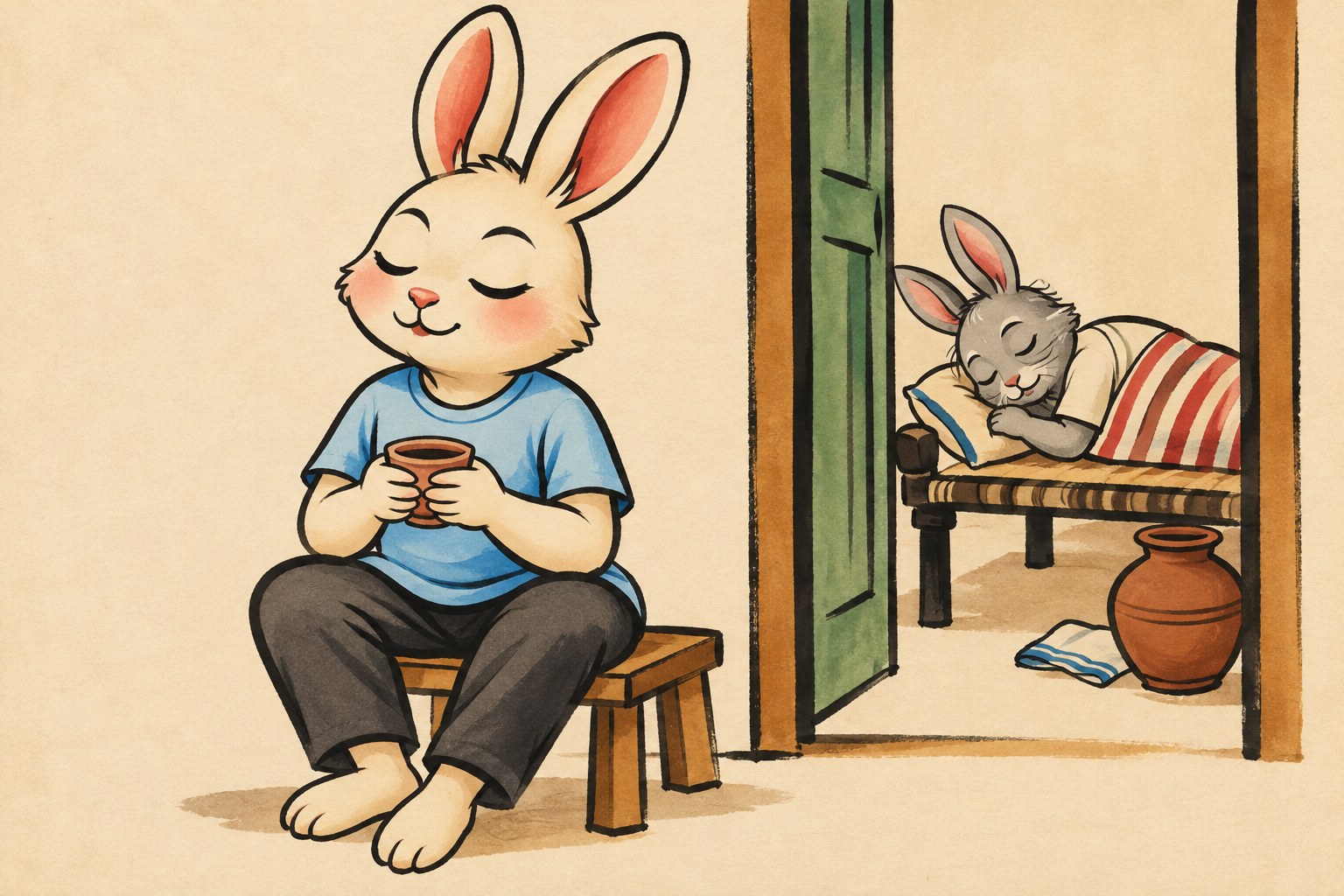
Both sides picture care as a fixed amount to be shared out, so that what I give myself I take from others and what I give others I take from myself. One side wants the scale tipped toward oneself and the other toward everyone else.
Read on its own, Medakathālikā’s answer sounds like what the second side objects to. “You look after yourself, and I shall look after myself” could be the motto of someone who wants nothing to do with anyone, every man for himself with good manners, and if the sutta stopped there, it would be an argument for selfishness.
Looking after yourself
Having agreed with Medakathālikā, the Buddha draws the lesson for the monks:
Thinking “I’ll look after myself,” you should cultivate mindfulness meditation. Thinking “I’ll look after others,” you should cultivate mindfulness meditation. Looking after yourself, you look after others; and looking after others, you look after yourself.
“Mindfulness meditation” here stands for satipaṭṭhāna, the establishing of mindfulness: the practice of attending closely to the body, to feelings, to the mind and to the qualities that arise in it, as they happen. And when the Buddha explains how looking after yourself looks after others, he adds nothing to it. You do it “by development, cultivation, and practice of meditation.”
That rules out most of what is sold today under the name of self-care. What the Buddha calls looking after yourself is a discipline, and at times an uncomfortable one, of noticing irritation and tiredness before they come out as harsh words or a short temper.
This discipline protects other people, because most of the harm we do to those around us comes from greed, anger or confusion acting while we are not looking. A discourse of the Aṅguttara Nikāya (AN 4.96) defines practicing for one’s own good in just those terms, as working to remove one’s own greed, hate and delusion. A person who does that does less harm to the people around them, even without setting out to help anyone.
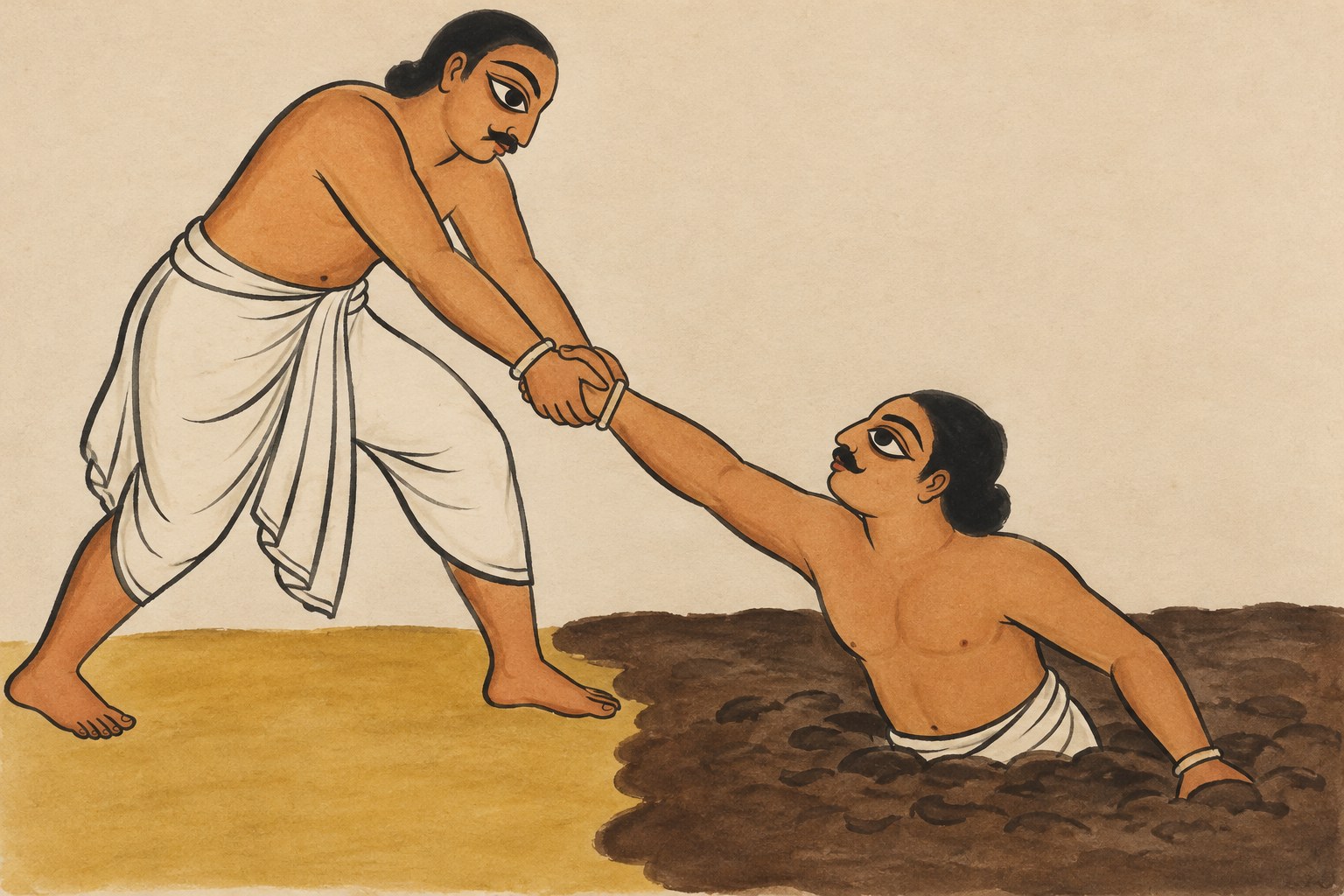
If anything in the texts resembles the oxygen mask, it is what the Buddha tells Cunda in another discourse (MN 8): “If you’re sinking in the mud yourself, Cunda, it is quite impossible for you to pull out someone else who is sinking in the mud. But if you’re not sinking in the mud yourself, it is quite possible for you to pull out someone else who is sinking in the mud.” The Dhammapada (verse 158) puts it as a matter of order: “The astute would avoid being corrupted by first grounding themselves in what is suitable, and then instructing others.”
The balance on the pole has something in common with the string on Soṇa’s lute, the image the Buddha used for how hard to try in meditation, neither too tight nor too slack. And for someone who has no time to sit, because they are the one doing the looking after, there is a mindfulness exercise that takes sixty seconds.
Looking after others
The second half of the Buddha’s sentence answers the charge of selfishness. “And how do you look after yourself by looking after others?” he asks, and answers with four qualities: “By acceptance, harmlessness, love, and sympathy.”
The first of them, khanti, is a wide word, covering patience, forbearance and the capacity to bear what is hard without striking back. Sujato’s “acceptance” is a good choice, because patience can mean gritting one’s teeth, and acceptance cannot. The other three are avihiṃsā, not harming; mettacittatā, a heart of goodwill that wishes another well; and anudayatā, sympathy, a tender concern for what is happening to someone else.
The four are ways of giving that do not use up the giver. Impatience and resentment charge their cost first to the person who feels them, and someone who cares for another while resenting it pays twice, once for the care and once for the resentment.
The phrase “compassion fatigue” entered the nursing literature in the early 1990s as a name for the wearing down of those who keep company with other people’s suffering every day. Olga Klimecki and Tania Singer, then at the Max Planck Institute for Human Cognitive and Brain Sciences in Leipzig, argued that the name is misleading: what exhausts people, they proposed, is not compassion but what they call empathic distress, feeling another’s pain as if it were one’s own, without the distance that makes it possible to do something about it. In their experiments, volunteers trained first in empathy, in resonating with the pain of others, watched videos of people suffering and came away with more negative feeling than before. After training in compassion, understood as warm concern for the other and the wish for them to be well, the negative feeling went down and positive feeling went up, though the videos showed the same suffering.
Those studies involved small groups of healthy volunteers, all of them women, watching short videos in a laboratory, a long way from the situation of someone three years into caring for a mother with dementia, and they do not show that looking after others cannot wear anyone out. But they agree with the sutta that the danger lies in a particular way of caring for others.
When the choice is real
All of this could sound like Buddhism solving the problem by declaring that there is no problem, yet when the choice is real, the texts put one’s own practice first. In the discourse just before that one in the Aṅguttara Nikāya (AN 4.95), the Buddha distinguishes four kinds of people: one who practices to benefit neither themselves nor others, one who practices to benefit others but not themselves, one who practices to benefit themselves but not others, and one who practices to benefit both. The first, he says, is like “a firebrand for lighting a funeral pyre, burning at both ends, and smeared with dung in the middle. It couldn’t be used as timber either in the village or the wilderness.” He then ranks the other two: “The individual who practices to benefit others, but not themselves, is better than that. The individual who practices to benefit themselves, but not others, is better than both of those.” And the one who practices for both is the best of the four, as the cream of ghee is the best of everything that comes from milk.
The Dhammapada says it more plainly still, in verse 166: “Never neglect what is good for yourself for the sake of another, however great. Knowing well what is good for yourself, be intent upon your heart’s goal.” According to the commentary, the Buddha spoke the verse after announcing that he would die in four months. Many monks, distressed, would not leave his side. One of them, Attadattha (his name is the verse’s own word, “one’s own good”), went off instead to meditate as hard as he could, determined to reach liberation while his teacher was still alive. The others, put out that he no longer came to them or spoke with them, took him to the Buddha and reported him. The Buddha answered that anyone who loved him should be like Attadattha, because the way to honor a teacher is to practice what he taught, and offerings of perfume and the like are no substitute for it.
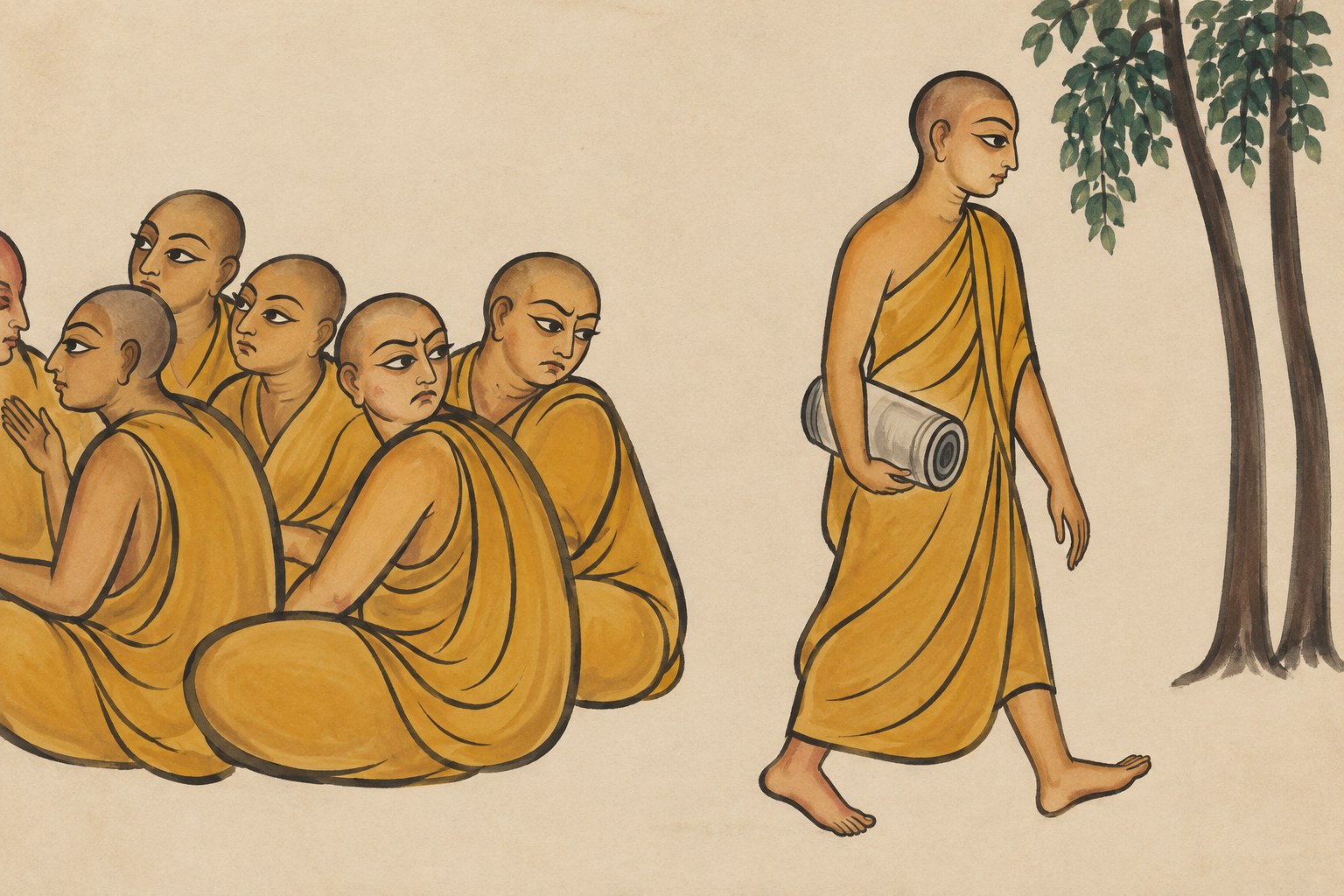
The same passages answer the old objection to monasteries, that monks are selfish for leaving the world to tend their own minds. What the texts mean by “one’s own good” is narrower than the objection assumes, though. The commentary on verse 166 reads it as a teaching on meditation and the noble fruits, and then adds a caution of its own. A monk may not plead his own good as a reason to neglect what the community needs, such as the repair of a shrine, or what he owes his preceptor, the senior monk who ordained him, because doing those things is part of how the fruits are reached, and so they are his own good too. Only a meditator on the point of breakthrough may set aside even his duties to his preceptor.
A bowl of oil at Sedaka
The discourse that follows it in the Saṃyutta Nikāya (SN 47.20) was given in the same town, and it is built on another performance. A large crowd gathers to watch “the finest lady in the land” dance and sing, and a man is handed “a bowl full to the brim with oil” and told to carry it between the crowd and the dancer, with “a man with a drawn sword” following right behind him, ready to strike if he spills a single drop. He does not take his eyes off the bowl, and the Buddha says that the bowl stands for mindfulness of the body.
Told in the same town, the two stories rest on the same thing, attention kept on what is in one’s own care, whether that is a woman’s balance at the top of a pole or a brimming bowl carried through a crowd.